
Renting vs. Owning Trainium Racks: What Amazon Proposed
Amazon is exploring selling its custom Trainium accelerators as full rack systems that outside companies install in their own non-AWS data centers, instead of renting Trainium capacity exclusively through AWS cloud instances. The shift surfaced when Peter DeSantis, who leads Amazon's AI and infrastructure organization, described early, exploratory talks in a Bloomberg interview around June 18–19, 2026 — Amazon's first explicit signal that it wants to operate as a merchant-silicon vendor (source: Yahoo Finance, 2026-06). This is a go-to-market change, not a new chip launch.
To understand the magnitude, look at what was true until now. Historically Amazon's silicon — Trainium for training and inference, Inferentia, Graviton Arm CPUs, Nitro networking — was available only by renting AWS instances. Trainium specifically reached customers through EC2 Trn1 and Trn2 instances and UltraServers, never as hardware a third party could rack in its own facility. The proposed product is racks or systems — chip, server, networking, and software bundled together — rather than loose chips, which moves AWS closer to Nvidia's hardware-vendor model and into merchant-silicon competition for the first time (source: Electronics For You, 2026-06).
The commercial stakes are concrete. Amazon's custom-silicon business already crossed a $20 billion annual run rate in Q1 2026, growing at triple-digit rates, so external rack sales would more than double that line (source: Yahoo Finance, 2026-06). CEO Andy Jassy has separately characterized external chip sales as roughly a $50 billion annual opportunity — a number best read as an aspirational total addressable market from Amazon executives, not booked revenue (source: MLQ.ai, 2026-06).
DeSantis was direct about the obvious objection — that selling racks could cannibalize AWS rentals. He dismissed it as a problem worth managing rather than avoiding:
"We view AI infrastructure as rapidly evolving. And we're constantly looking at ways to get to more customers… there's so much underconsumption in AI," — Peter DeSantis, who leads AI and infrastructure at Amazon (source: Yahoo Finance, 2026-06).
The DeSantis comments did not come from nowhere. Jassy's April 2026 shareholder letter said it was "quite possible" Amazon would sell racks of its chips to third parties, and on a subsequent earnings call he added that there was a good chance Amazon would offer full Trainium racks beyond AWS "over the next couple of years" — reported as the first specific timeframe Amazon had given (source: Business Insider, 2026-04). What remains undisclosed is everything a buyer would actually need: named customers, pricing, delivery dates, and whether racks would be sold outright or bundled with AWS software. As the sections below detail, that software layer — the Neuron SDK — is where the proposal gets harder than the hardware spec sheet suggests.
Trainium3 Internals: PFLOPs, HBM3e, and Efficiency
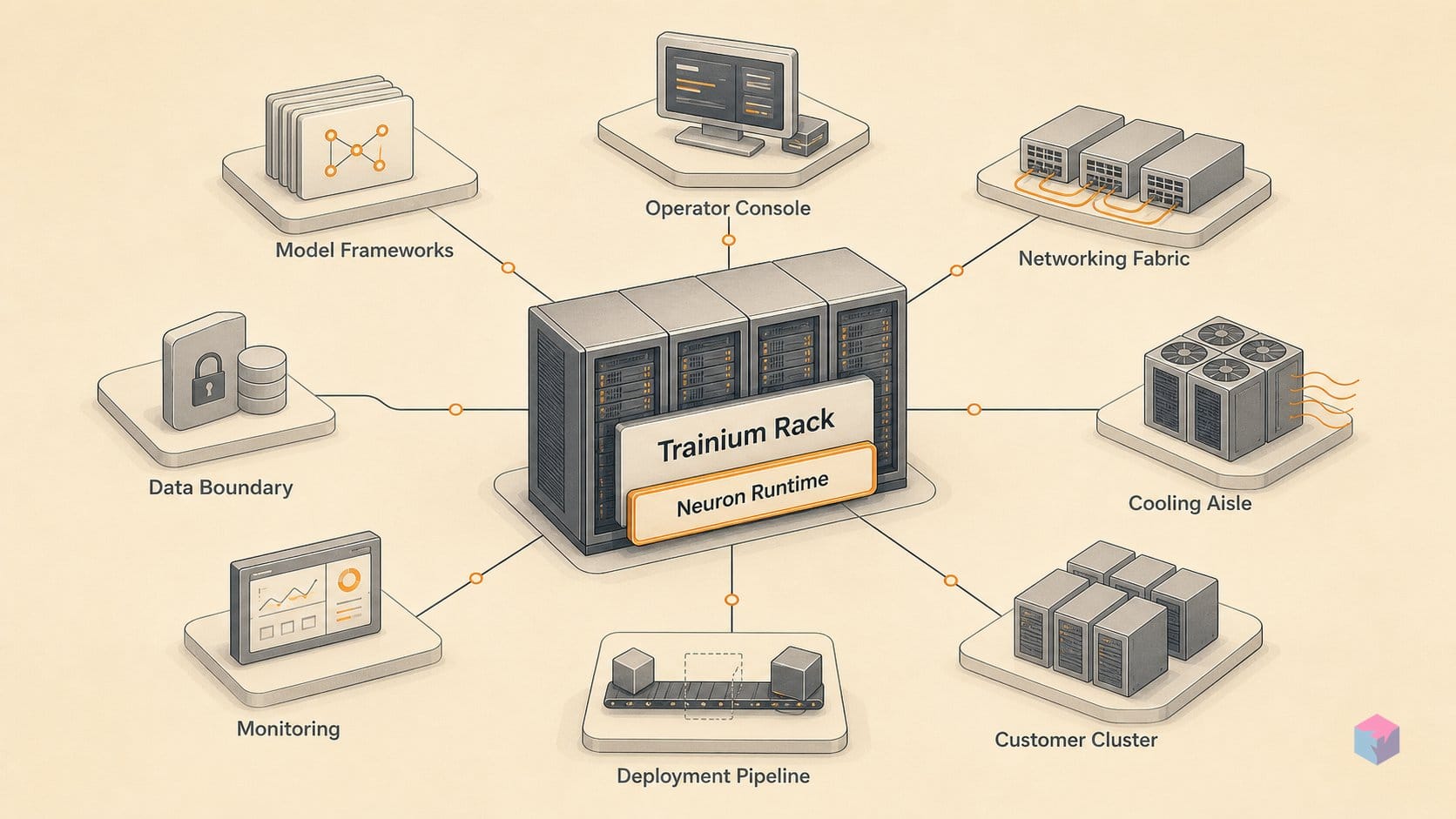
Trainium3 is AWS's third-generation training and inference accelerator, shipping in early 2026, and on paper it is the spec sheet that makes a merchant-hardware pitch plausible. Each chip carries eight large cores and 144 GB of HBM3e memory running at 4.9 TB/s, and a Trainium3 UltraServer scales to 144 chips for up to 362 MXFP8 PFLOPs, 20.7 TB of HBM3e, 706 TB/s of aggregate memory bandwidth, and up to 28.8 Tbps of scale-out bandwidth . AWS describes Trainium3 servers as delivering more than 4x the compute of Trainium2 while drawing roughly 40% less power .
The generational jump is clearer against the shipping prior part. A Trn2 UltraServer connects 64 Trainium2 chips for up to 83.2 FP8 PFLOPs, 6 TB of HBM, 185 TB/s of memory bandwidth, and 12.8 Tbps of EFAv3 networking; a single 16-chip Trn2 instance reaches 20.8 FP8 PFLOPs, 1.5 TB HBM3, 46 TB/s, and 3.2 Tbps . The table below puts the two UltraServer configurations side by side.
| Spec (UltraServer) | Trainium2 (64 chips) | Trainium3 (144 chips) |
|---|---|---|
| Peak compute | 83.2 FP8 PFLOPs | 362 MXFP8 PFLOPs |
| HBM capacity | 6 TB | 20.7 TB HBM3e |
| Aggregate memory bandwidth | 185 TB/s | 706 TB/s |
| Scale-out networking | 12.8 Tbps EFAv3 | 28.8 Tbps |
| Per-chip HBM | — | 144 GB @ 4.9 TB/s |
The economics argument rides on top of those numbers. AWS publishes a claim that Trn2 delivers 30–40% better price performance than its GPU-based EC2 P5e and P5en instances, and that Trn2 is 3x more energy efficient than the first-generation Trn1 . Third-party cloud comparisons put Trainium instances at roughly $1/hour against about $3/hour for comparable Nvidia GPU instances . Treat that gap as a rental-list/spot signal, not a quote for owned hardware — the merchant rack price is exactly what Amazon has not disclosed, and a sold-outright or bundled rack carries support, integration, and margin costs that hourly cloud rates hide.
Two caveats sit underneath the spec sheet. First, "is it real?" still depends on workload benchmarks: MXFP8 PFLOPs and HBM bandwidth set a ceiling, but realized throughput is governed by kernel coverage and library maturity, which the next section examines. Second, supply is the immediate constraint on any external sale — Trainium3 capacity is described as largely sold out within AWS as of early 2026, so racks shipped to outside operators would compete with AWS's own demand and depend on fab allocation decisions Amazon has not communicated publicly. Strong internal absorption is evidence the part is competitive; it is also the reason "we're in talks" has not become "here is a price."
Porting to Neuron: Adoption Barrier for Independent Operators
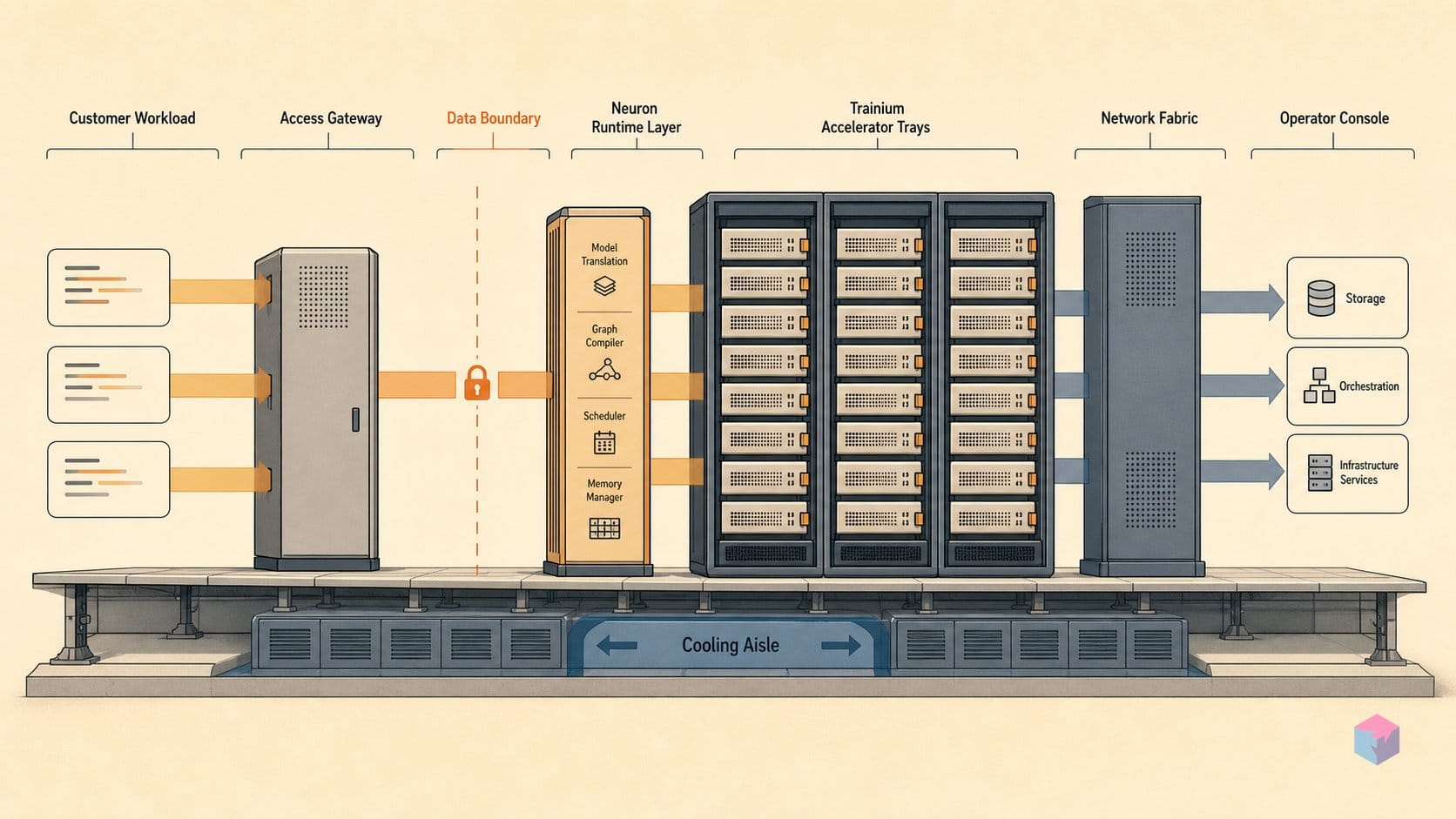
The gating question for any operator buying Trainium racks is not PFLOPs — it is whether their existing code runs on AWS Neuron, the software stack that compiles models down to the chip. Neuron is broad on paper: the current release (Neuron 2.30.0) supports PyTorch, JAX, vLLM, Hugging Face, Ray, EKS, and Batch . But framework support is not the same as a drop-in path. Workloads written against CUDA — custom kernels, fused operators, hand-tuned attention — do not transfer automatically. Moving them to Trainium means rewriting those kernels and validating numerical behavior, work that scales with how much a team has optimized below the framework layer.
That friction is the reason the move matters more for buyers than the spec sheet does. Inside AWS, the porting cost is absorbed by managed instances and AWS engineering. An external operator installing racks in its own data center inherits the stack without the captive cloud tooling around it.
History sets the expectation. Earlier Trainium generations drew complaints from startups about maturity gaps versus Nvidia GPUs — missing library coverage, rougher debugging, and slower iteration . Trainium3 is newer and presumably better tooled, but the public benchmark picture is thin: independent results from setups AWS does not manage remain sparse, so adoption decisions still rest largely on AWS-published figures rather than third-party reproductions.
The strongest counter-evidence that Neuron scales is Anthropic's Project Rainier, which AWS describes as using hundreds of thousands of Trainium2 chips and being more than five times the size of Anthropic's previous leading-model training cluster . That is real proof the software holds up at frontier scale. The caveat is the support model: Rainier ships with dedicated AWS engineering attached, and AWS lists Anthropic alongside Databricks, OpenAI, Ricoh, and Uber as customers running inside its managed environment . A flagship lab with a co-located AWS team clearing roadblocks is a different adoption profile from an independent operator buying racks without that backing.
For that buyer, the questions raw compute comparisons do not answer are the ones that decide the purchase:
- Kernel coverage — do your hot paths have Neuron-optimized implementations, or do you write them?
- Library compatibility — does your inference and training stack (vLLM, Hugging Face, Ray) work at your model sizes without forks?
- Support SLAs — without an embedded AWS team, who fixes a compiler regression, and how fast?
Until Amazon ships racks with a support and tooling contract that answers these for non-captive workloads, Neuron is the catch that turns a competitive part into an open question.
Jassy's $50B TAM: Credible Opportunity or Aspirational Anchor?
The $50 billion figure Andy Jassy attached to external chip sales is a signaling number, not a forecast. It is best read as an aspirational total addressable market that Amazon executives use to justify the investment thesis, not booked revenue or an announced pipeline . The context that makes it plausible: Amazon's custom-silicon business already crossed a $20 billion annual run rate in Q1 2026, growing at triple-digit rates, so external sales would more than double that line .
Whether $50 billion is reachable depends less on Trainium's specs and more on a market that demonstrably exists. Nvidia's official fiscal 2026 results show data-center revenue of $193.7 billion, up 68%, with Q4 alone contributing $62.3 billion, up 75% year over year . Against that pool, an executive TAM frame of $50 billion is large but not fantastical — it is a single-digit-to-low-double-digit share of merchant AI silicon, the slice Amazon argues is up for grabs as buyers seek a second source.
| Figure | Value | What it measures |
|---|---|---|
| Amazon custom-silicon run rate (Q1 2026) | $20B+/yr, triple-digit growth | Booked — internal AWS rentals |
| Jassy external-sales opportunity | ~$50B/yr | Aspirational TAM, unanchored |
| Nvidia data-center revenue (FY2026) | $193.7B (+68%) | Booked — comparable market size |
| Nvidia Q4 FY2026 data-center revenue | $62.3B (+75% YoY) | Booked — recent run rate |
The demand signal beyond named customers is the more interesting tell. AWS already lists Anthropic, Databricks, Decart, OpenAI, Ricoh, SplashMusic, and Uber among Trainium users . More telling for a merchant-hardware thesis: Apple has reportedly evaluated Trainium2 for model pre-training while already running Graviton, a sign that non-AWS hyperscale interest exists outside the published customer roster . A company with Apple's silicon discipline kicking the tires is the kind of validation a $50 billion frame needs.
The caveat is that none of this is contracted. Amazon has confirmed early talks but has not disclosed a single external buyer, contract form, or price for racks sold outside AWS . Jassy himself hedged the timing, saying on an earnings call there was "a good chance" Amazon would offer full Trainium racks beyond AWS over the next couple of years — the first specific timeframe the company had given, per Business Insider .
"It is quite possible that Amazon would sell racks of its chips to third parties," — Andy Jassy, CEO, Amazon, in his April 2026 shareholder letter (source: MLQ.ai).
Read the $50 billion the way you'd read any vendor TAM slide: directionally useful, financially unproven. The booked $20 billion run rate and Nvidia's $193.7 billion data-center line tell you the market is real; the absence of a named pipeline tells you Amazon's share of it is, for now, a thesis rather than a number.
TPU Commercialization as Precedent: The Hyperscaler Silicon Race
Amazon is not the only hyperscaler trying to sell its accelerators outside its own cloud — Google is doing the same, which reframes the Trainium news as one move in a sector-wide shift rather than an isolated pivot. Google has reportedly signed TPU infrastructure deals, including a roughly $5 billion Blackstone-linked cloud-services arrangement, and plans to deliver TPUs into select customers' own data centers (video: Alex Ziskind). Two of the three largest cloud silicon programs are now testing the same go-to-market thesis at roughly the same time.
Both moves answer the same demand signal: large operators increasingly want owned, on-premise accelerator capacity instead of metered cloud access. The trade is control and cost predictability over elasticity. An operator running steady, high-utilization training or inference for years gets little value from per-hour rental flexibility and a lot of value from a fixed capital base, known power draw, and physical custody of the hardware. That preference is exactly what a Trainium rack — chip, server, networking, and software sold as a unit — and a customer-sited TPU are built to serve.
This is why the framing of "Amazon versus Nvidia" undersells the real question. The harder, more interesting question is whether hyperscalers can become viable merchant silicon vendors at all. Renting your own chips inside your own cloud is a captive-workload business; selling racks to independent operators means competing on the things Nvidia has spent fifteen years building — driver maturity, library coverage, documentation, field support, and a developer base that already knows the tooling.
For Amazon specifically, that bar lands squarely on the Neuron SDK and the support organization behind it. The decisive variable is whether Neuron's PyTorch, JAX, and vLLM support — currently at Neuron 2.30.0 — and AWS's support staffing can be fully decoupled from the cloud teams that have carried Trainium so far. Inside AWS, a Trainium customer sits next to AWS solutions architects, managed services, and the EC2 control plane. An external operator running racks in a colo in Frankfurt has none of that by default. The software and support that AWS could previously bundle implicitly now has to ship as a standalone product.
Google's parallel bet provides a useful read on outcomes: if customer-sited TPUs gain traction, it validates that operators will tolerate non-CUDA toolchains for owned capacity, and the merchant-silicon path widens for everyone. If they stall on porting friction and support gaps, that is the clearest signal that Trainium racks will struggle outside the AWS perimeter regardless of their headline efficiency.
Off-US Operator Interest and the European Pitch
Geography is one of the few concrete demand signals Amazon has acknowledged. Cinco Días, reporting the story directly on June 19, 2026, flagged demand outside the U.S. for locally controlled compute — particularly in Europe — as a specific factor behind the Trainium sales push, not a generic market-expansion line . That detail matters because it reframes the rack pitch from a price-performance play into a control-of-infrastructure play, which is where European buyers have the sharpest incentives.
European operators face regulatory and political pressure to own accelerator capacity rather than rent it through a hyperscaler's cloud. Three forces compound here:
- EU AI Act compliance — obligations on high-risk and general-purpose models push operators toward auditable, controllable training and inference environments.
- Data-residency requirements — sectors like finance, health, and public administration need compute that demonstrably stays within national or EU borders, which on-premise racks satisfy more cleanly than shared cloud instances.
- Sovereign-compute initiatives — national and EU-level programs across France, Germany, and Brussels are explicitly funding domestically controlled AI capacity, creating buyers who want hardware they install and govern themselves.
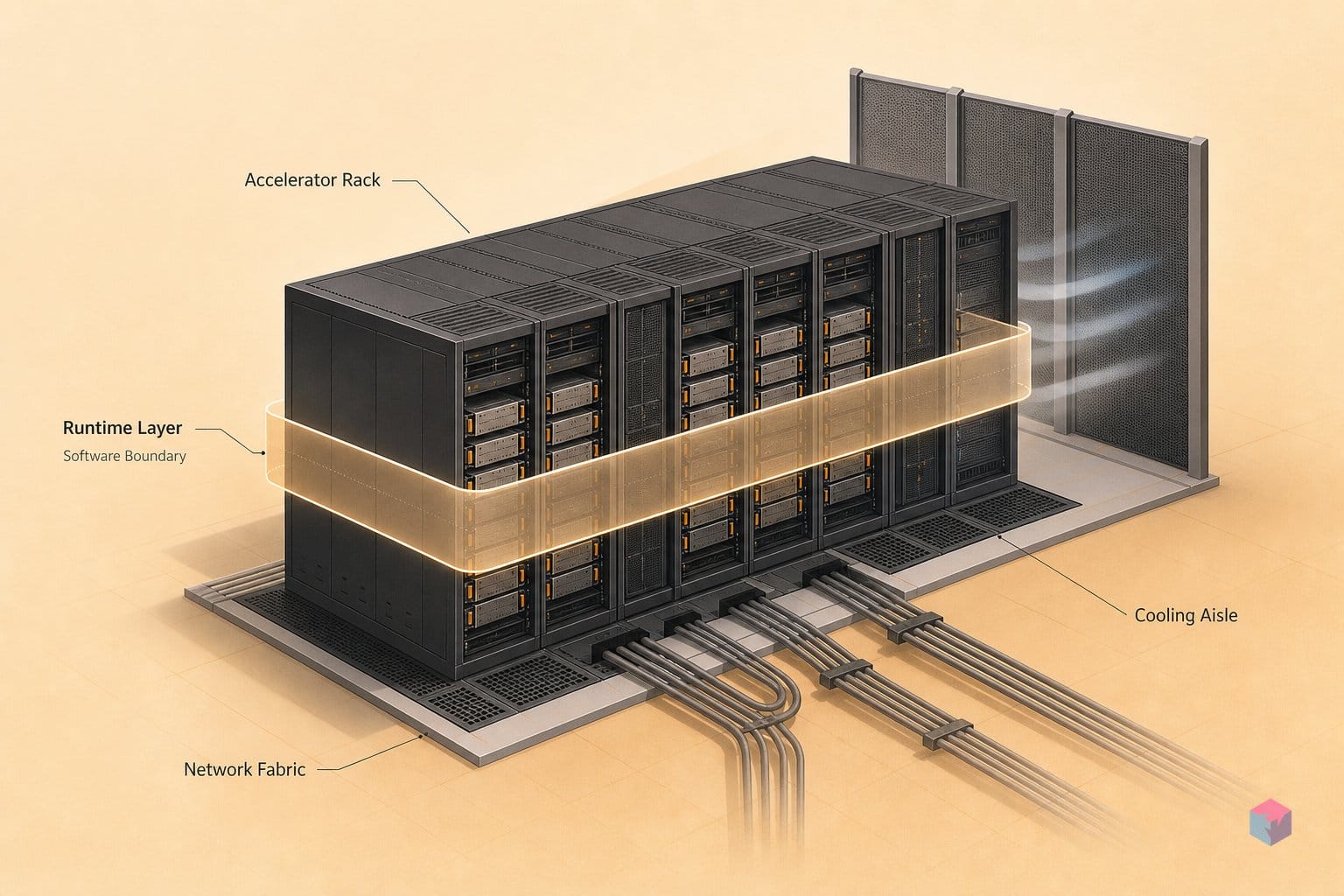
This is exactly the shape of customer the on-premise model serves. An operator that buys a Trainium rack — chip, server, networking, and the Neuron software stack — installs it in its own data center and runs workloads without routing them through AWS regions . Structurally, that answers the data-residency and control questions that cloud rentals cannot.
The messaging, though, is a non-trivial challenge. Positioning a U.S. hyperscaler's silicon as a "sovereignty-compatible" option sits awkwardly against the political logic that drives sovereign-compute programs in the first place, which often favor domestically designed or at least non-U.S.-dependent supply chains. Export controls add a second layer: Amazon has disclosed nothing about geographic or export limits on Trainium sales, and advanced-accelerator trade is a live regulatory variable . The on-premise rack pitch is real if Amazon proceeds and clears those hurdles — the hardware genuinely lives where the buyer wants it — but "where the chip sits" and "who controls the supply and software underneath it" are different questions, and European buyers evaluating sovereignty will weigh both.
Preliminary and Exploratory: No Buyers, No Delivery Dates, No Contracts
Strip away the strategic framing and what Amazon has actually committed to is narrow: early, exploratory talks. The company's spokesperson confirmed the discussions are preliminary, and on every variable a buyer would need to evaluate Trainium racks, the public record is blank . No prospective buyers were named. No pricing was disclosed. No rack-system suppliers were identified, and no availability dates were given . For a developer or operator deciding whether to plan around on-premise Trainium, "Amazon is interested" is not yet a product you can scope a budget against.
The open questions that matter most for total cost of ownership:
- Contract form is unresolved. Whether racks would be sold outright, leased, or bundled with Neuron software and AWS services is undisclosed . Each model implies a different TCO curve — a capex purchase, a recurring lease, and a software-attached subscription are not interchangeable when you are amortizing a data-center deployment.
- Export controls are unaddressed. No public statement covers geographic or export limits on merchant Trainium sales . That gap is material given the European demand angle and the fact that advanced-accelerator trade remains a live U.S. regulatory variable. An operator in a restricted jurisdiction cannot assume access.
- Support and software terms are undefined. Without disclosed service commitments, the Neuron SDK porting burden covered earlier in this article sits on the buyer with no published backstop.
One thing the talks are not: an exit from Nvidia. Amazon's stated position is that Nvidia stays a key partner while Trainium gives customers another option . Reuters reported in March 2026 that Nvidia would sell roughly 1 million GPUs to AWS by the end of 2027 under a wider cloud deal, and AWS is set to be among the first to deploy Vera Rubin-based instances . External Trainium sales are additive to that relationship, not a signal of its end.
The concrete takeaway: treat mid-June 2026 as a credible direction-of-travel signal, not a buy decision. Amazon clearly wants to become a merchant AI-silicon vendor, and the Trainium3 economics and Project Rainier scale make the ambition plausible. But until pricing, contract form, delivery dates, support terms, and export scope are published, an independent operator's rational move is to benchmark Neuron against its real workloads now and keep procurement plans GPU-anchored — then revisit the moment Amazon turns "exploratory talks" into a quotable spec sheet.
Frequently asked questions
Can I buy a Trainium3 rack today?
No. As of June 2026, Amazon's external-sales plan is exploratory talks only: no buyers have been named, and no pricing, suppliers, or delivery dates have been disclosed . Today Trainium3 is available only through AWS EC2 instances and UltraServers, not as standalone hardware . On an earnings call Andy Jassy framed external rack availability as a "next couple of years" prospect — the first specific timeframe Amazon has offered .
How does Trainium3 compare to Nvidia H100/H200 on price per PFLOP?
A clean hardware-level comparison is not yet possible, because merchant rack pricing is undisclosed. AWS claims its prior-generation Trn2 instances deliver 30–40% better price performance than GPU-based EC2 P5e/P5en instances . Independent cloud-comparison estimates put Trainium instances at roughly $1/hour versus about $3/hour for comparable Nvidia GPU instances, but those are list/spot rental figures, not the undisclosed merchant hardware prices . Until Amazon publishes a spec sheet, treat any per-PFLOP claim as directional, not settled.
What is the Neuron SDK and why does it matter for Trainium adoption?
Neuron is Amazon's compiler and runtime for Trainium and Inferentia chips — the software layer that turns model code into instructions the accelerators run. The current documentation tracks Neuron 2.30.0, and AWS says it supports PyTorch, JAX, vLLM, Hugging Face, Ray, EKS, and Batch . It matters because Nvidia's CUDA remains the default; porting workloads can require kernel rewrites, and earlier Trainium generations were reported as less mature than Nvidia GPUs . Independent Trainium3 benchmarks outside AWS-managed environments are still limited, so adoption hinges on real-workload testing rather than headline PFLOPs.
Is Amazon trying to replace Nvidia, or complement it?
Complement, officially. Amazon's public stance is that Nvidia remains a key partner while Trainium gives customers another option . Reuters reported in March 2026 that Nvidia would sell roughly 1 million GPUs to AWS by the end of 2027 under a wider cloud deal, and AWS is set to be among the first to deploy Vera Rubin-based instances . Jassy's April 2026 shareholder letter said AWS will remain a strong place to run Nvidia as customers seek better price-performance, framing external Trainium sales as additive rather than a substitution.
Why would a European data center prefer owning Trainium racks over renting AWS instances?
EU data-residency requirements, AI Act compliance, and sovereign-compute initiatives create pressure to own accelerators rather than rent them from a US cloud provider. Cinco Días reported that part of Amazon's push reflects demand outside the US for locally controlled compute, particularly in Europe . On-premise Trainium racks could satisfy data-sovereignty constraints that rented cloud capacity cannot — but only if Amazon finalizes the program and resolves outstanding export-control and pricing questions, none of which are settled today.