
Mistral shipped a document-intelligence model that no longer just hands you text — it hands you where the text sits, what kind of block it is, and how sure the model is about each word.
What OCR 4 Emits: Spatial Coordinates, Classification, and Per-Word Confidence
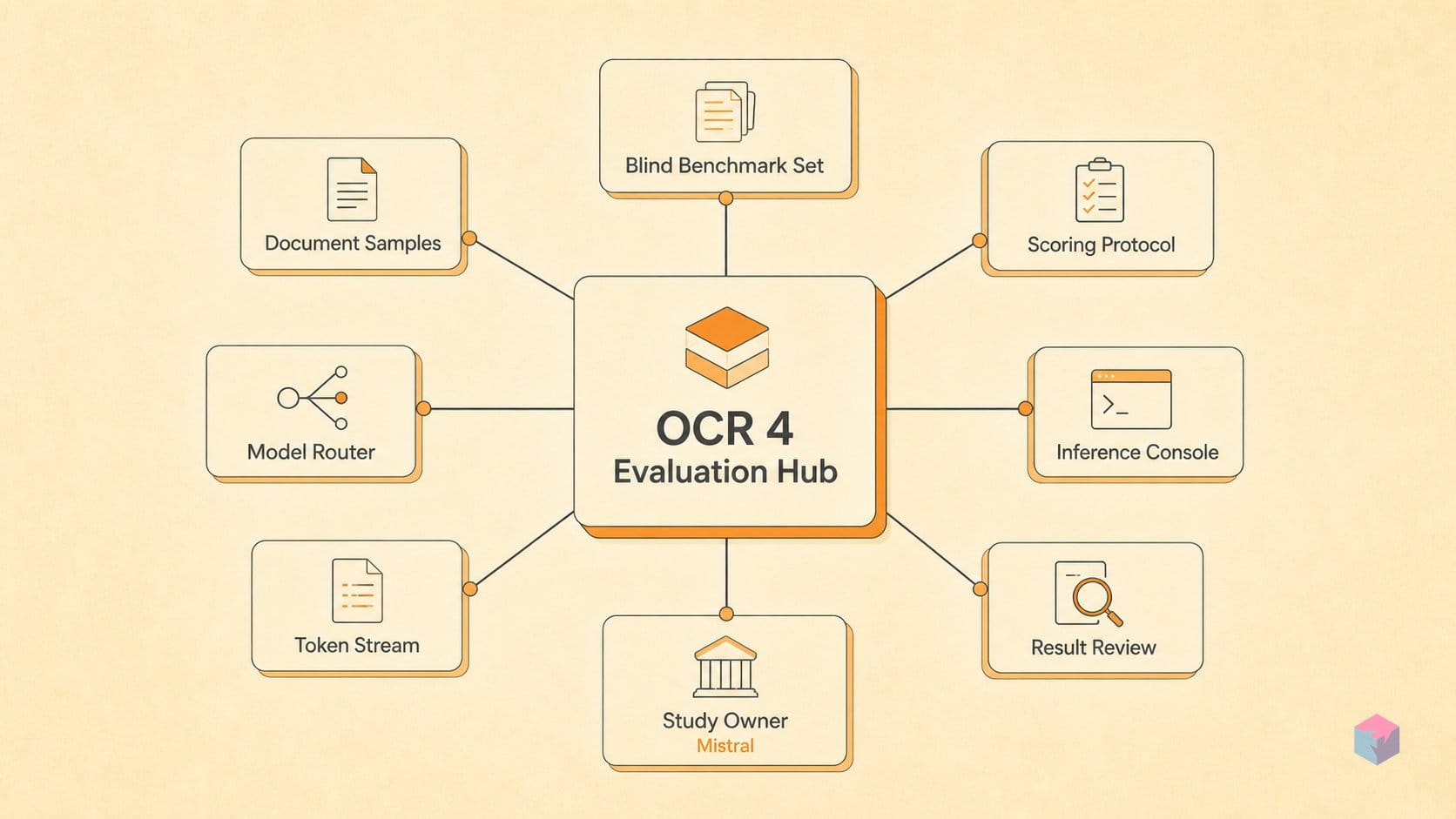
OCR 4 is Mistral's document-intelligence model that returns a structured page representation instead of a flat text dump. Released on June 23, 2026 and served as mistral-ocr-latest , it is the first Mistral OCR generation to emit paragraph- and word-level bounding boxes alongside the page transcription . For builders, that means the endpoint returns spatial coordinates you would otherwise reconstruct with a separate layout model.
Each page response also carries typed-block classification. According to Mistral's launch post, the model tags elements such as titles, tables, equations, and signatures, among other block types . In most retrieval-augmented-generation (RAG) pipelines, that classification is the step teams previously built a custom post-processor for — deciding whether a chunk is a heading, a data table, or body text before indexing it. OCR 4 moves that decision into the model output.
Confidence scoring ships inline at two granularities. The response includes per-page and per-word confidence values, surfacing low-confidence regions directly in the output rather than requiring a second inference pass or a separate verification model . Practically, a pipeline can route pages below a threshold to human review or re-scan without any extra API calls — the signal is already on every word.
Taken together, the three additions — bounding boxes, typed blocks, and per-word confidence — turn the response into structured JSON with spatial metadata suited for agent pipelines over document corpora . The developer-facing shift is the removal of parsing layers: where earlier OCR generations mainly produced clean text and tables, OCR 4's output is closer to a document object model an agent can query directly. Whether that structure holds up on messy real-world scans is a separate question, and one we return to later; the emission format itself is the concrete change here.
The 72% Preference Study: What's Auditable and What Isn't
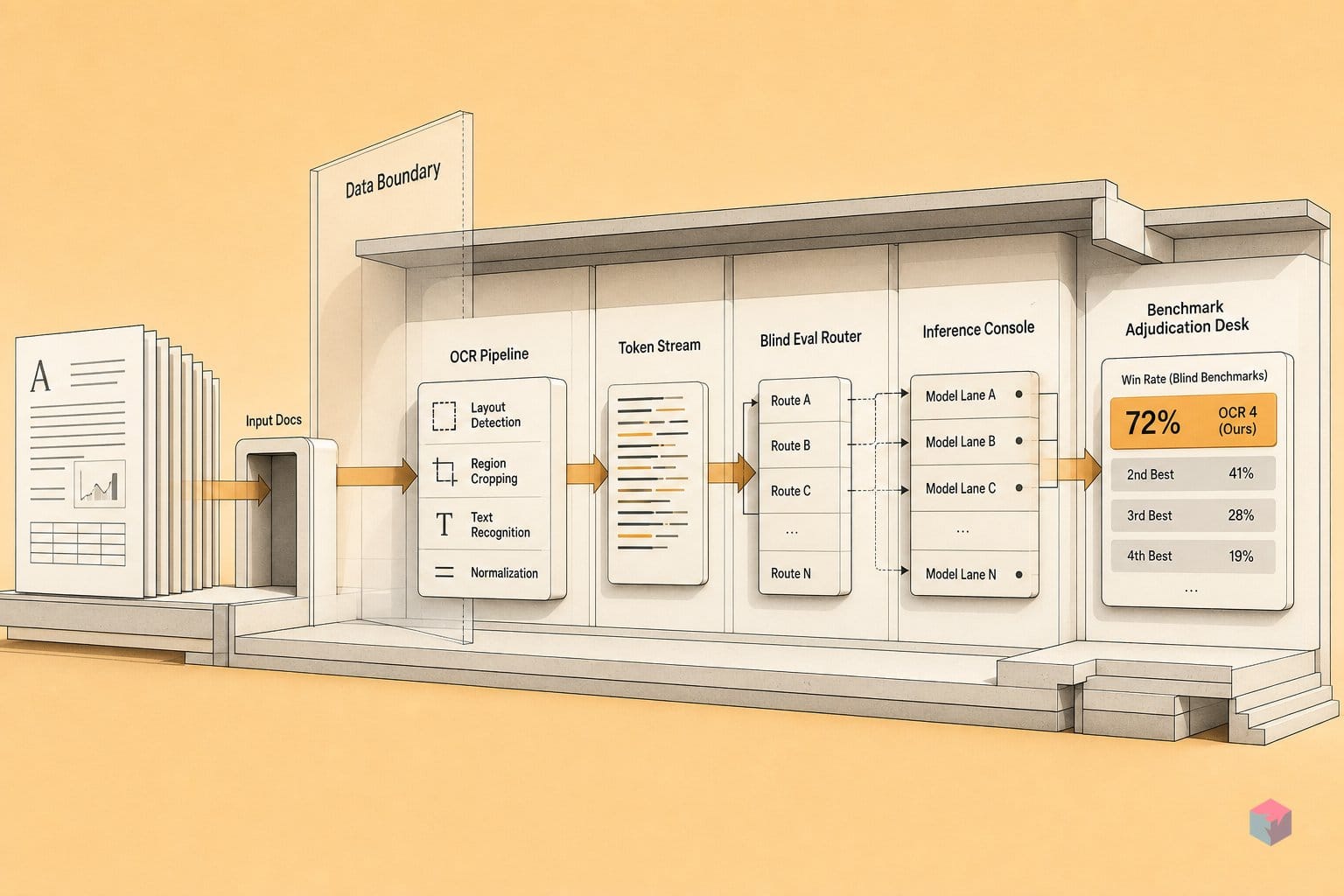
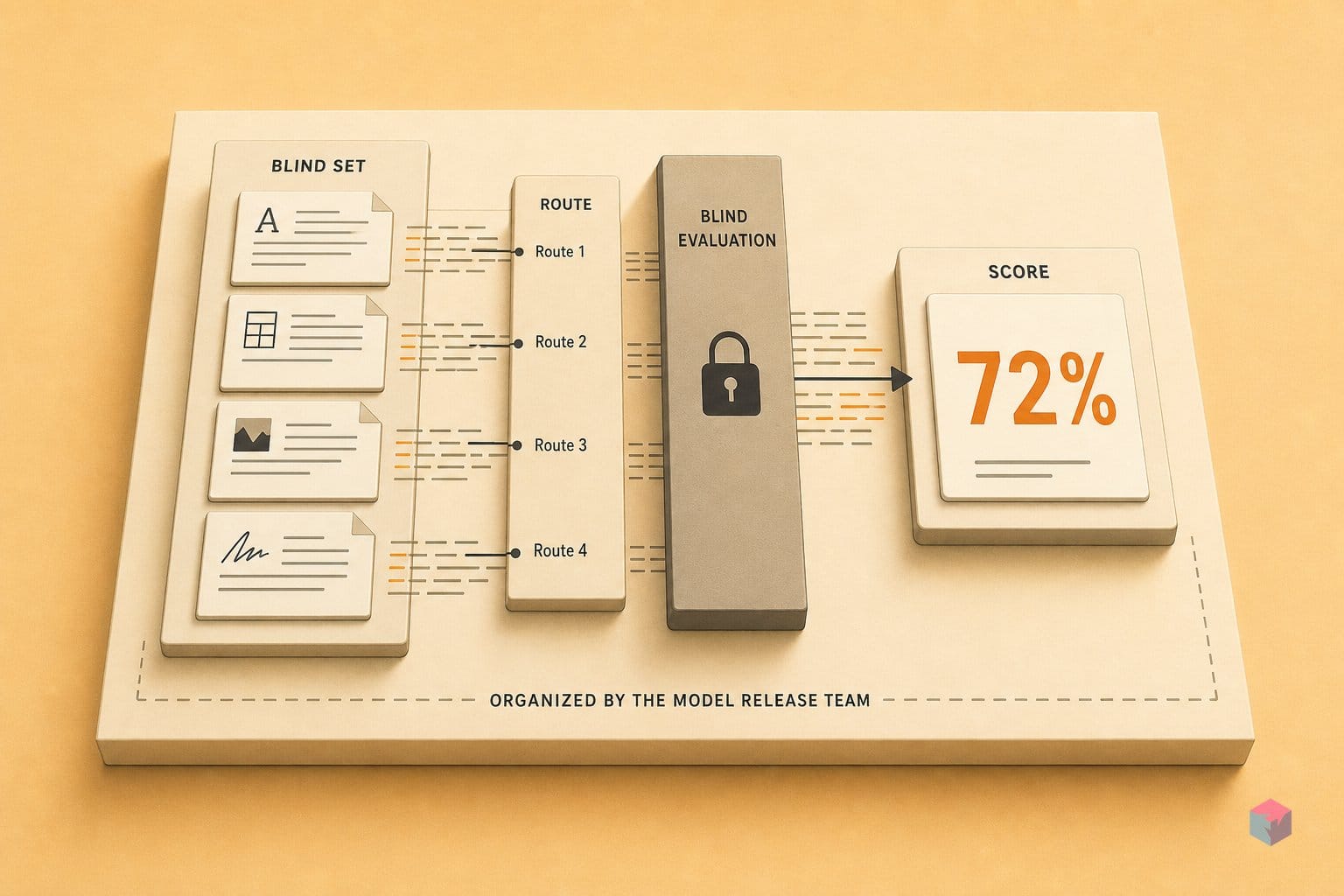
The number leading Mistral's OCR 4 launch is a 72% average win rate in blind human-preference evaluations, in which independent reviewers compared its output head-to-head against competing OCR systems across 600+ real-world documents in 12+ languages . That is a real result, but it is a specific kind of result. Neither Mistral's post nor the secondary coverage names the systems that were beaten or publishes the full protocol beyond "blind test with independent reviewers" . So the 72% figure is a vendor-run preference study, not an audited third-party benchmark — the distinction developers should keep in view when the word "SOTA" gets attached to it.
Quick Answer: OCR 4's 72% win rate comes from a Mistral-run blind human-preference test over 600+ documents in 12+ languages, with competitors and methodology undisclosed. Its public-leaderboard scores — 85.20 on OlmOCRBench, 93.07 on OmniDocBench — are reproducible protocols but still self-reported, so only those are meaningfully auditable.
Alongside the preference number, Mistral reports scores on public academic benchmarks: 85.20 on OlmOCRBench (claimed top overall), 93.07 on OmniDocBench, and 0.98 on a Crawl Multilingual evaluation . This matters because OlmOCRBench and OmniDocBench are established document-OCR benchmarks with fixed, reproducible protocols — anyone can run the same test set and check the number. The catch: Mistral is self-reporting its own scores. Reproducibility of the protocol is not the same as independent reproduction of the result.
The two evidence types differ in a way that changes how much weight each can carry:
| Signal | Score | Protocol fixed? | Third-party reproducible? | Audit status |
|---|---|---|---|---|
| Blind preference win rate | 72% avg | No (human-rated, undisclosed) | No | Vendor marketing metric |
| OlmOCRBench | 85.20 | Yes | Yes | Self-reported, pending replication |
| OmniDocBench | 93.07 | Yes | Yes | Self-reported, pending replication |
| Crawl Multilingual | 0.98 | Yes | Yes | Self-reported, pending replication |
The critical distinction is procedural. A preference study measures how humans rate output quality with no fixed rubric, so a rerun by a different lab with different documents and reviewers can land anywhere — there is nothing to reproduce. Leaderboard scores fix the inputs and the scoring, so an independent group can run OCR 4 against the same OlmOCRBench set and confirm or contradict 85.20. As The Decoder framed it in its headline, the model "beats competitors in 72 percent of blind test cases, company says" — the qualifier is doing real work .
For a build decision, treat the 72% as a directional signal that OCR 4 produces output humans tend to prefer, not as a settled ranking against Google Document AI, AWS Textract, or open stacks. The academic scores are the ones worth watching: until an independent lab reproduces the OlmOCRBench and OmniDocBench numbers, the SOTA claim sits on self-reported data. If your pipeline's accuracy budget is tight, run the benchmarks yourself on a representative sample of your own documents before committing — the only preference test that binds is the one over your corpus.
170 Scripts, PDF, DOCX, and PPT: What OCR 4 Ingests
OCR 4 accepts the four container formats that dominate enterprise document stores — PDF, DOC/Word, PPT/PowerPoint, and OpenDocument — and reads text across 170 languages spanning 10 language groups. That input surface covers most of what actually lands in a document pipeline without a pre-conversion step, and the language range is the specification most likely to change a build decision. The list explicitly includes lower-resource scripts — Hindi, Bengali, Armenian, Georgian, Hebrew, Greek, Gujarati, Tamil, Malayalam, Kannada, and Telugu — per Mistral's launch post.
Format breadth matters because it removes glue code. Feeding a slide deck or an ODT file directly, rather than exporting to PDF first, means one fewer lossy conversion and one fewer failure mode in an ingestion job. For teams running mixed-format archives — HR filings, contracts, presentations, scanned forms — a single endpoint that ingests all four cuts the surface area you have to maintain.
Script coverage is where OCR 4 draws a line against the managed incumbents. Cloud document-AI services such as AWS Textract and Google Document AI have historically offered narrower non-Latin support at comparable price tiers, so a 170-language claim is a genuine differentiator for corpora that lean on Indic, Semitic, or Caucasian scripts. If your workload is cross-border legal archives, multinational HR records, or public-sector filings in South Asian and Middle Eastern languages, that reach is the reason to evaluate OCR 4 at all.
Treat the number as a starting hypothesis, not a guarantee. "Supported" and "accurate on your documents" are different claims, and Mistral publishes the language list without a per-script accuracy breakdown. Low-resource scripts are exactly where OCR models degrade most — thin training data, complex ligatures, right-to-left or vertical layout quirks. Before committing a multilingual corpus to production, run a targeted evaluation on a representative sample per script you care about, weighted toward your worst-case documents. The 170-language figure tells you what OCR 4 will attempt; only your own corpus tells you what it gets right.
How OCR 4 Is Metered: From $2 to $5 per 1,000 Pages
OCR 4 is priced per page, not per token, and the tier you pick can change your bill by more than 2x. The standard synchronous API costs $4 per 1,000 pages, the asynchronous Batch API drops that to $2 per 1,000 pages — a 50% discount — and the higher-level Document AI tier runs $5 per 1,000 pages . The extra dollar on Document AI buys orchestration and structured-output features layered on top of raw OCR, not better extraction accuracy .
| Tier | Price / 1,000 pages | Cost for 10M pages | Best fit |
|---|---|---|---|
| Batch API (async) | $2 | $20,000 | Bulk backfills, corpus ingestion |
| Synchronous API | $4 | $40,000 | Interactive / low-latency requests |
| Document AI | $5 | $50,000 | Orchestration + structured output |
At the Batch rate, a 10-million-page corpus costs $20,000 to process . Coverage frames this as undercutting comparable Google Document AI and AWS Textract tiers at that volume — worth confirming against your own contracted enterprise rates, since incumbents negotiate volume discounts that public list prices don't reflect.
The practical rule for builders: the Batch discount is the single highest-leverage cost control for large-scale ingestion. If your workload is a one-time backfill or a nightly pipeline that tolerates queue latency, route it through the Batch API and halve the bill. Reserve the synchronous endpoint for genuinely interactive or latency-sensitive paths — a user uploading a document and waiting on a live response — where the async round-trip isn't acceptable. Mixing the two by default, and only paying the synchronous premium where a human is actually waiting, is the cost posture most teams should adopt.
One caveat on the Document AI tier: the $5 price only pays off if you actually consume the orchestration layer. If you are building your own RAG or agent pipeline and already handle chunking, indexing, and retrieval yourself, the raw OCR tiers give you the same structured output — bounding boxes, typed blocks, confidence scores — for less. Price the tier against features you'll use, not features that exist.
On-Prem OCR 4: A Container for Regulated Industries
The deployment story is where OCR 4 diverges most sharply from cloud document-AI incumbents. Mistral ships the model as a single self-hosted container image, letting teams run the full extraction pipeline inside their own infrastructure with no outbound API call . That is the same air-gapped pattern that accelerated on-prem LLM adoption across healthcare, finance, and legal — sectors where sending raw documents to a managed cloud endpoint is often a compliance non-starter .
If you would rather not operate the container, OCR 4 is also hosted across the usual enterprise surfaces: the Mistral API and Mistral Studio, Amazon SageMaker, and Microsoft Foundry, with Snowflake (Parse Document) listed as coming . Those managed paths cover most teams. The container matters specifically for the ones the managed paths have historically locked out.
The mechanism is straightforward: container deployment removes the external API dependency itself. For a hospital, bank, or public-sector body operating under data-residency or air-gap mandates, "the vendor never sees the document" is not a preference — it is a gating requirement, and it is why managed OCR APIs have struggled to penetrate these buyers. VentureBeat framed the release in exactly these terms:
"Mistral is turning document extraction into a full enterprise AI play," — VentureBeat data coverage of the OCR 4 launch (source: VentureBeat).
The caveat is that self-hosting shifts the accuracy and throughput questions onto you. Mistral's published numbers — the 72% preference win rate and the OlmOCRBench and OmniDocBench scores — reflect its own runs, and none of the coverage characterizes how the container performs relative to the managed API . Hardware provisioning, quantization choices, and the resources you allocate to the container will produce real differences in pages-per-second and, potentially, extraction quality. None of that is independently benchmarked yet.
Practical read: if compliance is your blocker, the container is the reason to evaluate OCR 4 at all — the hosted tiers were never going to clear your review. But treat on-prem accuracy as unverified until you run your own document set against it. Provision generously, measure throughput on representative pages, and validate output quality before you retire whatever extraction stack you run today.
OCR 4's Uncharted Territory: Handwriting, Layout Complexity, and Messy-Page Robustness
OCR 4's biggest open questions sit exactly where enterprise document corpora are messiest. The 600-document blind preference study that produced Mistral's 72% win rate does not name handwriting, low-quality scans, or complex multi-column layouts as evaluation conditions . Those are the failure modes most likely to show up in real archives — insurance claims, scanned contracts, clinical notes — and the ones a headline preference number is least equipped to characterize.
Three edge conditions deserve your own test harness. First, dense equation-heavy content: scientific PDFs and financial tables stress both bounding-box precision and typed-block classification, since a misclassified equation or merged table cell propagates straight into downstream RAG and agent pipelines. Second, mixed-script pages — plausible given the model's 170-language coverage — where script boundaries can confuse word-level segmentation. Third, degraded scans and handwriting, which the published protocol simply does not address.
The self-hosted container adds a second unverified axis. Container-based on-prem output versus the managed API is untested publicly, and quantization plus hardware variation typically introduces accuracy regressions that never appear in API-side numbers. Mistral positions the single-container deployment for air-gapped and data-sovereignty use — what VentureBeat called turning document extraction into a "full enterprise AI play" — but that framing is about market reach, not verified parity between the two deployment paths. Assume the numbers you get on-prem are your own until measured.
The good news: one of Mistral's claims is reproducible today. OlmOCRBench is a public benchmark, so its self-reported 85.20 (with OmniDocBench at 93.07) is a score any builder can attempt to match or challenge on their own document distribution . That is the practical move: don't relitigate the 72% preference figure, run OlmOCRBench and your representative corpus side by side.
Takeaway (결): OCR 4, released June 23, 2026, is a credible, well-priced document-intelligence model — but the SOTA claim is settled only for the benchmarks you can rerun. Before you migrate, benchmark handwriting, dense tables, and mixed-script pages on your own data, and compare the container against the API on identical inputs. The reproducible 85.20 is your baseline; everything past it is yours to verify.
Last updated: 2026-07-04.
Frequently asked questions
What does the mistral-ocr-latest API return beyond plain text?
The mistral-ocr-latest endpoint returns a structured document representation, not just extracted text. In a single JSON response it emits paragraph- and word-level bounding boxes for spatial localization, typed-block classification (titles, tables, equations, signatures, and other element types), and inline confidence scores at both per-page and per-word granularity . Because the layout and typing are baked into the output, you skip the custom post-processing step that older text-only OCR stacks required before feeding documents into a RAG or agent pipeline.
How reliable is OCR 4's 72% win rate claim?
Treat it as a vendor benchmark, not a settled fact. The 72% figure comes from a Mistral-run blind human-preference study across 600+ documents in 12+ languages, but Mistral names neither the competitors that were beaten nor the full evaluation protocol, so it is not independently reproducible . The more auditable data points are the public academic benchmarks — 85.20 on OlmOCRBench and 93.07 on OmniDocBench — though these are also self-reported by Mistral . Use those reproducible scores as your baseline.
Can OCR 4 run fully on-premises without sending documents to Mistral?
Yes. OCR 4 ships as a single container image for fully air-gapped deployment, targeting healthcare, finance, legal, and public-sector organizations with data-sovereignty requirements that have kept them off managed OCR APIs . The caveat: how the self-hosted container performs relative to the managed API has not yet been independently characterized, so benchmark the container against the API on identical inputs before committing regulated workloads to it .
How does OCR 4 pricing compare to AWS Textract and Google Document AI?
OCR 4 is metered at $4 per 1,000 pages standard, dropping to $2 per 1,000 pages with the Batch API discount; the higher-level Document AI tier is $5 per 1,000 pages . Coverage frames this as undercutting most enterprise document-AI alternatives, including cloud incumbents like AWS Textract and Google Document AI, which are generally priced higher at comparable feature tiers . The Batch discount is the key cost lever if you process at high volume.
Does OCR 4 handle handwriting, or only printed text?
The 170-language claim covers printed script across 10 language groups, including lower-resource scripts such as Hindi, Bengali, Armenian, Tamil, and Telugu . Handwriting performance is not specified in the preference study and has not been independently evaluated . Run targeted evaluations on your own handwritten-document samples before relying on OCR 4 for that use case.