
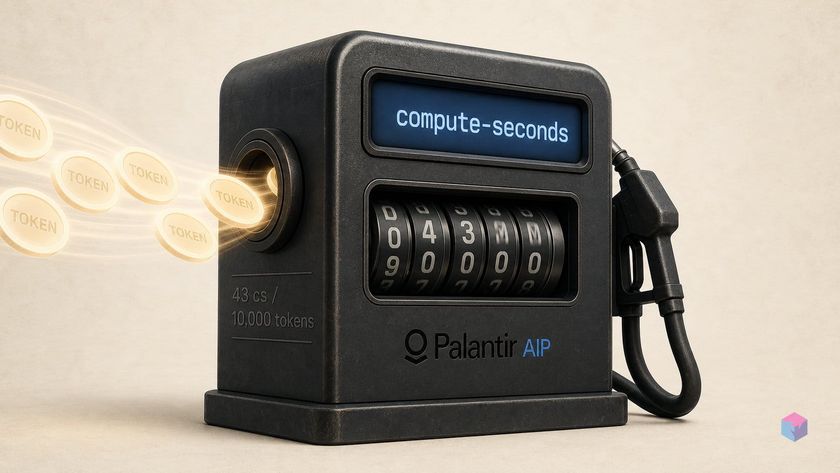
Palantir spent late June and early July 2026 telling enterprises to stop paying for tokens — while its own AIP documentation quietly explains exactly how it counts them.
The Token Conversion Palantir's Marketing Skips
Palantir does measure LLM usage in tokens; it simply converts them into a unit called compute-seconds before billing. AIP's product documentation states the conversion rate plainly: 43 compute-seconds per 10,000 tokens, so 24 GPT-4o tokens equal 0.1032 compute-seconds . That is the same per-token unit economics as any metered LLM endpoint — the meter is just relabeled at the contract layer.
Quick Answer: Palantir's "no token billing" pitch is about contract presentation, not the absence of token counting. AIP docs convert LLM usage at 43 compute-seconds per 10,000 tokens and export daily token, model, and currency reports — the same metered economics as any hosted API .
The measurement is not hidden — it is exportable. AIP surfaces usage as daily reports broken down by token count, model, resource, compute-second, and currency, matching the way underlying providers price their models . If tokens genuinely played no role, none of these fields would exist.
| What Palantir tracks | Value / unit | Source |
|---|---|---|
| Token-to-compute-second rate | 43 compute-seconds per 10,000 tokens | AIP compute usage docs |
| Worked example | 24 GPT-4o tokens = 0.1032 compute-seconds | AIP compute usage docs |
| Exportable report fields | token, model, resource, compute-second, currency (daily) | AIP compute usage docs |
| Rate-limit enforcement | tokens-per-minute, requests-per-minute | AIP capacity management docs |
The rate limits confirm the same thing. Palantir's provider-compatible proxy layer tracks usage per enrollment, project, and user, and enforces limits expressed directly in tokens-per-minute and requests-per-minute . Tokens are not just billed internally — they are the throttle mechanism the platform runs on.
So the accurate reading is narrower than the marketing. When Palantir says enterprises should stop buying "tokens that create no value," it is arguing about how AI should be packaged and sold to regulated buyers, not claiming its platform has abolished the token as a unit. The token meter still runs underneath AIP, Foundry, and the provider proxy; what changes is who negotiates the rate and what governance wraps each call. Keep that distinction in mind for the rest of this piece: the sovereign, owned-weights story is real and interesting, but it sits on top of the same counting that every hosted model relies on .
Palantir's Air-Gapped Sovereign AI OS: What It Offers and Requires
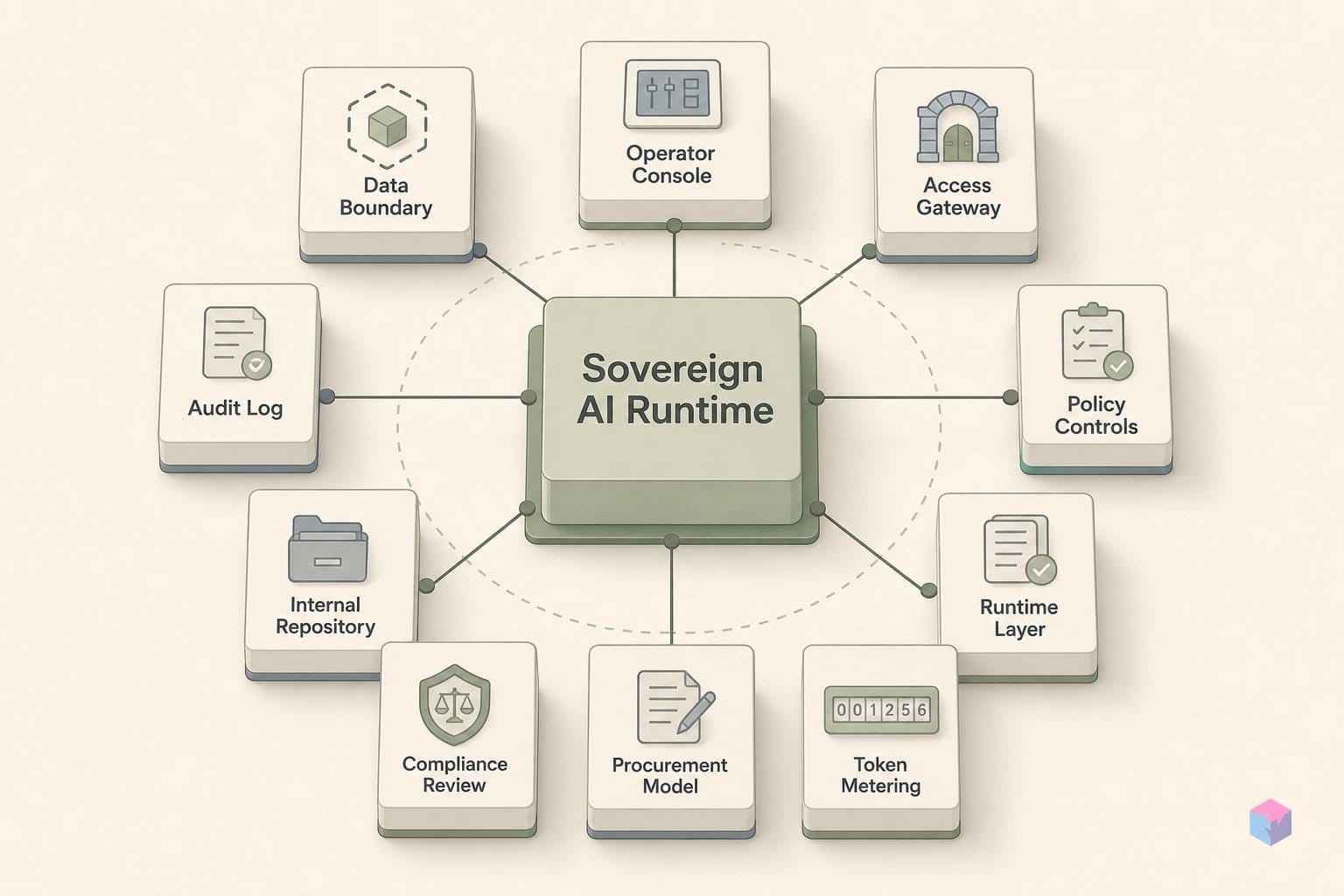
On June 29, 2026, Palantir and NVIDIA announced a Sovereign AI Operating System Reference Architecture — a deployment blueprint that runs frontier-class open models entirely inside a customer's own perimeter, with no hosted API calls and no data leaving that boundary . The stack pairs NVIDIA accelerated hardware and the NVIDIA AI Enterprise software suite with Palantir's four core platforms — AIP, Foundry, Ontology, and Apollo — and an "intelligent engine" for running NVIDIA Nemotron open models in air-gapped environments "completely isolated from unsecured networks" . This is the concrete product behind the sovereignty pitch, not a slide.
The defining property is ownership. Agencies "retain full ownership of the resulting models — including the weights that encode their operational knowledge," so a fine-tuned model and everything it learned stays a customer asset rather than a vendor's hosted endpoint . For a developer, that inverts the usual dependency: you hold the artifact, not just an API key that can be rate-limited, deprecated, or repriced.
The technically novel piece is a self-improving "data flywheel." The engine collects user telemetry and trace data inside the customer environment and uses it to post-train and align Nemotron to high-value tasks, so the model "continually improves" without exporting any data . In a shared multi-tenant API, that loop is hard to offer credibly — the training signal has to leave the tenant. Here the signal, the compute, and the resulting weights stay on the same side of the air gap.
The compliance surface Palantir cites at announcement is why regulated buyers evaluate this differently from a generic key. Its Trust portal lists:
- FedRAMP Certified Class D and FISMA High
- DoD Impact Level 5 (IL5) and IL6
- HIPAA and GDPR
- ISO 27001, 27017, and 27018
- SOC 2 Type 2
One caveat worth stating plainly: a platform holding these certifications does not mean every deployment is accredited for every workload. Workload-specific accreditation is a separate exercise the buyer still owns, and the announcement does not remove it .
Palantir frames the design as continuous with its origin, not a pivot. "Our customers must maintain control," Chief Architect Akshay Krishnaswamy said, tying the architecture to the government deployments where Palantir first built for classified, disconnected settings . NVIDIA aims the same package at U.S. agencies and critical-infrastructure operators across commerce, energy, healthcare, agriculture, education, and transportation, keeping "data, models and auditability under customer control" . What it requires in return — perimeter compute capex, ontology work, and platform dependency — is where the rest of this analysis turns.
Karp's Tokenmaxxing Manifesto: The CNBC Argument
Palantir CEO Alex Karp's "tokenmaxxing" argument is a commercial pitch that per-token AI billing charges enterprises for consumption rather than results — and that owned, sovereign deployment is the fix. On CNBC's Squawk Box on July 1, 2026, Karp said "something has gone completely wrong" with how AI is sold, arguing that enterprises pay for "tokens that create no value" . A nine-point manifesto published June 30, 2026 coined the term "tokenmaxxing" — chasing demos and burning inference budget without measurable outcomes . The framing is deliberately provocative, and it is worth separating the rhetoric from what was actually evidenced.
The sharpest line channeled reported customer sentiment: Karp described token billing as "a wealth tax that does not help the poor, it just punishes" . For a developer or technical founder, the underlying complaint is familiar: costs that are trivial in a pilot balloon once workloads become agentic, because prompt size, retrieved context, tool calls, output verbosity, thinking tokens, retries, and evals all multiply the meter.
"Something has gone completely wrong" with AI selling — enterprises pay for "tokens that create no value," — Alex Karp, CEO of Palantir, on CNBC's Squawk Box (source: Quartz).
Is the case independently validated? Not yet. Karp offered no third-party ROI figures and cited no independent buyer surveys. The only concrete number anchoring the commercial argument was Palantir's own projected free cash flow of roughly $15–18 billion two years out — a self-reported forecast, not external evidence that sovereign deployment outperforms metered access on total cost or outcomes.
The market reacted, but a reaction is not validation. Palantir shares rose roughly 8–9% on interview day , reflecting investor enthusiasm rather than any independent audit of the thesis. The manifesto also lands against a real budget backdrop: reports note companies including Uber and Microsoft have capped employee access to costly AI coding tools, which lends the "tokens without outcomes" complaint some empirical weight .
Read as signal rather than analysis, the manifesto reframes a pricing debate as a value debate — useful framing for buyers, but one that shifts, rather than settles, the burden of proof.
The Ontology: Palantir's Durable Competitive Moat
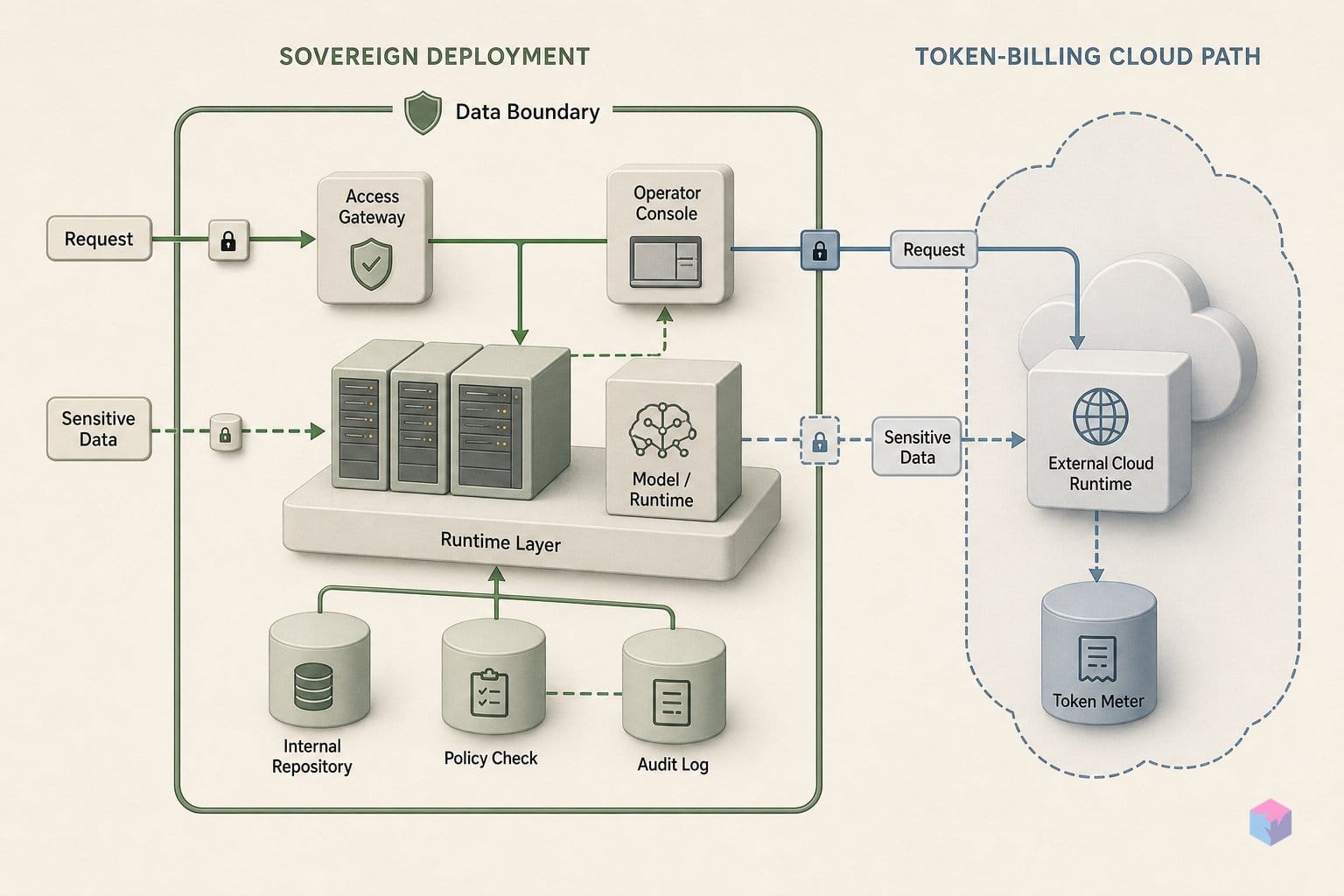
Palantir's real defensibility is not the model — it is the Ontology, the layer that turns a raw model call into a governed operation. The Ontology is an operational layer, often built as a digital twin, containing objects, properties, and links plus actions, functions, and dynamic security . The practical consequence: AI attaches to approved business objects and sanctioned actions rather than to free-form prompts, so an agent updating a shipment or approving a claim moves through the same permissions and audit trail as a human operator. That is the part a per-token API does not replicate.
Everything above the Ontology routes through Foundry governance. AIP Logic, AIP Chatbot Studio, and AIP Evals — the application and evaluation surfaces — plus the provider-compatible model-proxy endpoints all pass model traffic through the same control plane, which enforces zero-data-retention, usage tracking, rate limits, and per-provider georestriction . The proxy speaks Anthropic-, OpenAI-, xAI-, and Google-style formats, so existing client code can point at Foundry and inherit governance without a rewrite. Supported families span OpenAI, Anthropic, Meta, Google, xAI, Mistral, and Llama, subject to enrollment and georestriction .
Apollo carries this into the field. Its Hub-and-Spoke model has spoke agents report telemetry back to a hub and execute Plans, and environments can run disconnected — on moving vehicles, for instance — then reconnect for upgrades. That is the edge and mission-deployment case that a hosted API structurally cannot serve, and it is why Palantir frames the control plane, not the weights, as the strategic asset.
"Because Palantir was born deploying software into government environments, our customers have always had to maintain control of their systems," — Akshay Krishnaswamy, Chief Architect at Palantir (source: Palantir Investor Relations).
The moat has a deliberate exit ramp. A March 2026 registered-model / bring-your-own-model implementation lets customers connect their own LLMs with native tool calling, reasoning, permissions, and observability . It reads as an answer to lock-in complaints, but the coverage is incomplete: BYOM does not yet support every AIP feature, with AIP Assist and some Pipeline Builder functions still excluded. Model portability is real; feature parity is not.
Read together, these pieces explain why the "no tokens" slogan understates what Palantir actually sells. The Ontology, the governed proxy, Apollo's disconnected deployment, and selective BYOM are switching costs — accumulated schema, permissions, and change-management work — not model performance. That is durable in a way a frontier model, refreshed every few months, is not. The trade for buyers is depth of control against optionality: you gain a governed operating layer, and you accept that the layer itself becomes infrastructure you depend on.
Open-Weight Nemotron vs Per-Token Metering: The CapEx Case
The financial argument for owned weights rests on inverting the cost curve. Per-token metering charges for every unit of inference forever; open-weight deployment like NVIDIA Nemotron front-loads GPU capital expenditure and then pays near-zero marginal cost per token at sustained volume . Break-even is not about peak burst; it depends on throughput consistency. A cluster that sits idle overnight loses the arbitrage, while a workload running steadily against the same fine-tuned model can undercut hosted API pricing over a multi-year horizon — the CFO version of Palantir's pitch .
Quick Answer: Per-token frontier APIs in mid-2026 range from about $1.50/$9 (Gemini 3.5 Flash) to $5/$30 (GPT-5.5) per million input/output tokens. Open-weight deployment swaps that recurring meter for high upfront GPU capex and near-zero marginal cost — cheaper only at sustained, consistent throughput.
The metered baseline it competes against is a moving target that is trending up, not away. Current short-context list pricing per million tokens illustrates the spread buyers model against owned compute :
| Model (mid-2026) | Input / 1M tokens | Output / 1M tokens |
|---|---|---|
| OpenAI GPT-5.5 (short-context) | $5.00 | $30.00 |
| Anthropic Claude Sonnet | $3.00 | $15.00 |
| Anthropic Claude Opus 4.7 | $5.00 | $25.00 |
| Google Gemini 3.5 Flash | $1.50 | $9.00 |
| AWS Bedrock Claude 3.5 Sonnet (extended) | $6.00 | $30.00 |
These headline rates understate real production spend, because agentic workflows multiply token consumption non-linearly. Once a pilot graduates to a pipeline, cost compounds across prompt size, retrieved context, tool calls, output verbosity, thinking tokens, retries, and eval runs. The same task that costs a fraction of a cent as a single prompt becomes a chain of dozens of billed calls per user action. In practice a $500/month proof-of-concept can scale into a $50,000/month production bill without adding a single new use case — the meter grows with usage, not just headcount .
That pressure is documented rather than hypothetical. Reports note companies including Uber and Microsoft have capped employee access to costly AI coding tools to contain spend . So the tokenmaxxing critique has a factual basis even where Palantir's framing is self-serving: metered inference does scale unpredictably, and finance teams are responding by rationing access .
The honest counterweight is that capex only wins under specific conditions. Owned Nemotron clusters demand sustained utilization, in-house MLOps, and depreciation math that most buyers with bursty or exploratory workloads cannot justify — for them, transparent per-token pricing and cross-vendor benchmarking remain cheaper and more flexible. The CapEx case is real, but it is a volume-and-consistency argument, not a universal one.
AIP Capacity Enrollment: The Negotiated Alternative to Retail Token Billing
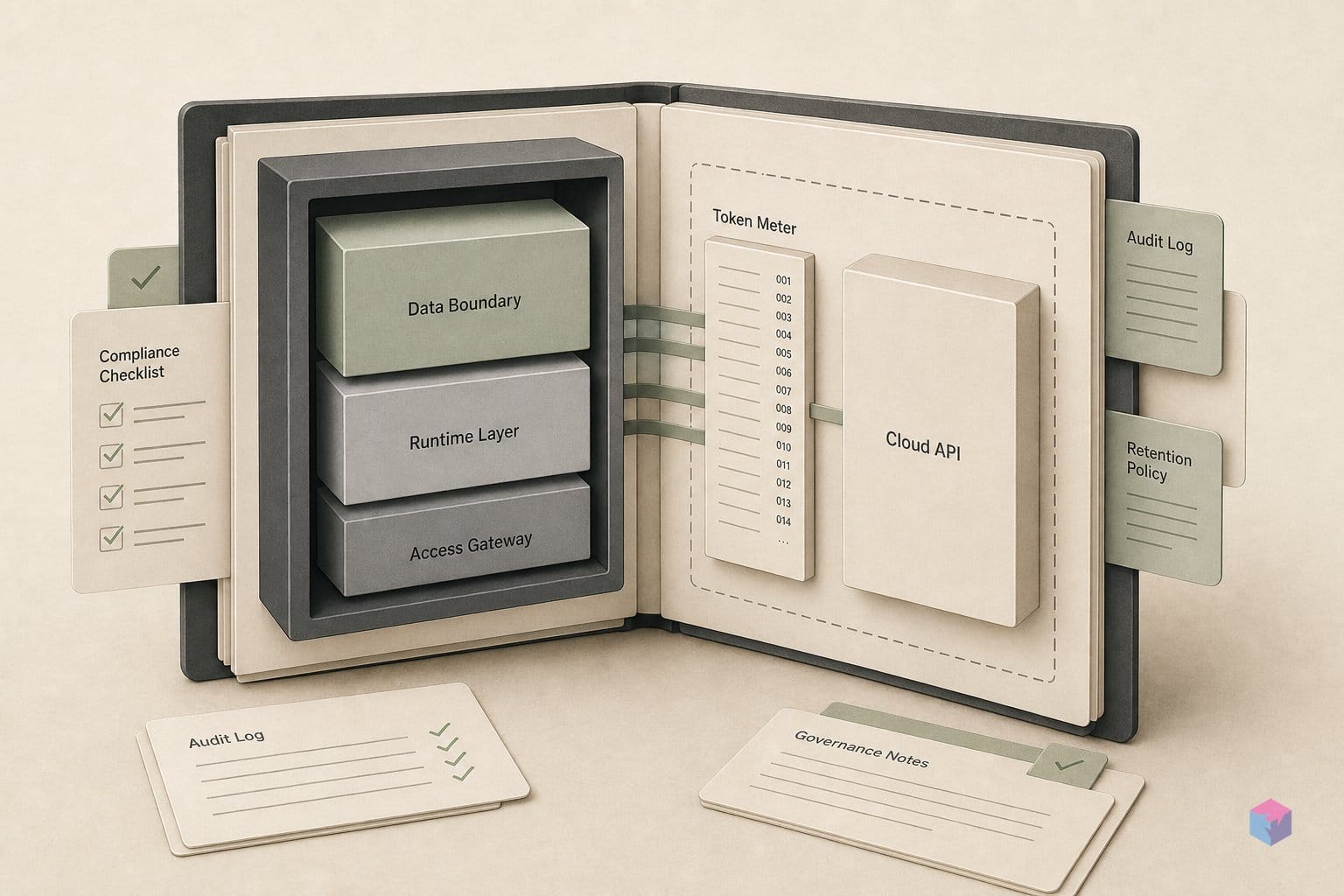
AIP has no retail per-token price — capacity is provisioned through enrollment tiers you negotiate, not a self-serve meter you top up. New deployments default to a "medium" capacity tier, and moving to "large" or "XL" requires opening a Support ticket rather than clicking an upgrade button . That single detail reframes the whole "no tokens" pitch: Palantir still counts tokens internally, but it packages them as a governed capacity allocation instead of a line-item invoice.
The limits themselves are not a monthly cap or a dollar ceiling. They are expressed as tokens-per-minute and requests-per-minute, applied separately at the enrollment, project, and user levels . For a developer this is closer to a rate limit than a budget. You are not asking "how much will this cost this month" but "will my agentic workflow saturate the tokens-per-minute ceiling on this project, and if so, whose Support queue do I join to raise it." Capacity planning becomes an operational conversation, not a billing-console slider.
Underneath, the hosted-model paths are not Palantir compute at all. AIP's LLM capacity is constrained by upstream providers — Azure, OpenAI, AWS Bedrock, and Google Vertex — with Palantir operating as a governed proxy layer above them . So the same frontier-model tokens the tokenmaxxing manifesto criticizes are still being metered by the same clouds; Palantir wraps them in enrollment governance, georestriction, and rate management rather than replacing the meter. The proxy-compatible API layer even mirrors Anthropic-, OpenAI-, xAI-, and Google-style endpoints while enforcing zero-data-retention and usage tracking .
Model choice is broad but gated. AIP supports families from OpenAI, Anthropic, Meta, Google, xAI, Mistral, and Llama, each subject to enrollment and georestriction rather than free selection . And there is no published dollar pricing anywhere in the docs — enterprise contracts are custom, negotiated per deployment .
The practical trade is legibility. Retail token billing gives you a transparent marginal cost and instant cross-vendor benchmarking; AIP capacity enrollment gives you a governed, budgetable envelope in exchange for opaque economics and a Support-mediated upgrade path. For a regulated buyer who values predictability over price transparency, that is a feature. For a team that wants to A/B two models by cost tomorrow, the enrollment gate is friction the retail meter never imposes.
Sovereignty vs. Shared Cloud: The Ownership Case AIP Makes and Doesn't
Palantir's sovereignty pitch rests on a claim both major labs dispute: that metered, hosted APIs inherently leak your work back into someone else's training set. That framing is contestable. OpenAI states it does not train on business API data by default absent explicit opt-in, and Anthropic states it does not train on inputs or outputs from Claude for Work, its API, or Claude Gov by default . So the sharper question for a technical buyer is not "who owns the training signal" — the labs already answer that contractually — but "who owns the weights, the deployment perimeter, and the control plane," which is a genuinely different axis than data-retention policy.
It also helps to stop treating "sovereign AI" as a single product. In practice it is a spectrum: on-prem, national cloud, classified cloud, customer-controlled encryption keys, disconnected edge, or merely policy-controlled routing. Each implies different threat models, upgrade cadences, and accreditation work. A vendor slide that says "sovereign" tells you almost nothing until the contract specifies which of those you are buying. Treat the word as a variable to define, not a guarantee to accept.
The ownership story Palantir tells is real at the architectural level — air-gapped deployment, retained weights, an in-perimeter data flywheel — but it is not independently verified at the value level. Palantir publishes no dollar pricing for sovereign AIP; contracts are custom and negotiated . And Alex Karp's CNBC case offered no third-party ROI audit or independent survey. The only figure attached to the argument was Palantir's own projected free cash flow of roughly $15–18B two years out, and the stock rose about 8–9% on interview day — a market reaction, not validation of the underlying economics.
"Customers must maintain control," — Akshay Krishnaswamy, Chief Architect at Palantir, tying the sovereign engine to the company's government origins (source: Palantir Investors).
Strip away the manifesto and the real decision is narrow: control-plane depth versus commodity optionality. Palantir gives you faster operationalization in hard environments — the ontology, governed actions, Apollo deployment, in-perimeter post-training — if you accept ontology lock-in, sustained change-management overhead, and platform economics you cannot benchmark. Token-billed cloud AI gives you transparent metering and next-day model swaps if you build identity, audit, lineage, and approvals yourself.
The concrete takeaway: pick on constraints, not slogans. If your workload must touch classified or regulated systems of record and cannot leave a perimeter, Palantir's depth is worth its opacity. If you are still iterating on models and use cases, the retail meter's optionality beats a control plane you will spend a quarter negotiating. "No token billing" is a marketing frame; Palantir's own docs still count tokens. Buy the architecture that matches your threat model — and write the definition of "sovereign" into the contract yourself.
Frequently asked questions
Does Palantir AIP charge per token?
Not at the retail level — but it still counts tokens. Enterprise billing runs through negotiated capacity tiers (default "medium," with "large" and "XL" upgrades via Support), not a public per-token rate . Under the hood, AIP measures LLM usage in tokens and converts them to compute-seconds — 43 compute-seconds per 10,000 tokens, so 24 GPT-4o tokens equal 0.1032 compute-seconds — exportable as daily token, model, and compute-second reports . The "no token billing" message is about contract form, not the measurement unit.
What is tokenmaxxing and why does Karp use the term?
Tokenmaxxing is Alex Karp's term, coined in a nine-point manifesto on June 30, 2026, for enterprises chasing demos and burning inference budget without measurable outcomes . On CNBC's "Squawk Box" the next day he called token billing "a wealth tax that does not help the poor, it just punishes" . It is a rhetorical label positioning Palantir's owned-weight sovereign deployments as delivering ROI where metered-API spend allegedly does not — a sales argument, not third-party analysis.
Can I bring my own LLM to AIP instead of using Palantir's hosted models?
Yes. Since a March 2026 registered-model/BYOM implementation, customers can connect their own LLMs with native tool calling, reasoning, permissions, and observability . The caveat: BYOM models do not yet support every AIP feature — AIP Assist and some Pipeline Builder functions are excluded. Either way, the Ontology and Foundry control plane still governs every call, enforcing authorization, audit, and rate limits regardless of which model you route to.
What does "sovereign AI" actually mean in a Palantir contract?
It is not a single technical spec. "Sovereign AI" spans on-prem, national cloud, classified cloud, customer-controlled keys, disconnected edge, and policy-controlled routing. The June 29, 2026 air-gapped Nemotron deployment with NVIDIA — isolated from unsecured networks with customers retaining full ownership of model weights — is one specific implementation . Because the term is elastic, buyers should define isolation, ownership, and routing contractually rather than accepting "sovereign" as self-defining marketing language.
Do OpenAI and Anthropic train on my prompts by default?
No. OpenAI says it does not train on business data by default absent an explicit opt-in, and Anthropic says it does not train on inputs or outputs from Claude for Work, its API, or Claude Gov by default . Both labs directly dispute Palantir's implicit framing that hosted API usage feeds frontier-model training. The genuine distinction is architectural — perimeter control, weight ownership, and auditability — rather than a blanket claim that cloud APIs harvest your data.
Last updated: 2026-07-05. Reviewed against Palantir and NVIDIA announcements of June 29–July 1, 2026, and Palantir's published AIP documentation.
Enjoyed this article? Subscribe to get new stories by email whenever they're published.