
NVIDIA's build.nvidia.com hands you one nvapi- key that unlocks dozens of hosted models, and the viral pitch is "stop paying for API keys." The catch most tutorials skip: the throughput budget is attached to your key, not to each model — so mixing models drains the same pool faster than you'd expect.
Why NVIDIA's ~40 RPM drains faster when you mix models
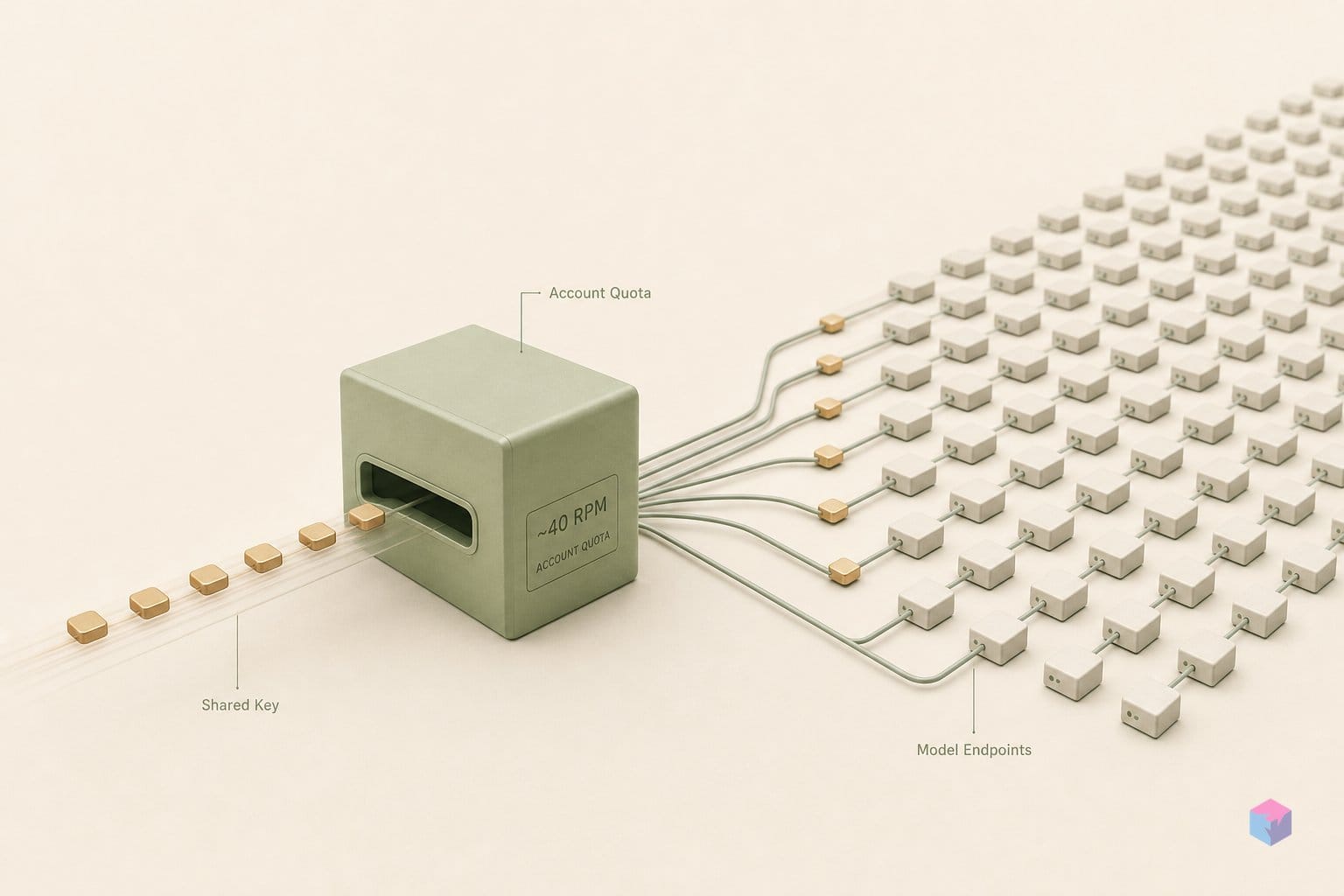
The widely-cited ~40 requests-per-minute limit on NVIDIA NIM's free endpoints applies at the nvapi- key (account) level, not per model. Concurrent calls to, say, Llama and Mistral on the same key share one throttle pool, so a two-model agent hits 429s roughly twice as fast as a single-model workload . This is community-observed as of July 2026, not a published SLA.
Quick Answer: NVIDIA NIM's free tier throttles at roughly 40 RPM per nvapi- key, shared across every model you call — not per model. NVIDIA publishes no stable per-model RPM/TPM/RPD table for the free tier, so treat ~40 RPM as a community baseline and verify empirically in your own console.
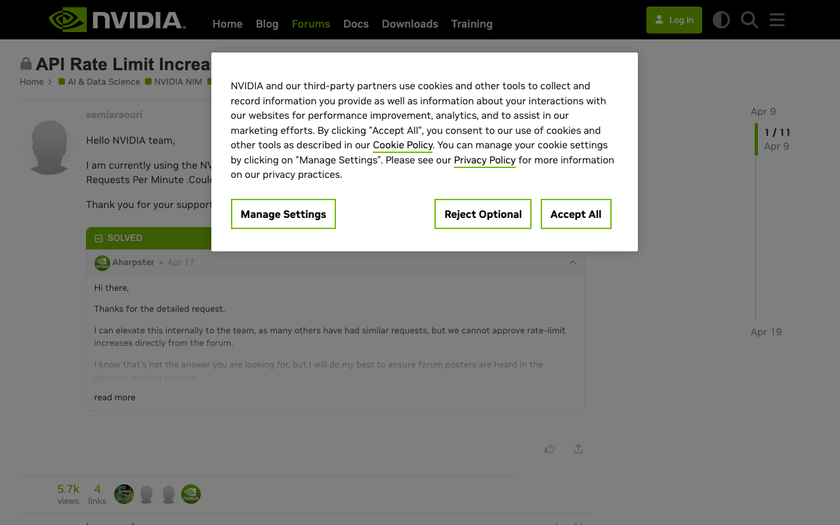
NVIDIA does not publish a fixed number. The only on-record staff statement, on the developer forum (April 16, 2026), says the team "cannot approve rate-limit increases directly from the forum" and that trial limits are "dependent on model, use-case and the amount of current overall traffic" . No stable per-model RPM/TPM/RPD table exists for the free tier. Here's how the three common free/low-cost access points compare on transparency:
| Platform | Free-tier limit model | Documented? |
|---|---|---|
| NVIDIA NIM | ~40 RPM, account-wide, shared across models | No — undocumented, community-observed |
| OpenAI Free | RPM/RPD/TPM/TPD per model | Yes — console + response headers |
| Together AI serverless | Dynamic per-org, per-model; no fixed guarantee | Partial — $5 minimum balance for any access |
OpenAI exposes RPM, RPD, TPM and TPD per model, inspectable in the console and response headers . Together AI's serverless limits flex per organization and per model against live capacity, with no fixed guarantee and a $5 minimum balance to access the platform at all . NVIDIA's edge is breadth on one key — not guaranteed throughput.
Two-minute onboarding: build.nvidia.com signup and base_url override
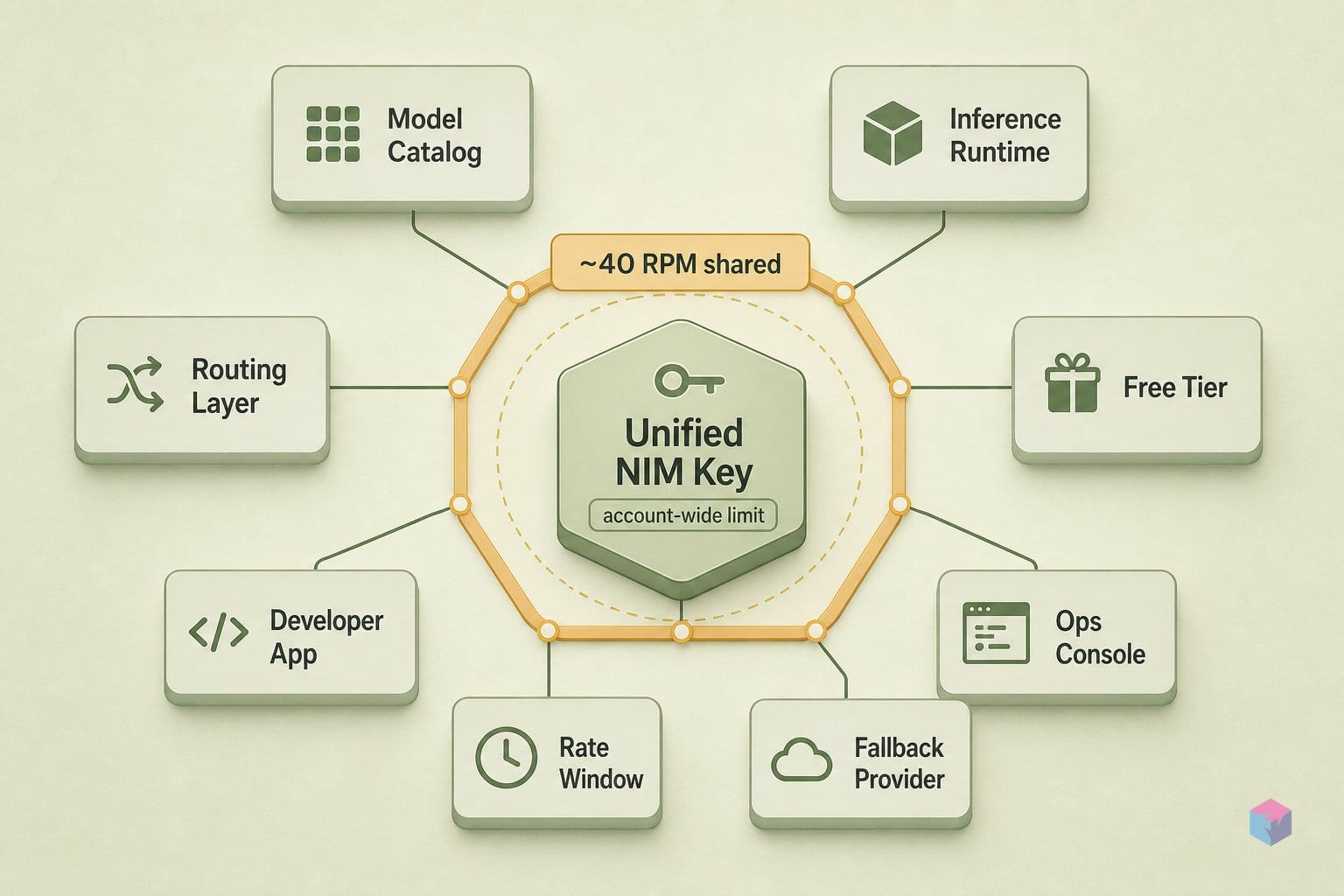
Getting a key takes about two minutes. Create an account at build.nvidia.com, which requires phone-number verification but no credit card . Then open the API Keys page and generate one nvapi- string. That single key calls every free-endpoint model — 77 of them as of July 2026 — under the unified-key architecture, so you never juggle per-provider credentials.
Because every text endpoint is OpenAI-compatible at base URL https://integrate.api.nvidia.com/v1 , existing OpenAI-SDK code works with two changes: point base_url at NVIDIA and set NVIDIA_API_KEY. No other rewrite is needed.
from openai import OpenAI

client = OpenAI(
    base_url="https://integrate.api.nvidia.com/v1",
    api_key=os.environ["NVIDIA_API_KEY"],
)

resp = client.chat.completions.create(
    model="meta/llama-3.3-70b-instruct",
    messages=[{"role": "user", "content": "Hello"}],
)
print(resp.choices[0].message.content)
One caveat trips people up: some model families return a 403 until you visit that model's page and click "Try API" once . This per-family registration is not automatic on account creation, so if a specific identifier rejects your key, open its catalog page and register before retrying. The same swap points at self-hosted NIM later — no code change .
Mapping your actual RPM headroom empirically
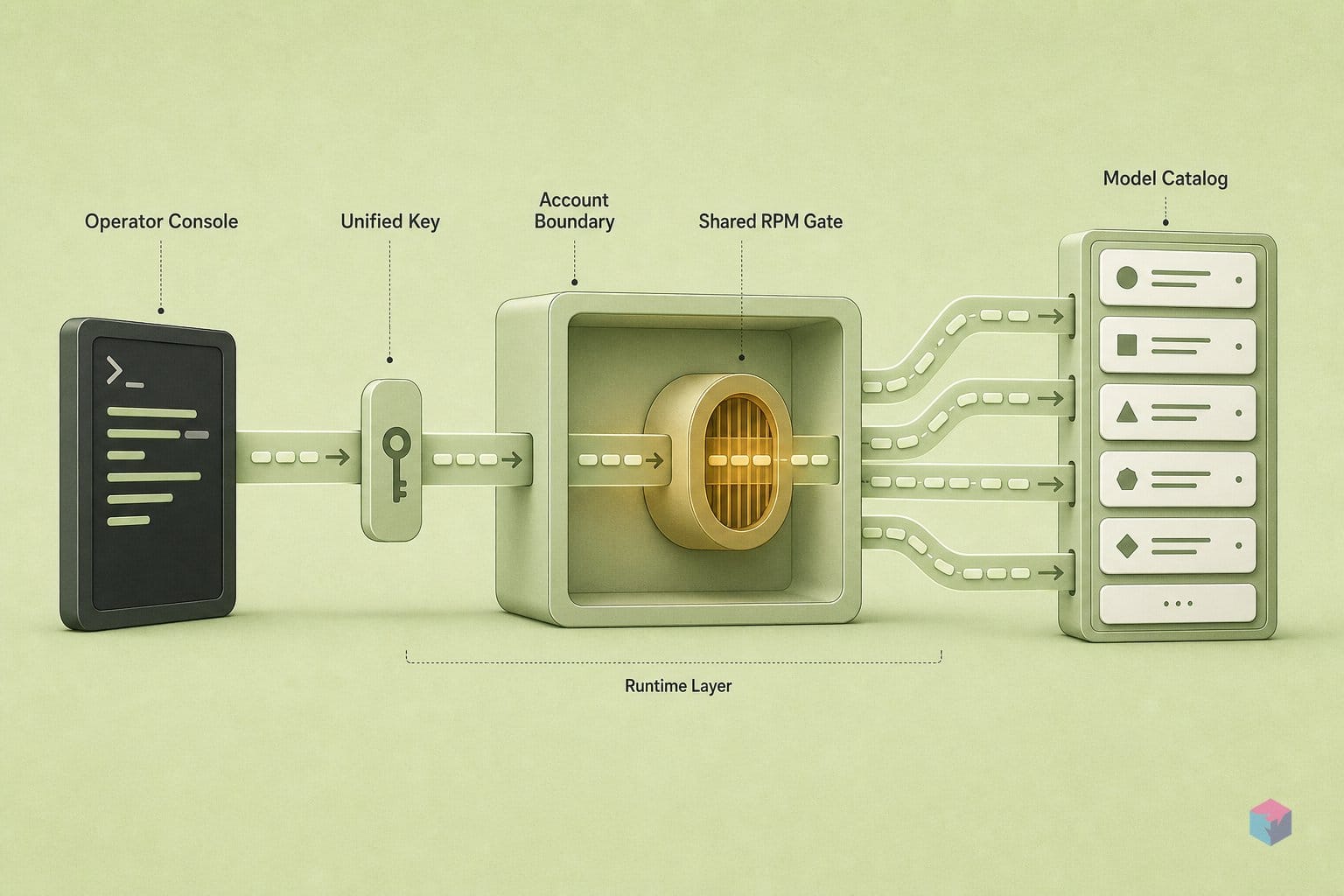
Because the ~40 requests-per-minute cap is account-wide and shared across every model call rather than granted per model , the only trustworthy number is the one you measure from your own nvapi- key. NVIDIA does not publish a stable per-model RPM/TPM table for the free tier, and the sole on-record staff statement (forum, April 16 2026) says trial limits are "dependent on model, use-case and the amount of current overall traffic" . Treat any community-posted figure as folklore until your console confirms it.
- Confirm the shared pool. Fire requests against two different free-endpoint models in tight succession from the same key. If both start returning 429 from a single counter — not independent ones — you have verified the account-wide behavior for yourself.
- Capture Retry-After. NVIDIA honors the
Retry-Afterheader on 429 responses . Parse it, back off exponentially around the value it returns, and log every observed pause across a 5-minute window. - Derive your number. Record model identifier, timestamp, and HTTP status per attempt, then divide successful calls by elapsed minutes. That empirical RPM is more reliable than the widely repeated ~40 baseline.
import time, requests

def observe(model, key):
    r = requests.post(
        "https://integrate.api.nvidia.com/v1/chat/completions",
        headers={"Authorization": f"Bearer {key}"},
        json={"model": model, "messages": [{"role": "user", "content": "ping"}]},
    )
    print(model, time.strftime("%H:%M:%S"), r.status_code,
          r.headers.get("Retry-After"))
    return r.status_code
One capability caveat is worth testing in the same pass. The openai/gpt-oss-120b page lists reasoning as unsupported, yet its sample code checks for a reasoning_content field . Inspect the actual response shape from your own output before designing logic around any documented capability flag — the metadata and the returned payload do not always agree.
Edge cases that bite before you reach the RPM wall
Several failure modes on the free catalog have nothing to do with rate limits — they stem from shifting availability and legal framing. The clearest example: moonshotai/kimi-k2-thinking moved from a free endpoint to a partner-only endpoint, visible by July 2026 . A hardcoded model string that worked last week can start returning errors without notice when NVIDIA reclassifies a model. Pin model names in config, not in code, and log the exact model string on every call so a silent deprecation surfaces in your own telemetry rather than in a user complaint.
The "Prototype" label in NVIDIA's own UI is a legal signal, not marketing filler. The Technology Access terms disclaim warranties of availability, security, and error-free operation, and reserve the right to change, deprecate, or slow the technology without prior notice . There is no uptime commitment on the free path — treat it as evaluation infrastructure, not a dependency.
The same terms bar sensitive data from the free tier: PHI, PCI, confidential, controlled, and personal data are prohibited unless a separate Product Agreement covers your use . Route anything regulated through a governed deployment.
Finally, verify counts before you design around them. The official models page showed 77 free endpoints in July 2026, not the "80+" repeated in viral tutorials . NVIDIA's own forum guidance underlines the uncertainty: the team "cannot approve rate-limit increases directly from the forum," and trial limits are "dependent on model, use-case and the amount of current overall traffic" . Confirm every number in your own console before it becomes a design assumption.
After the prototype: when to graduate from the free catalog
NVIDIA designs the free catalog as an exit, not a home. Model pages label the hosted area "Prototype" and prompt "Ready to scale? Choose your deployment path," routing you toward partner endpoints or self-hosted NIM under an NVIDIA AI Enterprise license . Treat the free key as an evaluation instrument: if consistent throughput beyond the community-baseline ~40 RPM or any SLA matters to your product, budget for a paid, partner, or self-hosted path from day one .
The payoff for prototyping here is portability. The free hosted endpoint and self-hosted NIM both expose the same OpenAI-compatible surface at https://integrate.api.nvidia.com/v1, so graduating is a base_url swap, not a rewrite . Bank that portability now with three habits:
- Keep the
nvapi-string server-side only — never ship it to a browser or mobile client. - Abstract the provider behind a thin interface so the model string and endpoint are configuration, not code.
- Plan a fallback (another catalog model, a partner endpoint, or a direct provider) for sustained 429 bursts, since limits are unpublished and shift without notice .
Takeaway: use build.nvidia.com to compare models, wire up coding agents, and validate long-context or multimodal ideas for free — then migrate the moment reliability becomes a feature you sell, not a convenience you enjoy.
Frequently asked questions
Is NVIDIA's ~40 RPM free tier limit officially documented?
No. The ~40 requests-per-minute figure is community-observed, not a published SLA. The only on-record NVIDIA staff statement (developer forum, April 2026) says trial limits vary by model, use-case, and current overall traffic, and that the team cannot approve increases from the forum. NVIDIA publishes no stable RPM/TPM/RPD table for the free tier , so verify your own console before designing around any number.
Does each model on build.nvidia.com get its own RPM allocation?
No — the cap is account-wide. A single nvapi- key calls every catalog model through one OpenAI-compatible surface, and each call to any model draws from the same throttle pool at build.nvidia.com. Mixing model families (say, Llama plus Qwen plus Nemotron) drains the shared budget faster than staying on one model, and exceeding it returns 429 responses honoring Retry-After.
How does NVIDIA's free tier compare to OpenAI and Together AI in 2026?
OpenAI is the most transparent: it publishes RPM, RPD, TPM, and TPD per model, scoped at organization/project level and inspectable via the console and response headers in its rate-limit docs. NVIDIA publishes nothing official for its free tier in the NIM documentation. Together AI has no true free tier — a $5 minimum credit is required and serverless limits are dynamic per organization and model per its rate-limit docs. NVIDIA's edge is breadth on one key, not guaranteed throughput.
Can I request a rate limit increase on NVIDIA's free tier?
You can post on the NVIDIA developer forum, but staff have stated they cannot approve increases directly there, and that trial limits depend on model, use-case, and live traffic forum, April 2026. Community requests to raise the cap from 40 RPM to 200 RPM circulate but are not reliably granted. Treat the free tier as prototyping capacity, and plan a paid partner or self-hosted path if you need dependable throughput.
How hard is it to migrate from NVIDIA's free endpoints to self-hosted NIM?
Migration is low-friction because both environments expose the same OpenAI-compatible /v1/chat/completions surface. Moving from the hosted trial endpoint to a self-hosted or partner NIM deployment is a base_url change, not a code rewrite per NVIDIA NIM docs. That portability — prototype for free, then repoint the same code at production infrastructure under an NVIDIA AI Enterprise license — is the main architectural value of the unified-key design.
Enjoyed this article? Subscribe to get new stories by email whenever they're published.