

Anthropic just put a number on its answer to AI-driven job loss — and it looks less like a grant program and more like a hiring spree. On June 11, 2026, the company launched a $150 million fellowship that pays people to embed inside nonprofits and build with Claude.
What Claude Corps is: embedded fellows, not software seats
Claude Corps is a 12-month, full-time fellowship that will recruit, train, and place 1,000 early-career workers inside U.S. nonprofits to help those organizations adopt Claude across operations and service delivery . The distinction that matters: this is embedded labor, not a training course or a stack of donated licenses. Fellows work full-time on real problems inside a host organization's systems — intake workflows, dashboards, internal tools, agents, automations, and staff enablement — rather than attending a workshop and leaving .
The rollout is staged. Cohort 1 places roughly 100 fellows starting October 19, 2026; the remaining ~900 join later cohorts beginning January 2027 and August 2027, reaching 1,000 fellows across the full $150 million commitment . On the demand side, Anthropic says more than 400 U.S. nonprofits have committed to host fellows over the first 12 months, spanning 16 focus areas including education, housing, public health, and workforce development . Named hosts include the International Rescue Committee, Code for America, RAINN, and Year Up United .
Claude Corps is the larger half of a broader pledge. Anthropic's Economic Policy Framework outlines $350 million in spending: $150 million for Claude Corps and $200 million for an Economic Futures Research Fund, framed explicitly as a response to AI-driven labor displacement . That framing — a company that says its models will displace entry-level workers now paying entry-level workers to deploy those models — is what makes the program worth reading closely, and it's the tension the rest of this article unpacks.
Pay and benefits: $85k/year, Claude licenses, CodePath as employer of record
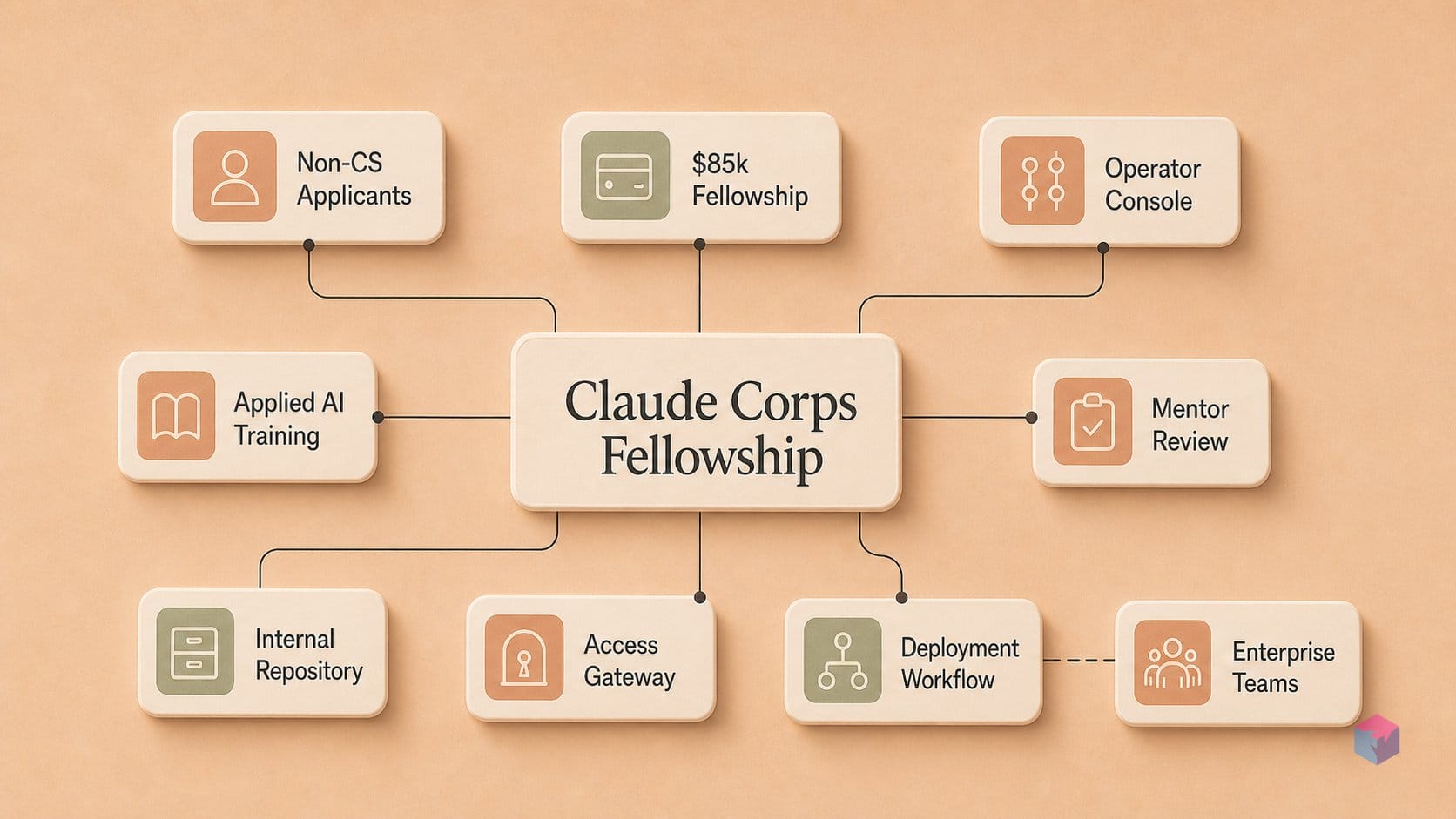
Each fellow is a full-time employee earning $85,000 per year, paid twice monthly . The detail that matters structurally: the paycheck comes from CodePath, not Anthropic. CodePath — a San Francisco nonprofit that opens tech careers to low-income and first-generation students — is the official employer of record, handling payroll, W-2s, and HR, while Anthropic funds the program and supplies Claude expertise . Fellows are W-2 employees of CodePath for the 12-month term, which keeps Anthropic off the cap table of the labor relationship even as it bankrolls it.
The package is a conventional full-time benefits set, not a stipend. Fellows get medical, dental, and vision coverage, a 401(k), paid holidays, flexible PTO, and life and disability insurance .
On the tooling side, each fellow receives up to $2,500 in Claude licenses and API credits for approved host projects . That budget covers Max, Team, or Enterprise seats — including Claude Code — plus project-scoped API credits, so the work fellows do inside nonprofits is built on production Claude access rather than a free-tier sandbox.
Training is front-loaded and ongoing. The year starts with a mandatory week-long "base camp" orientation in San Francisco, followed by roughly five hours per week of structured learning across the fellowship, plus CodePath mentorship and Anthropic office hours . Relocation funding is provided where needed — relevant because every Cohort 1 placement is in person .
| Component | Detail | Provider |
|---|---|---|
| Base salary | $85,000/year, paid twice monthly | CodePath (W-2) |
| Benefits | Medical, dental, vision, 401(k), paid holidays, flexible PTO, life & disability | CodePath |
| Claude access | Up to $2,500 in licenses + API credits (Max/Team/Enterprise, incl. Claude Code) | Anthropic |
| Training | 1-week SF base camp + ~5 hrs/week structured learning | CodePath + Anthropic |
| Relocation | Funded where needed; Cohort 1 all in person | CodePath |
The split is deliberate: Anthropic carries the cost and the credits, CodePath carries the employment liability, and the fellow gets a market-rate entry-level salary with full benefits attached to applied AI work.
What fellows ship during 12 months inside nonprofit operations
Claude Corps fellows produce working software, not advisory slide decks. Over the 12-month placement that begins October 19, 2026 , each fellow embeds inside a host nonprofit and ships operational and programmatic deliverables: intake workflows, data analysis, dashboards, internal tools, agents, automations, evaluation harnesses, integrations, and staff enablement . The output profile reads closer to a junior engineer's than to volunteer consulting.
The work starts with assessment, not deployment. Fellows evaluate where Claude actually fits an organization's existing workflows, then prototype and deploy targeted solutions with measurable operational impact — using up to $2,500 in Claude licenses and project-scoped API credits provisioned for approved host projects . The Register characterized the initiative bluntly as Anthropic hiring 1,000 fellows "to push Claude into nonprofits," and the deliverable list bears that out: this is embedded implementation labor aimed at standing up production systems inside the social sector .
That evaluation harnesses and integrations are explicitly in scope is the tell. A program optimizing for press-friendly enablement would stop at training sessions; instead, the scope expects fellows to wire Claude into real data pipelines and to build the eval scaffolding that tells a nonprofit whether an automation is reliable enough to trust. As The Next Web summarized the program's intent: "Fellows work on operational and programmatic problems inside host organizations" rather than delivering recommendations from the outside .
Ownership is the part developers should note. The host organization — not Anthropic, not the fellow — owns all code, tools, products, and documentation produced during the fellowship, formalized in a host memorandum of understanding . At the end of 12 months, fellows hand off fully functional assets the organization can keep running. The open question is staffing: a nonprofit that owns the code still needs someone able to maintain it once the fellow leaves, which is exactly what Social Finance's measurement framework is built to track.
Who qualifies: no degree needed, visa sponsorship unavailable
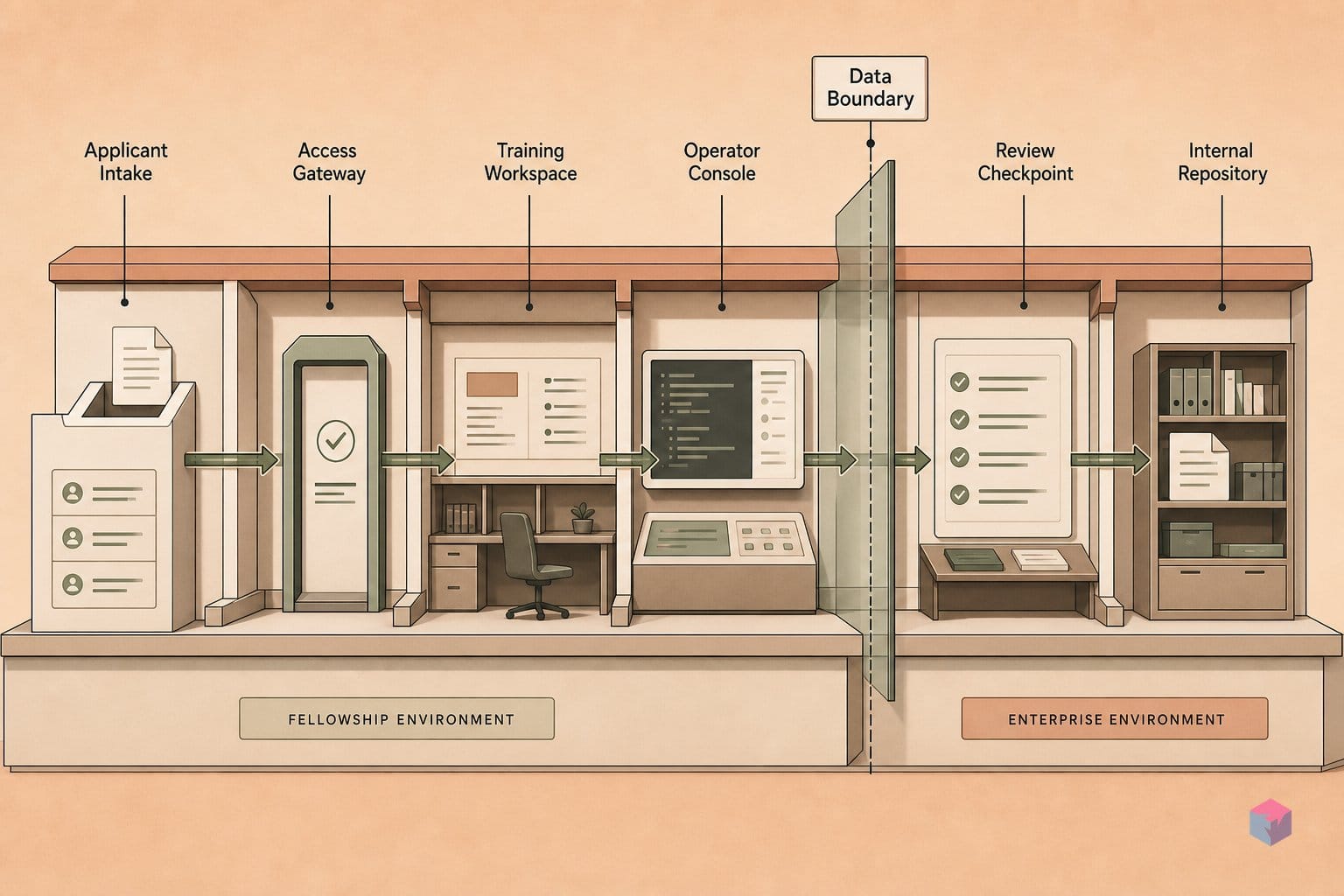
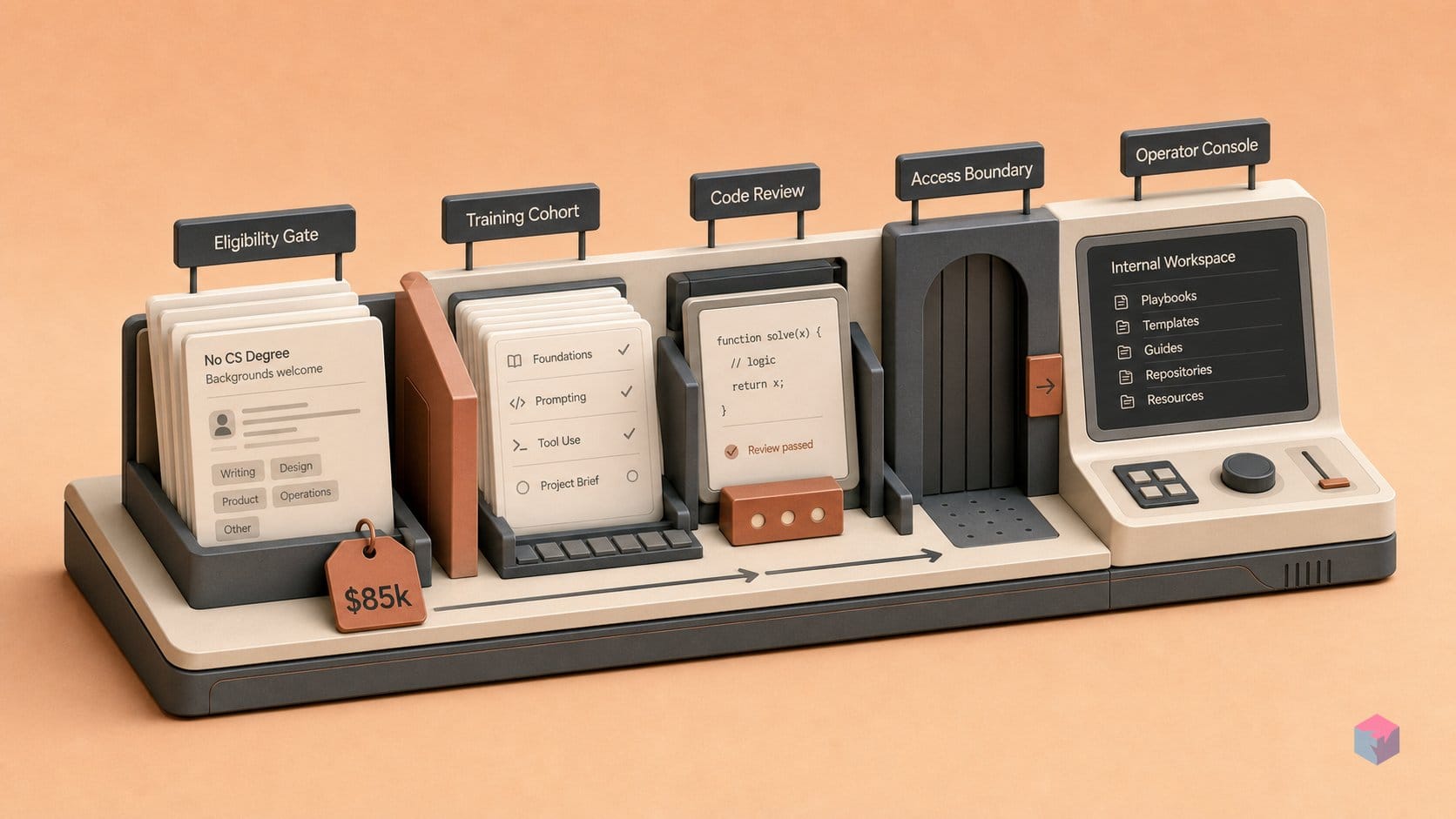
Claude Corps eligibility is intentionally broad but tightly bounded: applicants must be 18 or older, have under two years of full-time work experience, and hold valid U.S. work authorization for the full 12 months . There is no minimum education requirement and no coding or formal AI-training prerequisite — the program is explicitly open to people without a CS degree or any tech background . The under-two-years cap is the real gate: this is an early-career on-ramp, not a mid-career switch.
What replaces credentials is evidence of two things. Anthropic expects applicants to already use AI tools in daily life or work, and to have taken concrete action on a cause or community problem — volunteering, organizing, or building something for a group they care about . The screening reflects that: completing the AI Fluency and Claude 101 courses is part of the application itself, alongside a take-home skills assessment, so demonstrated fluency stands in for a diploma.
The hard exclusion is immigration status. Visa sponsorship is not available, and authorization must be valid for the entire fellowship without depending on an employer . The FAQ names the disqualifying categories directly:
- F-1 OPT and STEM OPT
- TN status
- H1-B1 and similar employer-tied statuses
Because CodePath is the employer of record and cannot sponsor, anyone whose right to work hinges on a sponsoring employer is out — a meaningful constraint given how many recent international graduates rely on OPT to start U.S. careers.
Current students are not excluded outright. They can apply provided they can begin full-time on October 19, 2026 and still fall under the two-years-of-experience cap when the cohort starts . In practice that suits graduating seniors and recent grads, who match both the timing and the early-career profile the program is built around.
Host qualification and the $10,000 implementation grant
To host a fellow, an organization must be a U.S.-based 501(c)(3) nonprofit that is already a Claude for Nonprofits customer on the Team or Enterprise plan . The plan requirement is a gate, not a formality: it ensures the fellow lands in an environment where Claude is already licensed and sanctioned, so the 12 months go to building rather than procurement. Eligible hosts must also run an in-person or hybrid workplace, name a senior sponsor and a day-to-day supervisor, and commit to the full year before any placement is confirmed.
Several categories are explicitly out of scope for Cohort 1. Universities and colleges, K-12 school districts, government agencies, and international organizations cannot host this round, though Anthropic says it may explore expansion after the first year . Fully remote nonprofits may apply now but cannot receive fellows until the 2027 cohorts, since Cohort 1 placements are all in person.
The money flows along two distinct lines, which clears up figures reported inconsistently across coverage. Anthropic covers the full fellow salary and benefits through CodePath's payroll; separately, each host receives a one-time $10,000 implementation grant administered by Social Finance to offset onboarding and tooling costs . That grant is separate from the up-to-$2,500 in Claude credits attached to each fellow.
| Host item | Detail |
|---|---|
| Eligibility | U.S. 501(c)(3) on Claude for Nonprofits Team/Enterprise |
| Out of scope (Cohort 1) | Universities, K-12 districts, government, international orgs |
| Fellows per host | Up to 4; Anthropic recommends ≥2 where feasible |
| Implementation grant | $10,000 one-time, via Social Finance |
| IP ownership | Host owns all tools, products, and code, per MOU |
A single host can take up to four fellows, and Anthropic recommends at least two where feasible so a fellow is not isolated . Critically for nonprofits weighing the deal, the host owns everything fellows build — tools, products, and code — formalized in a host memorandum of understanding that also locks in the named sponsor, supervisor, and 12-month commitment before a match is finalized .
Goodwill initiative or sales wedge? The critique Anthropic can't dismiss
The honest answer is that Claude Corps is both at once, and Anthropic has not fully reconciled the tension. The program embeds 1,000 funded fellows inside U.S. nonprofits specifically to drive Claude adoption across their operations . Fortune captured the structural conflict directly, framing the initiative as a "fox guarding the henhouse": Anthropic warns publicly that AI will displace entry-level workers, then deploys those same workers to deepen Claude's footprint in the social sector .
"Anthropic launches Claude Corps nonprofit fellows — fox guarding the henhouse" — Fortune, June 11, 2026 (source: Fortune).
The commercial logic is hard to ignore. Eligible hosts must already be Claude for Nonprofits Team or Enterprise customers, so every Cohort 1 placement lands inside a paying account and seeds deeper usage — often at organizations that could not previously afford enterprise AI without the subsidy . The unresolved question is renewal: once the fellowship subsidy ends after 12 months, will those nonprofits keep paying independently, or does the program function as a year-long, philanthropically-funded customer acquisition channel?
Anthropic positions the spend as a workforce-transition investment, citing labor displacement as the explicit motivation in its Economic Policy Framework — the same framework that pairs the $150 million for Claude Corps with a $200 million Economic Futures Research Fund, $350 million in total . Whether that reads as genuine investment or reputational cover for aggressive enterprise expansion is, for now, an open question the company has not answered with evidence.
And evidence is precisely what is missing. Social Finance administers the philanthropic capital and runs the measurement framework — skills assessments at the start, middle, and end of the fellowship, plus surveys and portfolio reviews — but it has produced no results, because Cohort 1 does not begin until October 19, 2026 . The two outcomes that would settle the debate — whether fellows land durable careers and whether nonprofits retain AI capability without ongoing subsidy — remain unproven. Until those numbers exist, the goodwill-versus-wedge framing is not cynicism; it is the correct posture for reading a program whose incentives point in two directions at once.
Cohort 1 opens October 2026 — application phases and two-sided matching
Both fellow and host applications for Cohort 1 close on July 17, 2026 at 11:59 pm PT , and the cohort's week-long "base camp" orientation in San Francisco begins October 19, 2026 . Host organizations apply on a rolling basis against the same cutoff and receive selection notices in late August 2026 . This first group is capped at roughly 100 fellows .
The fellow pipeline is multi-stage and front-loads proof of effort. The sequence runs: a short application form; completion of two online courses — AI Fluency and Claude 101 — with proof of completion submitted; short-answer written questions; a practical take-home skills assessment; a roughly 25-minute conversation; and a final round of two one-on-one host-matching conversations .
Placement is not a one-way assignment. Matching is two-sided: fellows and hosts interview each other and rank preferences, with the field typically narrowing to two or three finalists on each side before a placement is finalized . That structure gives both parties a veto, which matters for a 12-month in-person commitment.
Cohort 1 is the small opening tranche of a much larger plan. The remaining ~900 of the program's 1,000 total fellows are distributed across two later groups — Cohort 2 beginning January 2027 and Cohort 3 beginning August 2027 — though Anthropic notes the exact composition of those cohorts may still shift .
The concrete takeaway: if you meet the experience cap and want in on the first wave, the only hard date that matters right now is July 17, 2026 — clear the two courses and the take-home before then, treat the host-matching round as a two-way interview, and expect to be working in person from October. Everyone else has January and August 2027 windows to plan against.
Frequently asked questions
Can I apply to Claude Corps if I'm currently enrolled in school?
Yes. Current students can apply as long as they can commit to full-time work starting October 19, 2026 . The under-two-years-of-full-time-experience cap still applies, and internships and part-time roles are weighed differently from full-time positions . If your situation is borderline — for example, you have mixed part-time and full-time history — confirm directly with CodePath, the program's recruiter and employer of record, before submitting.
Does my nonprofit need to already be a Claude customer to host a fellow?
Yes. Eligible hosts must already be U.S.-based 501(c)(3) nonprofits on a Claude for Nonprofits Team or Enterprise plan . The one-time $10,000 implementation grant, administered by Social Finance, helps cover adoption costs, while Anthropic covers all fellow salary and benefits through CodePath . Existing Claude tooling is the baseline; the fellow is the implementation capacity on top of it.
Which visa statuses are ineligible for Claude Corps?
F-1 OPT, STEM OPT, TN, and H1-B1-like statuses are explicitly excluded, and no visa sponsorship is offered . Work authorization must be valid for the full 12 months and cannot depend on employer sponsorship . Applicants must be authorized to work in the United States independent of the fellowship for the entire term.
Who owns the code and tools a fellow builds during the placement?
The host nonprofit owns everything — software, internal tools, agents, and documentation — formalized in a host memorandum of understanding . Neither Anthropic nor CodePath claims IP rights over the deliverables built during the fellowship. Separately, Anthropic has said it may open-source some of the program's own core infrastructure, but that is distinct from the work product a fellow ships for a host .
Can a fully remote nonprofit host a Claude Corps fellow?
Not in Cohort 1. All Cohort 1 placements are in-person or hybrid, with a named physical workplace and an on-site day-to-day supervisor required . Remote-first organizations can apply but cannot receive fellows until the 2027 cohorts . Government agencies, universities, K-12 districts, and international organizations are also out of scope for the first year.