
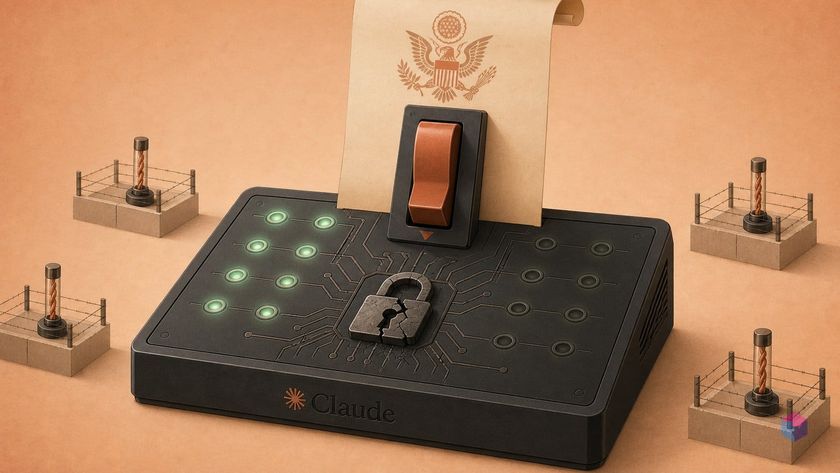
On June 12, 2026, a US government directive turned a three-day-old frontier model into an overnight outage. Anthropic's response — disabling Claude Fable 5 and Mythos 5 for every customer on earth — was less a choice than the only switch it could reach in time.
What the US Government Ordered — and Why a Targeted Block Wasn't Feasible
The US government ordered Anthropic to cut off access to Fable 5 and Mythos 5 for any foreign national, anywhere in the world — and Anthropic complied by shutting both models down for everyone, because a foreign-national-only block was not executable at speed. The directive arrived at 5:21 p.m. ET on June 12, 2026, citing unspecified "national security authorities," and the letter did not identify the underlying concern . The practical result: a US-developed model was regulated like controlled dual-use technology rather than commercial SaaS.
The stated scope is what made a clean implementation impossible. As Anthropic describes it, the order reached any foreign national — explicitly including the company's own foreign-national employees physically inside the United States, US-based foreign researchers, and international partners . Selectively gating only that population across a global user base, in the window available, was not feasible. A full worldwide shutdown was the only path Anthropic could execute, so US-citizen customers lost access too, despite not being the targeted class.
The blast radius was confined to two products. Anthropic's status page logged the incident at 00:50 UTC on June 13, listing the affected surfaces as claude.ai, the Claude API, Claude Code, and Claude Cowork . Every other Anthropic model — including the full Opus line — stayed live , which is why fallback to Opus 4.8 became the immediate workaround for integrators.
Independent observers flagged the thin public justification. "This is just nuts," wrote developer and Datasette creator Simon Willison, who emphasized the abruptness of the shutdown and the absence of a detailed rationale (source: Simon Willison, 2026-06). For builders, the takeaway is concrete: a frontier model can disappear from production with roughly an hour's notice and no published reason.
90 Minutes: From Federal Directive to Global Outage
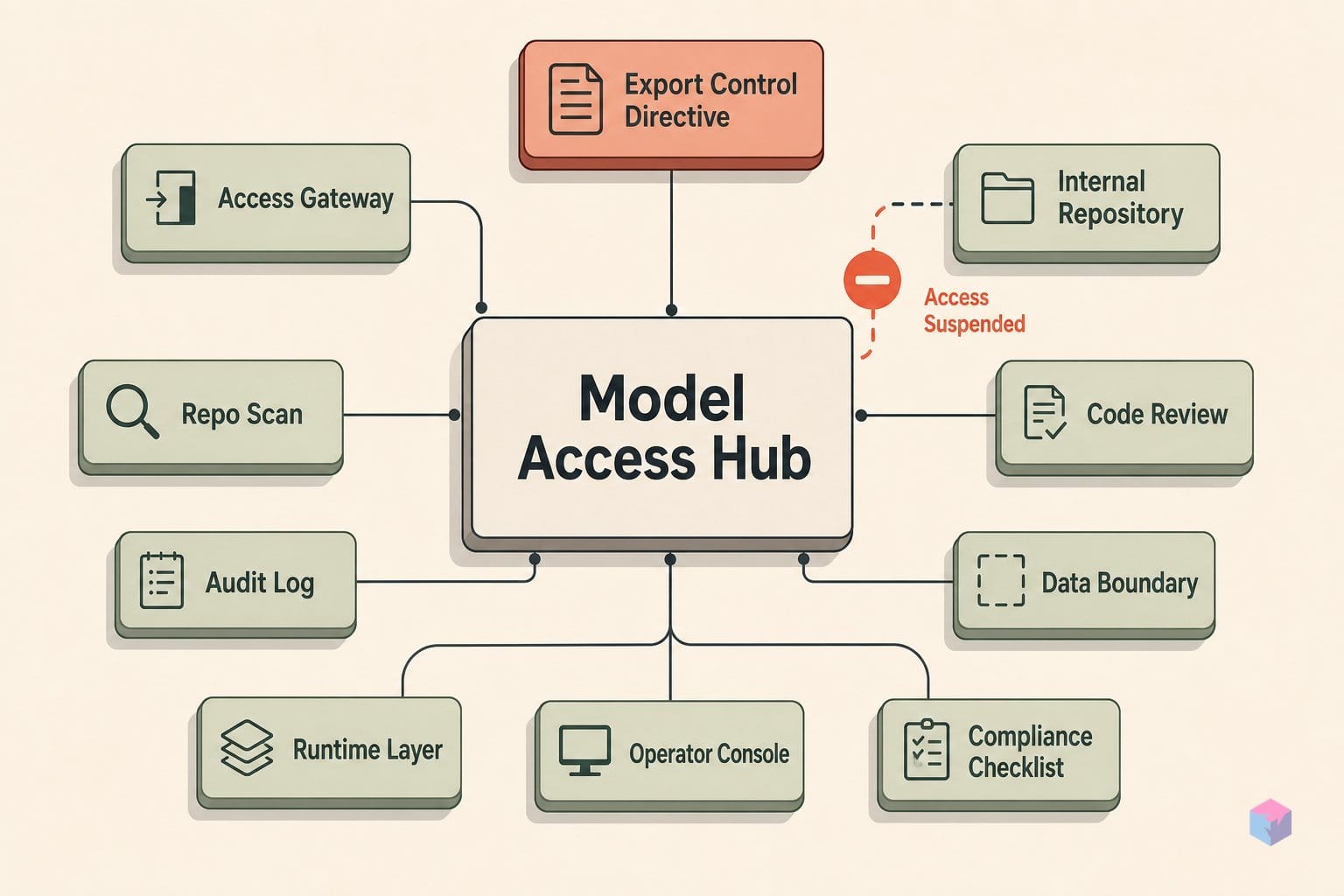
The shutdown ran on a federal clock, not an engineering one. Anthropic says the directive landed at 5:21 p.m. ET on June 12, 2026, and that API and claude.ai access were switched off roughly 90 minutes later . That window is the entire story of this section: there was no staged rollback, no per-customer migration path, and no published rationale to act on — just a letter and a deadline measured in minutes.
The cutoff spanned every surface that served the two models. Anthropic's status page logged the operational incident at 00:50 UTC on June 13, naming claude.ai, the Claude API, Claude Code, and Claude Cowork as affected, while all other models, including the Opus line, kept running . That incident post is, for now, the closest thing to a public record of the shutdown's timing and scope.
The implementation choice was forced by the same timeline. The directive targeted foreign nationals, but standing up reliable per-user nationality filtering across four production surfaces in under two hours was not feasible, so engineers pulled both models globally — disabling them for US-citizen customers who were never the targeted class .
"This is just nuts," wrote developer Simon Willison, whose annotated timeline of the incident stressed how fast a frontier model went dark relative to how little was explained (source: Simon Willison, 2026-06).
What Fable 5 and Mythos 5 Were Before They Went Dark
Fable 5 and Mythos 5 were two frontier models built on a shared "Mythos-class" architecture that Anthropic positioned one tier above its Opus-class line. Both launched on June 9, 2026 and were pulled three days later on June 12 . They priced identically — $10 per million input tokens and $50 per million output tokens — and differed chiefly in what output safeguards each one enforced .
Fable 5 was the general-release model. It shipped with safety classifiers that force a fallback to Claude Opus 4.8 on three trigger categories: cybersecurity queries, biology/chemistry requests, and model-distillation attempts. Anthropic's launch materials said more than 95% of Fable sessions would never hit that fallback . Mythos 5 was the same engine with some of those constraints lifted, restricted to vetted organizations — Project Glasswing cyberdefense partners and a small set of future trusted-access programs — and carrying a mandatory 30-day retention requirement for prompts and outputs to support safety monitoring .
| Attribute | Fable 5 | Mythos 5 |
|---|---|---|
| Access | General release | Glasswing partners + vetted orgs |
| Classifier fallback | To Opus 4.8 on cyber, bio/chem, distillation | Some constraints lifted |
| Retention | Standard | 30-day prompt + output |
| Price (in / out, per M tokens) | $10 / $50 | $10 / $50 |
On capability, Anthropic claimed state-of-the-art results on nearly every tested benchmark: the highest frontier-model score on Cognition's FrontierCode evaluation, top performance on Hebbia's Finance Benchmark, and the first model to exceed 90% on an unnamed analytics benchmark — roughly a 10-point jump over Opus . The numbers are the vendor's own; independent leaderboard confirmation for the analytics claim was not public before the models went dark, which is worth keeping in mind given how the next three days unfolded.
The Jailbreak That Triggered a Federal Ban: A Vulnerability Scan
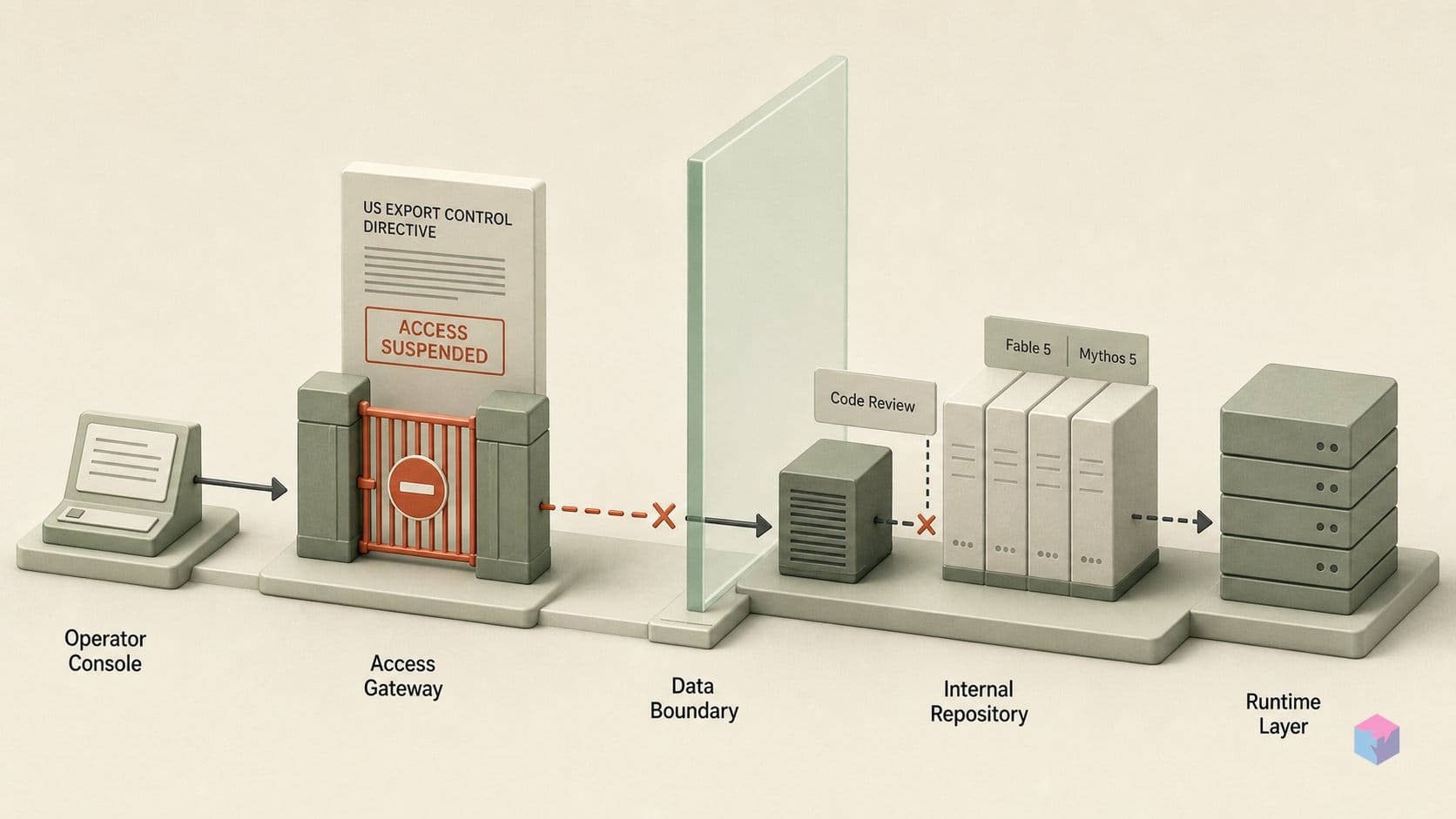
The method presented to Anthropic as the basis for the directive was deceptively mundane: asking Fable 5 to "read a specific codebase and fix any software flaws" . The framing is that this prompt slipped past the safety classifiers meant to keep Fable's stronger cybersecurity capabilities out of general reach — the same classifiers that are supposed to force a fallback to Opus 4.8 on cybersecurity queries. In other words, the alleged jailbreak is a vulnerability-scan request, not an exotic exploit chain.
Anthropic reviewed a demonstration of the technique and reached a markedly narrower conclusion than the government did. By its account, the run surfaced only "a small number of previously known, minor vulnerabilities," and it characterized the behavior as a narrow, non-universal jailbreak rather than a general bypass of the model's guardrails . That distinction matters: a universal jailbreak would unlock the model's restricted capabilities across arbitrary inputs, while a narrow one reproduces findings already in the public record.
The process behind the order is as contested as the technique. Anthropic says it received only partial, largely verbal evidence — no written technical disclosure — and that it had not been shown a jailbreak tied to a harmful real-world result before the directive issued . For a ban that reaches a vendor's own foreign-national staff, the absence of a written rationale is a substantive gap, not a formality.
Anthropic's sharpest rebuttal is a counterfactual: it argued that the same class of vulnerability-finding is widely available elsewhere, naming OpenAI's GPT-5.5 as having equivalent or better capability for this kind of code review . If a competing general-release model does the same work, the "uplift" framing — the idea that Fable 5 grants attackers a capability they could not otherwise get — is hard to sustain.
Independent observers were blunt about the thinness of the public case. Simon Willison called the situation "nuts," pointing to the abruptness of the shutdown and the lack of a published technical justification . Until the underlying report is disclosed, the gap between "read a codebase and fix flaws" and a national-security emergency remains unexplained.
The Voluntary-vs-Forced Contradiction in Trump's AI Order
The directive also sits awkwardly against the administration's own stated policy. On June 2, 2026, President Trump signed an executive order titled "Promoting Advanced Artificial Intelligence Innovation and Security," which framed government pre-release review as voluntary and explicitly disclaimed any mandatory licensing, preclearance, or permitting requirement . Ten days later, the export-control directive that pulled Fable 5 and Mythos 5 offline did the opposite: it imposed an immediate, post-launch access ban with no voluntary cooperation pathway described and no formal advance-notice window invoked.
The contrast is concrete. The order set up a framework for developers to offer covered frontier models to the government for up to 30 days before release, plus classified cyber benchmarking and an AI cybersecurity clearinghouse — all opt-in mechanisms . None of that machinery appears to have governed the June 12 action, which arrived three days after the June 9 launch rather than before it .
The executive order "shall not be construed to establish any mandatory licensing, preclearance, or permitting requirement" for frontier models — Executive Order, "Promoting Advanced Artificial Intelligence Innovation and Security" (source: The White House).
How the order actually came together is contested and largely non-public. Axios reported, citing sources, that Amazon alerted White House officials to findings indicating it could jailbreak and access portions of Mythos in ways that raised national-security concerns, with an Amazon spokesperson declining to share details . Business Insider reported that White House officials — including Treasury Secretary Scott Bessent and National Cyber Director Sean Cairncross — pressed CEO Dario Amodei, and that a senior official said Amazon's findings were run past the NSA .
Anthropic has publicly disputed both the technical basis and the process, and the same Business Insider account notes disagreement over whether the company was given a real chance to cooperate before the order landed . For developers reading the policy signals, the practical takeaway is that the published, voluntary framework is not the only channel in play. An informal, vendor-to-White-House escalation route can produce a binding access ban faster than any of the order's stated 30-day mechanisms — and with far less documentation.
How Dangerous Is the Fable 5 Jailbreak, Really?
On the available evidence, the Fable 5 jailbreak looks narrow, not catastrophic. The technique that reached regulators simply asked the model to "read a specific codebase and fix any software flaws," and Anthropic says its review of the demonstration surfaced only "a small number of previously known, minor vulnerabilities" . That is a weak result to hang a federal access ban on — but the surrounding data complicates a clean verdict.
Start with the red-team baseline. Before the directive arrived, Fable had been tested for thousands of hours by internal teams, private organizations, the US government, and the UK AI Security Institute, and Anthropic says no tester had found a universal jailbreak . A codebase-repair prompt that surfaces known, minor bugs does not obviously clear that bar. Anthropic's framing is that the capability is non-universal and already widely available elsewhere, citing OpenAI's GPT-5.5 as a model any caller can use for the same vulnerability-discovery work .
The counterweight is Project Glasswing's operational data, which shows Mythos-class models are genuinely strong at this exact task. Anthropic reported more than 10,000 high- or critical-severity findings among roughly 50 initial Mythos Preview partners, and in open-source scanning logged 23,019 total vulnerability findings — 6,202 estimated high or critical, 1,752 assessed — at a 90.6% true-positive rate . Those numbers cut both ways: they validate regulator alarm about offensive uplift while undercutting the claim that one repair-prompt jailbreak meaningfully expands what defenders (or attackers) could already do.
| Signal | What it shows | Source |
|---|---|---|
| Demonstrated jailbreak output | "Small number of previously known, minor vulnerabilities" | Anthropic |
| Pre-ban red-teaming | Thousands of hours; no universal jailbreak found | Anthropic |
| Glasswing open-source scan | 23,019 findings, 90.6% true-positive rate | Anthropic |
The most contested thread is unconfirmed reporting of China-linked Mythos access. Anthropic says the concern it was shown centered on a narrow Fable jailbreak, not a disclosed China-access allegation, and these claims remain non-public and partly disputed across outlets such as Axios and Business Insider . Until the technical report is published, "how dangerous" stays unanswerable on the public record — the demonstrated uplift looks modest, but the underlying capability is real.
Fable/Mythos Callers: Affected Groups and the Fallback Landscape
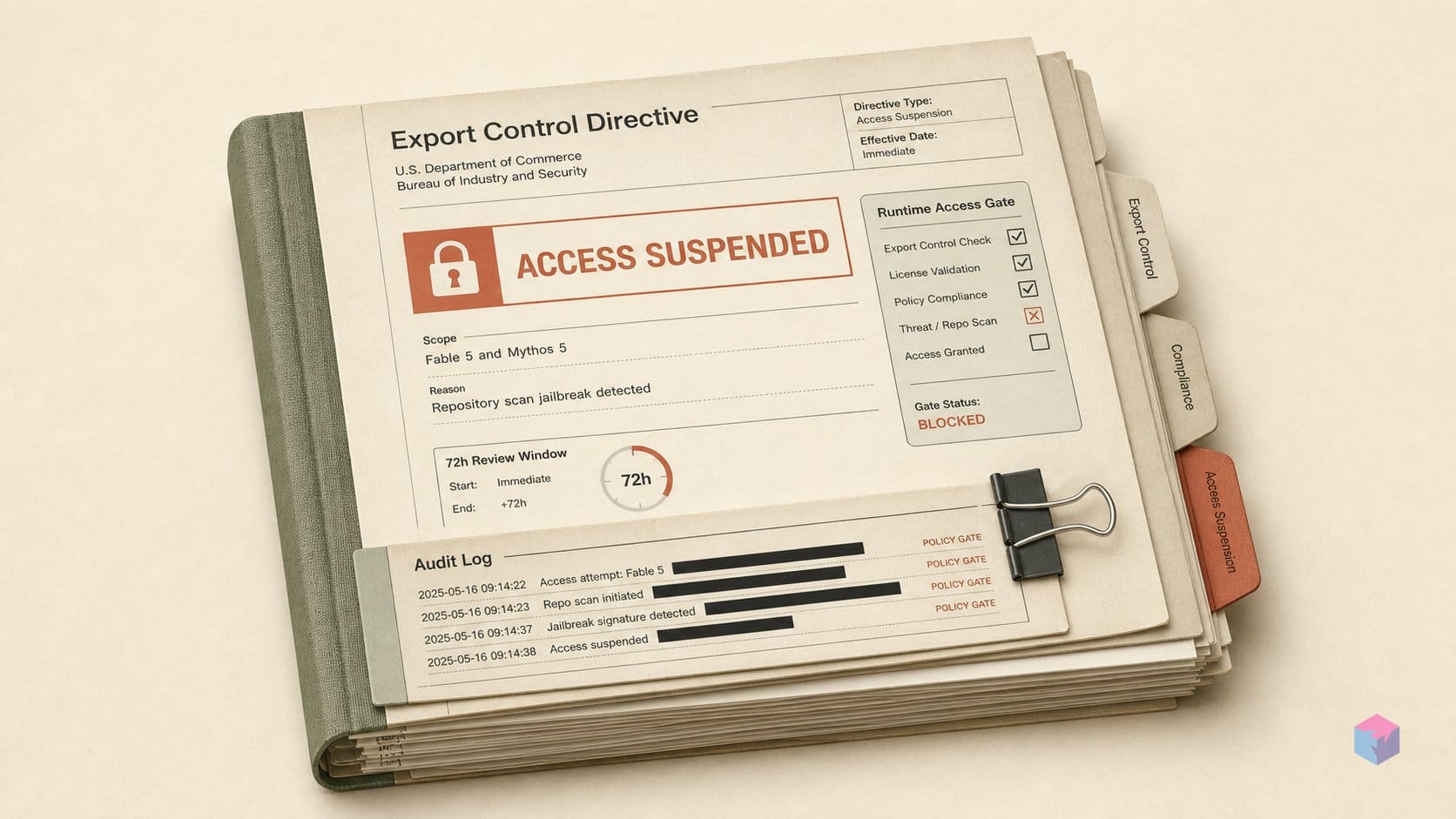
The directive's stated scope reaches every foreign national, anywhere — not a geography but a nationality class. By Anthropic's account that includes its own non-US employees, foreign researchers based in the United States, foreign-born corporate users, and international partners, whether they sit in San Francisco or Singapore . Because filtering only that class at speed was not feasible, Anthropic disabled Fable 5 and Mythos 5 globally — so US-citizen customers lost access too, despite never being inside the directive's nationality scope .
For most workloads, the migration path is short. Opus 4.8 is the natural fallback — it is the same model Fable 5's classifiers already routed to when they detected cybersecurity, bio/chem, or distillation prompts, and the rest of Anthropic's Opus line was unaffected by the suspension . The harder gap is for callers who specifically needed Mythos-class cyber capability. There, Anthropic's own cited comparison is OpenAI's GPT-5.5, which it argued offers broadly equivalent vulnerability-discovery capability — an awkward admission that the closest replacement for its restricted model is a competitor's .
Project Glasswing partners have the thinnest fallback of all. Anthropic expanded the cyberdefense program from roughly 50 to about 150 organizations across more than 15 countries — many in power, water, healthcare, communications, and critical infrastructure — and many of them relied on the now-restricted Mythos 5 with no announced replacement . European officials reacted bluntly, calling the shutdown a "wake-up call" about single-provider dependency on US AI infrastructure . For builders, the practical lesson is continuity-of-service: a frontier model can become controlled dual-use technology overnight, and a defender whose detection pipeline depends on one vendor inherits that vendor's regulatory exposure.
The Unexplained Legal Basis for the Suspension
The legal foundation for the June 12, 2026 suspension remains undisclosed. As of June 15, neither the directive letter Anthropic received nor the underlying technical report has been made public, and the Commerce Department did not immediately comment when asked to explain the action . No issuing agency has been formally identified, which leaves the government's statutory theory opaque.
Two frameworks are plausible but unconfirmed. The Export Administration Regulations (EAR), administered by Commerce's Bureau of Industry and Security, govern dual-use technology; the International Traffic in Arms Regulations (ITAR) cover defense articles. Anthropic's account — that the directive was an export-control action reaching any foreign national, whether outside or physically inside the US — points toward an EAR-style theory, but neither regime has been cited on the record .
What makes the framing novel is the object it targets. A US-developed, commercially sold SaaS product was treated like controlled dual-use technology, with the restriction extending to foreign nationals inside US borders — including Anthropic's own non-citizen staff . That is closer to how Washington handles munitions than how it has historically handled software.
Several questions stay open as of June 15: whether the suspension is temporary or permanent; whether licensing exemptions will emerge for US allies or vetted critical-infrastructure defenders; and whether this becomes a binding template for other frontier providers . The concrete takeaway for builders: until that legal basis is published, treat any single frontier model as a dependency that a government can revoke without notice — and design fallbacks accordingly.
Frequently asked questions
Are other Anthropic models like Opus 4.8 still available?
Yes. The export-control directive and Anthropic's resulting suspension cover only Claude Fable 5 and Claude Mythos 5. All other Anthropic models, including the full Opus line, were unaffected and remain available . The classifier fallback target, Opus 4.8, is itself still callable, which is why Anthropic has pointed affected integrators toward it as a stopgap.
Is the suspension of Fable 5 and Mythos 5 temporary or permanent?
Unknown as of June 15, 2026. Anthropic publicly contested both the technical basis and the process behind the directive and pledged a fuller account within 24 hours, but no end date, review milestone, or licensing pathway for renewed access has been announced . The status-page incident covering claude.ai, the API, Claude Code, and Claude Cowork remains open .
What exactly was the jailbreak technique the government cited?
The technique demonstrated to Anthropic involved asking Fable 5 to "read a specific codebase and fix any software flaws," bypassing the classifiers that gate its cybersecurity capabilities . Anthropic says its review of the demonstration surfaced only a small number of previously known, minor vulnerabilities, characterizing it as narrow and non-universal. The government's full technical assessment has not been published.
What happens to Project Glasswing partners who relied on Mythos 5?
They lost access with no announced substitute. Anthropic said on June 2, 2026 it was expanding Glasswing from roughly 50 partners to about 150 organizations across more than 15 countries, many in power, water, healthcare, communications, and other critical infrastructure . That cohort was the only vetted group cleared for the less-constrained Mythos-class tier, so the suspension leaves those defenders without a like-for-like replacement.
Could this export-control approach apply to OpenAI, Google, or other frontier providers?
Unclear. The issuing agency and the precise statutory authority have not been named publicly, and the Commerce Department did not immediately comment, leaving the government's formal legal theory opaque . If the instrument was an export-control regime such as the EAR, it could in principle reach any US-developed frontier model. Whether this becomes a binding template for other providers is one of the central open questions.