
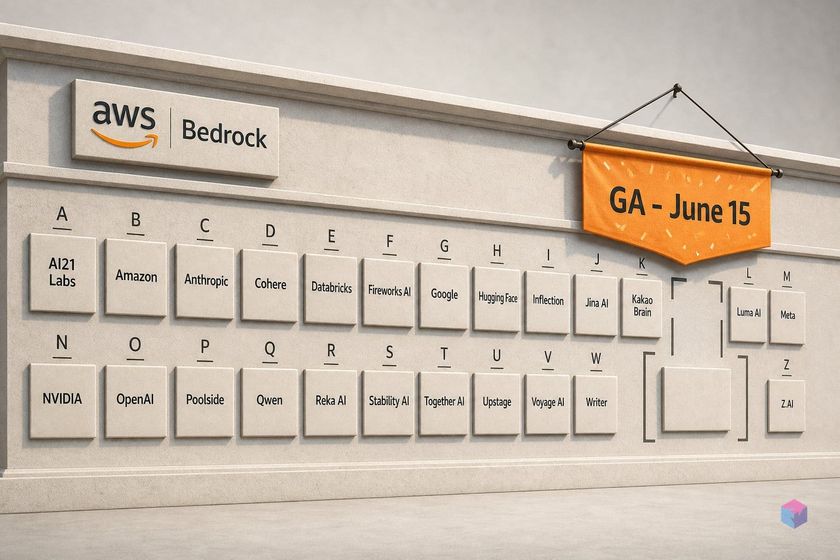
An AWS "What's New" post says Grok 4.3 went generally available on Amazon Bedrock on June 15, 2026. Open the Bedrock model catalog three days later and there is no xAI provider to be found.
Grok 4.3 on Bedrock: Reported GA vs. What the Console Shows
Grok 4.3 on Amazon Bedrock is, as of June 18, 2026, a reported general-availability launch that the live AWS console does not yet confirm. An AWS "What's New" post dated June 15, 2026 announces GA , and a matching model card for xai-grok-4-3 exists on docs.aws.amazon.com . But a direct check of Bedrock's own catalog and pricing surfaces tells a different story — so treat the launch as reported, not confirmed, and verify it in your own account before writing integration code.
Quick Answer: An AWS "What's New" post and a model card claim Grok 4.3 is GA on Bedrock as of June 15, 2026, but a June 18 check of Bedrock's official model catalog lists no xAI provider — its lineup runs from AI21 Labs to Z.AI with no Grok entry — and the pricing page has no xAI line item. Confirm in your own Bedrock console first.
The contradiction is concrete. Bedrock's official model catalog enumerates its providers alphabetically — AI21 Labs, Amazon, Anthropic, Cohere, DeepSeek, Google, Meta, MiniMax, Mistral, NVIDIA, OpenAI, Qwen, Stability, TwelveLabs, Writer, through Z.AI — and contains no xAI or Grok entry . The Bedrock pricing page carries no xAI or Grok provider section and no per-token line item for the model . A GA model that does not appear in the catalog you would select it from, and carries no published price, is not something to build a production path against on faith.
xAI's own signals do not close the gap. Its release notes through June 15, 2026 describe direct-platform changes — Priority Processing, Public URLs and the Files API, and the Grok Build 0.1 early-access model — but make no mention of AWS distribution at all . A vendor shipping a model to a hyperscaler partner usually says so in its changelog; the silence here is a data point, not proof either way.
The skeptical framing predates the reported launch. The Register reported in late May 2026 that AWS planned to add Grok to Bedrock under unusual circumstances:
"AWS reportedly to tuck Elon Musk's Grok into Bedrock despite zero enterprise demand," — The Register, reporting on the planned addition (source: The Register).
That single-sourced reporting is unverified against primary AWS material, and we revisit how much of it holds up later in this guide. For now the practical takeaway is narrow: the documentation says GA, the console says no provider, and only your own account settles it. Open the Bedrock model access page in your target region and check for an xai.grok-4.3 entry before you commit any client code . The rest of this guide treats the Bedrock details as reported-and-unconfirmed, and the xAI direct API — which both research passes confirm is live — as the firm baseline.
Mantle: The Separate AWS Runtime That Bypasses Bedrock Converse
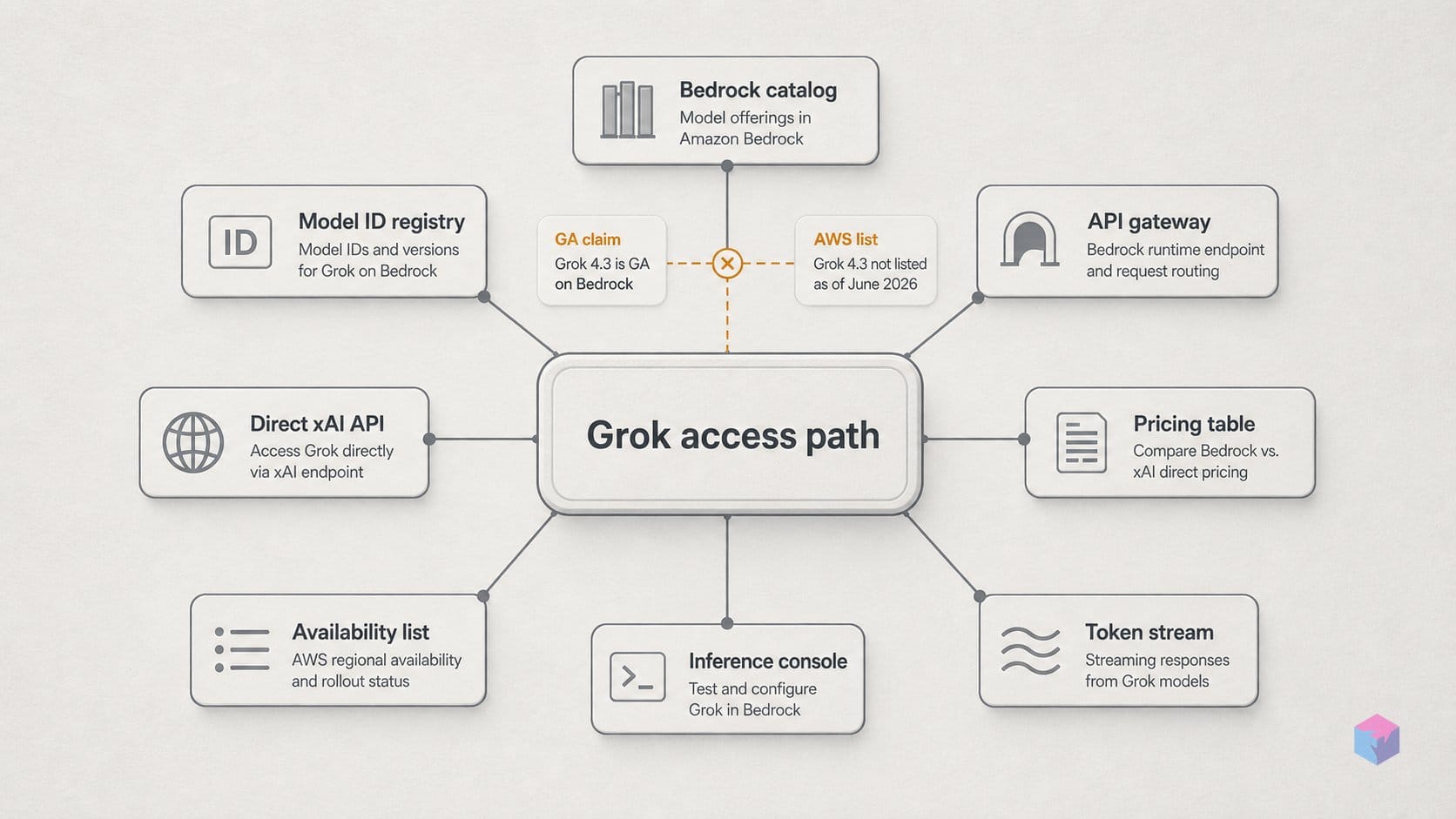
Mantle is a new AWS inference engine that, per the reported launch, serves Grok 4.3 entirely outside the standard Bedrock runtime. It is described as a price-performance-optimized engine that speaks OpenAI-compatible APIs rather than Amazon's own protocols . The practical consequence: your existing bedrock-runtime boto3 client cannot reach Grok 4.3, and the Converse API you may use to normalize calls across Anthropic, Meta, and Mistral models does not apply here.
Instead, the model card describes a dedicated endpoint pattern: https://bedrock-mantle.{region}.api.aws/openai/v1 — for example, us-west-2 — exposing OpenAI Chat Completions and a Responses API, with the responses path at openai/v1/responses . There is no InvokeModel call and no Converse support. If you have built tooling around Bedrock's unified message schema, none of it carries over; Mantle is a parallel surface that happens to live under an api.aws hostname.
Authentication also diverges from the rest of Bedrock. Mantle uses a long-term Bedrock API key passed as a bearer token, not IAM SigV4 request signing . That is convenient if you are coming from the OpenAI SDK — you set a base URL and a key — but it means the SigV4 credential-rotation and role-assumption patterns most AWS teams standardize on do not directly govern these calls. The engine does support tool calling, structured output, and response streaming, so the OpenAI-style feature set is reportedly intact .
The service-tier and region constraints are where Mantle's early-stage nature shows. Three tiers are reported — Standard, Priority, and Flex — while Reserved is not supported . Priority is billed at roughly a 2× premium over the standard text rate, mirroring xAI's own Priority Processing surcharge. Cross-region (Geo/Global) inference is listed as not supported, and the reported launch region is us-west-2 (Oregon) only .
- Runtime: Mantle, not
bedrock-runtime; no boto3 Converse client. - Endpoint:
https://bedrock-mantle.{region}.api.aws/openai/v1— Chat Completions and Responses only. - Auth: long-term Bedrock API key (bearer), not IAM SigV4.
- Tiers: Standard, Priority (~2×), Flex; Reserved unsupported.
- Region:
us-west-2only; no cross-region inference.
For a developer, the takeaway is that "Grok on Bedrock," if it ships as described, is less a new model in the catalog and more a separate OpenAI-compatible gateway wearing AWS billing and access controls. Plan integration as a distinct client, not a one-line addition to existing Bedrock code.
Grok 4.3 Model IDs, Regions, and the Encrypted Thinking Block
The model identifier you pass differs by surface: on xAI direct it is grok-4.3, while the reported Bedrock listing exposes it as xai.grok-4.3 . The xAI native surface also accepts the aliases grok-4.3-latest and grok-latest, plus legacy aliases for Grok 3, 4, and 4.1-Fast, so existing code pinned to a moving alias keeps resolving to the current default model . If you target Bedrock, hardcode the dotted xai.grok-4.3 form — the alias shorthands are an xAI-platform convenience and are not described on the AWS model card.
Both surfaces share the same core shape: a 1,000,000-token context window, text and image input, and text-only output . On the xAI direct API the model runs in us-east-1 with throughput limits of 1,800 requests per minute and 10,000,000 tokens per minute . The reported Bedrock deployment, by contrast, launches in us-west-2 (Oregon) only, with cross-region (Geo/Global) inference listed as unsupported .
| Attribute | xAI direct | Reported Bedrock (Mantle) |
|---|---|---|
| Model ID | grok-4.3 (+ aliases) | xai.grok-4.3 |
| Region | us-east-1 | us-west-2 only |
| Context window | 1,000,000 tokens | 1,000,000 tokens |
| I/O | text + image in, text out | text + image in, text out |
| Throughput | 1,800 RPM / 10M TPM | not published on model card |
Reasoning is always active on Grok 4.3 and cannot be switched off, only tuned. Effort is set through a reasoning parameter accepting none, low (the default), medium, or high . The detail that bites developers is where the thinking goes on Bedrock: reasoning content is encrypted and is retrievable only through the Responses API by passing include: ["reasoning.encrypted_content"]. The Chat Completions path does not surface it at all .
Practically, that means if you build against the Mantle gateway's Chat Completions endpoint to mirror an existing OpenAI-style client, you forfeit visibility into the model's reasoning trace entirely — and even via the Responses API the block is encrypted, not human-readable. Teams that rely on inspecting chain-of-thought for evaluation or debugging should route through Responses and treat the encrypted payload as an opaque round-trip token, not a transcript.
Grok 4.3 Pricing: What xAI Charges and What Bedrock Might Add
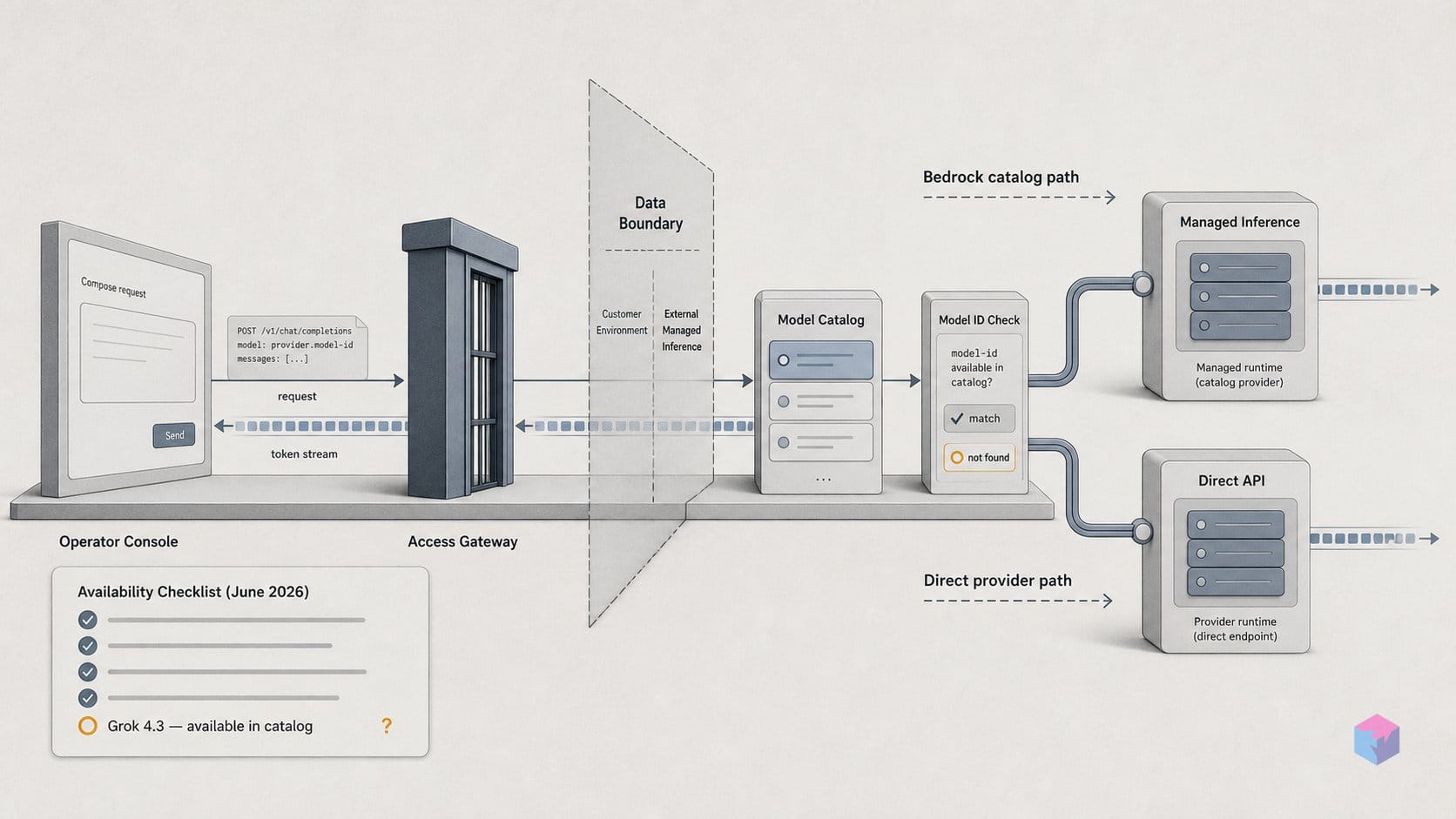
Cost is the one part of this story with a firm baseline: xAI's direct pricing is published and current. Grok 4.3 on the native API runs $1.25 per 1M input tokens, $0.20 per 1M cached input tokens, and $2.50 per 1M output tokens, on a pricing page last updated June 12, 2026. Secondary reporting on the Bedrock listing claims identical per-token rates — no AWS markup — but AWS publishes no xAI or Grok line item on its Bedrock pricing page, so price parity is reported, not verifiable. Treat the xAI direct rate as the only number you can build a budget on today.
Quick Answer: Grok 4.3 costs $1.25/1M input, $0.20/1M cached, and $2.50/1M output via xAI's direct API (updated June 12, 2026). Bedrock is reported at the same rates with no AWS markup, but AWS's pricing page lists no Grok entry — so any Bedrock cost remains unconfirmed.
The headline token rate is also not the whole bill. Agentic tool invocations are billed separately on top of token usage, and they add up fast on search-heavy workloads:
| Item | Rate (xAI direct) |
|---|---|
| Input tokens (Grok 4.3) | $1.25 / 1M |
| Cached input tokens | $0.20 / 1M |
| Output tokens | $2.50 / 1M |
| Web Search / X Search / Code Execution | $5 / 1,000 calls |
| Attachment Search | $10 / 1,000 calls |
| Collections Search | $2.50 / 1,000 calls |
| grok-build-0.1 (coding, 256K context) | $1.00 / $0.20 / $2.00 per 1M |
So a pipeline that fires Web Search, X Search, or Code Execution at $5 per 1,000 calls, Attachment Search at $10 per 1,000, and Collections Search at $2.50 per 1,000 can see its tool surcharge rival its token spend. Budget for tool calls as a first-class line, not a rounding error.
Two levers move the effective rate in opposite directions. The Batch API runs 20%–50% below standard rates for latency-tolerant jobs, while Priority Processing applies a 2× multiplier over standard text rates for lower-latency throughput. For coding-specific work, grok-build-0.1 prices at $1.00/$0.20/$2.00 per 1M tokens with a 256K-token context — cheaper than Grok 4.3 but with a smaller window and early-access status.
The practical takeaway for cost modeling: if the Bedrock listing is real and matches xAI rates, the decision becomes a governance-versus-simplicity question, not a price one. You would pay the same per token but gain AWS IAM, consolidated billing, and Bedrock-side controls — features that justify the integration work only if you already standardize on AWS. Until AWS's Bedrock pricing page shows a Grok line, model your costs against xAI's published rates and treat the reported Bedrock parity as a planning assumption to confirm, not a committed price.
Switching from xAI Native to Mantle: What Your Client Config Needs
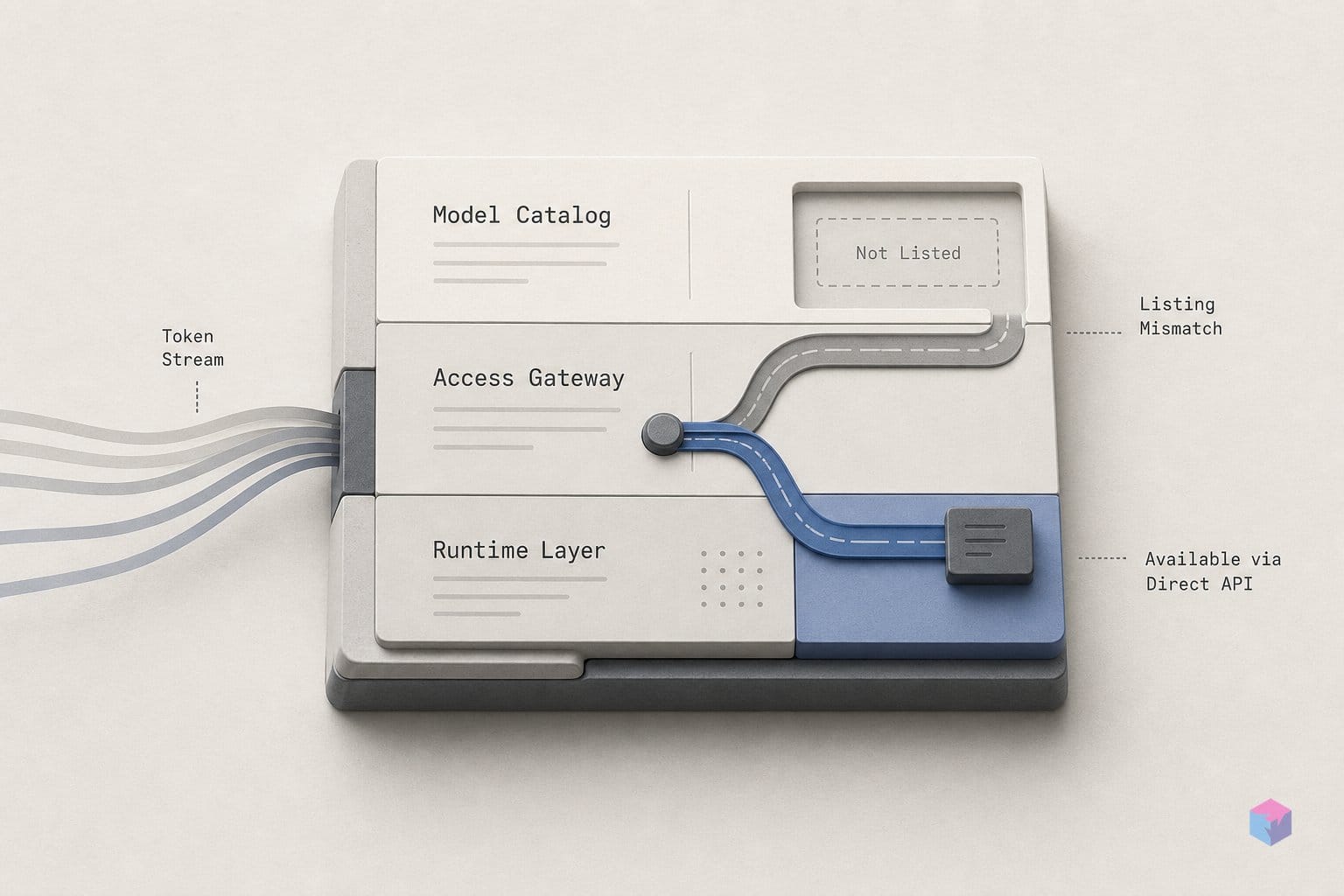
If the reported Bedrock listing is real, moving an existing xAI-native integration to Mantle is a three-line config change, not a rewrite — both surfaces speak OpenAI-compatible Chat Completions and Responses APIs, so your request bodies stay the same. You swap the base URL, swap the credential, and rename the model. The reported migration path: point OPENAI_BASE_URL from https://api.x.ai/v1 to https://bedrock-mantle.us-west-2.api.aws/openai/v1 , replace the xAI Authorization: Bearer key with a long-term Bedrock API key, and change the model field from grok-4.3 to xai.grok-4.3 .
# xAI native
export OPENAI_BASE_URL="https://api.x.ai/v1"
export OPENAI_API_KEY="<xAI key>"
# model="grok-4.3"

# Reported Mantle endpoint (us-west-2 only)
export OPENAI_BASE_URL="https://bedrock-mantle.us-west-2.api.aws/openai/v1"
export OPENAI_API_KEY="<long-term Bedrock API key>"
# model="xai.grok-4.3"
The trap is not the endpoint — it is default parameter drift. Mantle reportedly diverges from OpenAI's published spec, setting temperature to 0.7, top_p to 0.95, and max_completion_tokens to 131,072 by default . If your app relied on the OpenAI SDK's defaults and never set these explicitly, your outputs will shift the moment you switch base URLs — more sampling variance and a different completion cap than you tuned against. Set temperature, top_p, and your token ceiling explicitly in every request so behavior is identical across both surfaces. This matters most for deterministic pipelines and eval harnesses, where a silent move from 0.0 to 0.7 quietly invalidates your regression baseline.
One capability gap blocks a clean swap: not every xAI model has a Bedrock equivalent. The reported model card lists only xai.grok-4.3. The coding-oriented grok-build-0.1 (aliases grok-code-fast-1, grok-code-fast) and the legacy Grok 3/4/4.1-Fast aliases remain xAI-direct only, with no Mantle counterpart documented . If your stack routes coding tasks to grok-build-0.1 at its $1.00/$0.20/$2.00 per 1M token rate , you cannot consolidate that traffic onto Bedrock — you would run a hybrid setup, keeping the xAI key live for coding and pointing only general inference at Mantle. Note too that aliases like grok-4.3-latest and grok-latest are xAI-direct conveniences ; pin the exact xai.grok-4.3 ID on Bedrock rather than assuming alias resolution carries over.
Bottom line: budget the migration as a config swap plus a parameter audit, not an SDK change — and verify xai.grok-4.3 actually appears in your Bedrock console before you cut any traffic over.
What The Register Got Wrong About Why AWS Added Grok
The framing, not the facts, is where the early coverage slipped. The Register's May 29, 2026 report led with the line that AWS planned to add Grok "despite zero enterprise demand" — but demand was never the structural story. The structural story is Mantle: a standalone, OpenAI-compatible inference runtime on AWS infrastructure that can host non-native models, of which Grok 4.3 is the first publicly attached case rather than the point of the exercise.
"AWS reportedly to tuck Elon Musk's Grok into Bedrock despite zero enterprise demand," — The Register, May 29, 2026 (source: The Register).
Two things undercut the demand angle. First, Business Insider reported on May 28, 2026 that the models had reportedly already been shipped to AWS infrastructure while AWS was still "in talks," with timing unclear . Procurement and provisioning preceded any public demand signal — so "no demand" describes the market's reaction, not the decision that drove it. Second, building a dedicated OpenAI-compatible path that bypasses the Bedrock Converse API is a large amount of platform work to do for a single third-party model. A separate `bedrock-mantle` endpoint speaking Chat Completions and Responses is the kind of surface you stand up when you intend to host several external models, not one.
Read that way, "zero enterprise demand" is a weak critique. Both the Business Insider and Register pieces were secondary, single-sourced, and unverified against primary AWS material — and at least one researcher could not even retrieve the Register article body . The more useful frame is platform strategy: Mantle looks positioned as a general third-party inference lane, with Grok as its launch tenant.
The operative risk for builders isn't whether other teams want Grok — it's that anything served through Mantle sits outside the standard Bedrock runtime. That means the Converse API, cross-region inference, and the governance, audit-logging, and guardrail tooling many enterprise workloads assume may not apply on the `bedrock-mantle` path the way they do on `bedrock-runtime`. If your compliance posture depends on those controls, treat Mantle as a different surface that happens to share AWS billing and IAM, not as a drop-in Bedrock model.
Concrete takeaway: ignore the demand narrative, and evaluate Mantle on governance fit. Confirm `xai.grok-4.3` actually appears in your own Bedrock console, then verify which guardrail, logging, and region controls carry over before you route regulated traffic through it. Until that check passes, the firm baseline remains xAI's direct OpenAI-compatible API.
Frequently asked questions
What is the model ID for Grok 4.3 on Amazon Bedrock?
The reported Bedrock model ID is xai.grok-4.3, served on the Mantle endpoint in the us-west-2 (Oregon) region — distinct from the xAI direct ID grok-4.3 . Treat this as unconfirmed: a live check on June 18, 2026 found no xAI provider entry in Bedrock's official model catalog . Confirm the ID resolves in your own Bedrock console before referencing it in code.
Does Grok on Bedrock support the Converse API?
No. Per the reported model card, Grok runs on AWS's separate "Mantle" inference engine, which exposes an OpenAI-compatible Chat Completions and Responses surface at https://bedrock-mantle.{region}.api.aws/openai/v1 — not the standard Bedrock Converse API or the bedrock-runtime boto3 client . You integrate it with the OpenAI Python SDK by setting OPENAI_BASE_URL to the Mantle endpoint, not by calling existing Bedrock model abstractions.
How does Grok 4.3 pricing compare on xAI direct vs. Amazon Bedrock?
xAI direct charges $1.25 per 1M input tokens, $0.20 per 1M cached input, and $2.50 per 1M output, last confirmed on the xAI pricing page June 12, 2026 . Secondary reporting puts Bedrock at identical rates, implying price parity, but AWS's official Bedrock pricing page carries no xAI or Grok line item as of June 18, 2026 . Any Bedrock markup is therefore unverifiable; the firm baseline is xAI direct.
Which AWS regions support Grok 4.3 on Bedrock?
The model card reports a single launch region, us-west-2 (Oregon), with cross-region (Geo/Global) inference not supported . For comparison, the xAI direct API operates from us-east-1 with rate limits of 1,800 requests per minute and 10,000,000 tokens per minute . If you need multi-region failover today, neither surface offers it through a single Grok endpoint.
Is Grok 4.3 actually available on Amazon Bedrock right now?
It is contested. AWS published a "What's New" post and a model card dated June 15, 2026 announcing Grok 4.3 as generally available on Bedrock . However, a live check on June 18, 2026 found no xAI entry in Bedrock's provider catalog and no Grok line item on the pricing page . Until your own Bedrock console shows xai.grok-4.3, treat the GA as reported but unconfirmed and build against xAI's direct API.