
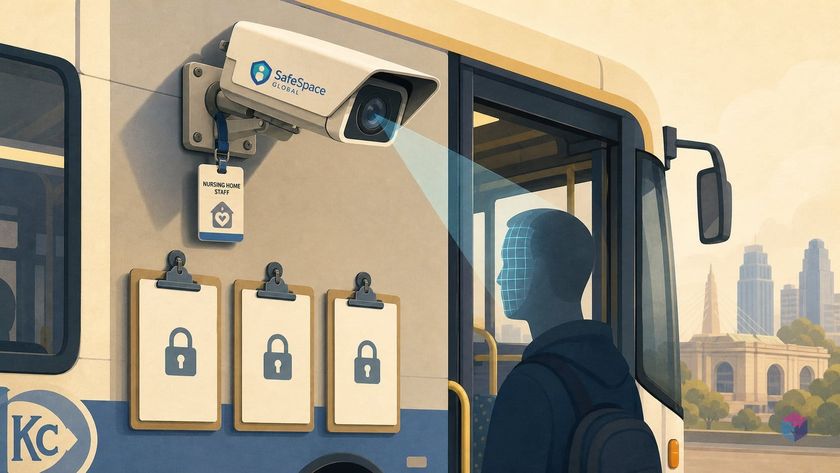
From CCTV to biometric scanning: the Kansas City bus camera upgrade
The change in Kansas City is not cameras on buses — it is real-time biometric matching. The Kansas City Area Transportation Authority (KCATA), which runs the RideKC network, already records every bus, but the planned upgrade would scan riders' faces live and check them against active watch lists . That shift — from passive footage to face-to-list matching — is what turned a routine hardware refresh into a national test case.
The system, built by SafeSpace Global, would match faces against three categories of active alerts:
- Banned riders — people barred from the transit system.
- Missing persons — alerts that could flag someone for assistance.
- Law-enforcement subjects — watch-list names designated by the transit authority .
On top of that list-matching, the plan layers AI-assisted behavioral analysis. Reporting describes up to five AI cameras added per bus beyond the existing onboard surveillance, though that camera count traces to coverage rather than a published contract . So the bus becomes both a face scanner and a movement/behavior sensor — two distinct surveillance functions on one vehicle.
Scope is still moving. The deployment was originally scoped as a nine-bus pilot, but KCATA chief mobility and strategy officer Tyler Means told the Associated Press that a 2026 launch could be "a little bit bigger" — potentially as many as 30 buses .
| Dimension | Before | Planned change |
|---|---|---|
| Camera function | Recording / archive | Live biometric matching + behavior analysis |
| Watch-list check | None | Banned riders, missing persons, law-enforcement subjects |
| Cameras per bus | Existing surveillance | Up to 5 additional AI cameras |
| Fleet scope | — | 9-bus pilot → up to 30 buses |
The deeper issue is consent. SafeSpace's technology was first deployed in nursing homes, then in correctional facilities and schools, all settings with defined populations and house rules . A public bus is different: riders generally cannot meaningfully opt out, so the same software lands in a context where the people being scanned never agreed to it — and often have no other way to get where they are going.
SafeSpace Global: from dementia ward alerts to transit biometrics
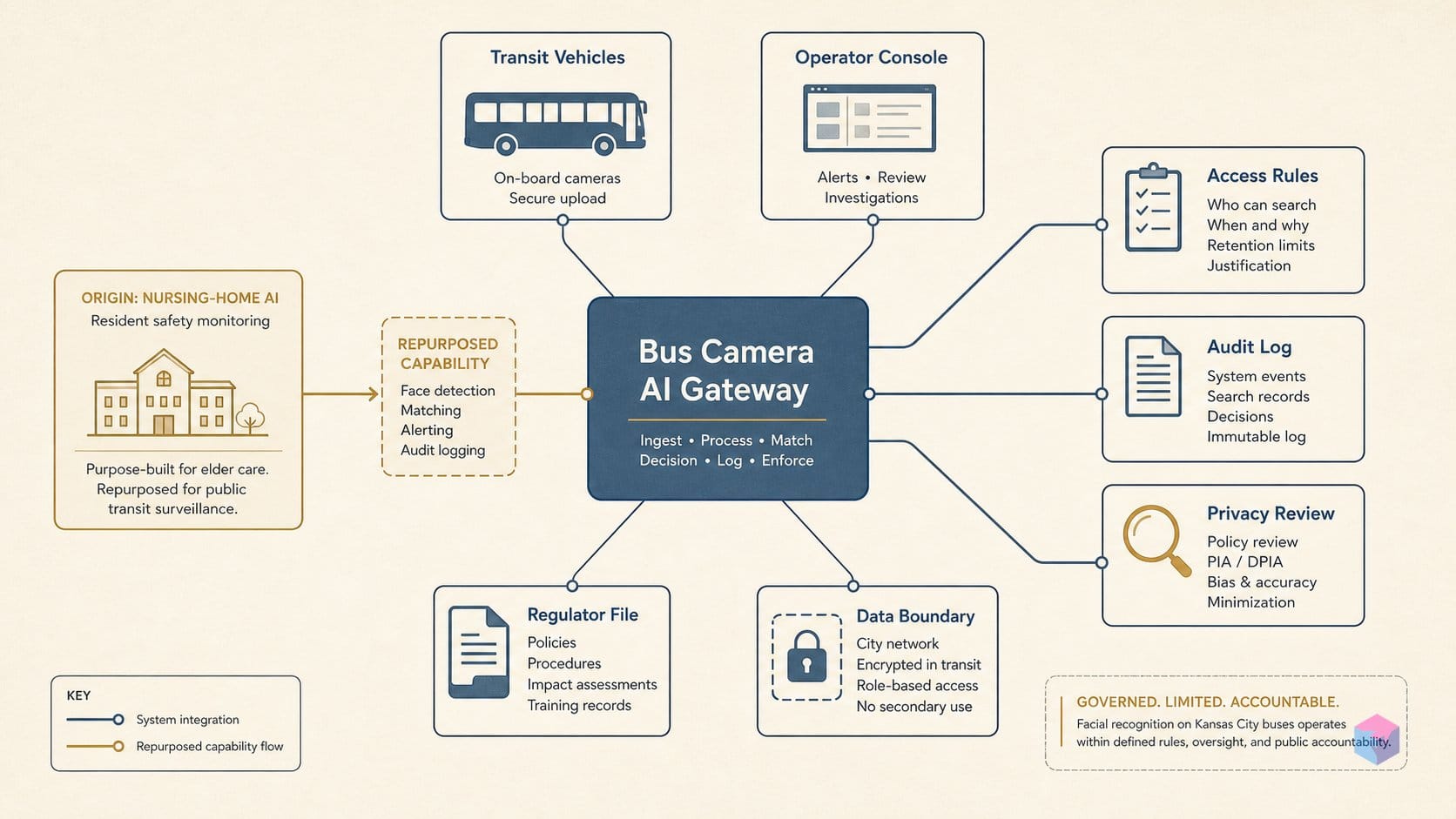
SafeSpace Global is a Knoxville, Tennessee company whose facial-recognition and AI behavioral-monitoring systems began as a tool to alert nursing-home staff when residents with dementia wandered off . That origin matters: a memory-care ward is a closed, consented, supervised environment with a known resident roster. The same matching engine is now headed for a moving public bus, where the people in frame are anonymous, unwarned, and effectively unable to decline.
The product traveled through institutions before reaching transit. According to Associated Press reporting, SafeSpace expanded from nursing homes into correctional facilities and then schools — each a setting with a defined population, an enrollment process, and explicit house rules . Kansas City buses would be the company's first public-transit client, making the RideKC pilot a genuine sector debut rather than another deployment in a familiar institutional pattern.
That distinction is why both supporters and critics treat the project as a litmus test. Prisons and schools control who enters; a bus stop does not. The technical task is similar, but the consent model collapses.
On timing, the company says it is ready when the money is. SafeSpace CEO Scott Boruff told AP that installation could begin once funding arrives, but that configuring the software for Kansas City's specific environment would take roughly three to four months .
"We've always had cameras on our buses. It's just new technology," — Tyler Means, chief mobility and strategy officer at KCATA (source: Associated Press).
Means's framing captures the supporter case — incremental upgrade, not new surveillance. But it sidesteps what changes when the vendor's institutional track record meets an open system. SafeSpace's prior deployments share three features absent on a city bus:
- Defined population — residents, inmates, and students are enrolled and known; transit riders are not.
- Notice and rules — institutional settings post policies and conditions of entry; a bus rider receives neither.
- Ability to decline — even constrained, institutional subjects exist inside a governed framework; riders generally cannot meaningfully opt out and often have no alternative route.
None of the company's earlier environments tested face matching against a watch list of anonymous strangers in motion. That is the unproven variable Kansas City would be the first to run in production, and it is the gap between SafeSpace's résumé and the system it is being asked to build.
NIST's 10–100× error differential on bus-style FR: who gets flagged most
The largest independent test of face-recognition accuracy says the errors are not evenly distributed. In its 2019 demographic-effects study, the U.S. National Institute of Standards and Technology evaluated 189 algorithms from 99 developers against 18.27 million images of 8.49 million people . A majority showed demographic differentials, and the highest error rates landed on the faces KCATA's watch lists would scan most.
Two matching modes matter here, and they fail differently. KCATA's plan checks a live face against a list of named subjects — that is one-to-many (identification) matching, the harder mode. NIST's results map directly onto it.
| Matching mode | What it does | NIST 2019 finding | Relevance to KCATA |
|---|---|---|---|
| One-to-one (verification) | Confirms a face matches a single claimed identity | False positives for Asian and African American faces ran 10–100× higher than for Caucasian faces, depending on the algorithm | Indirect — KCATA is not verifying claimed identities |
| One-to-many (identification) | Searches a face against a watch list of many subjects | Higher false-positive rates for African American females in an FBI mugshot database test | Direct — this is exactly how watch-list matching works on a bus |
The one-to-many result is the one to weigh. NIST tested algorithms against an operational FBI mugshot database and found African American women drew more false positives than other groups . A false positive in this mode means an innocent rider gets surfaced as a watch-list hit — the exact failure that triggers a stop, a flag, or an officer's attention.
The one-to-one figures show how wide the spread between algorithms can be. The 10–100× range is not a single number; it depends entirely on which model a deployment picks . Some algorithms in the test were far more balanced than others. That makes the vendor's specific model — and its published score — the decisive variable, not face recognition in the abstract.
That is where the Kansas City record goes quiet. SafeSpace Global has not published an FRVT score for the algorithm it would run on RideKC buses, and no KCATA-commissioned independent accuracy evaluation has appeared in any indexed source as of June 2026 . Without an FRVT number, there is no way to place SafeSpace's system on the 10–100× curve — whether it sits near the balanced end or the worst.
Civil-liberties analysts treat that gap as the core risk. Jay Stanley, senior policy analyst with the ACLU's Project on Speech, Privacy and Technology, warned that pointing face recognition at live public spaces "is a line that until recently has never really been crossed in the last 25 years," and that watch lists can expand over time . On a transit system where riders cannot opt out, an undisclosed error rate is not a footnote — it is the part of the system most likely to misfire on the people who ride the bus.
What gets kept vs. purged when a no-match comes back
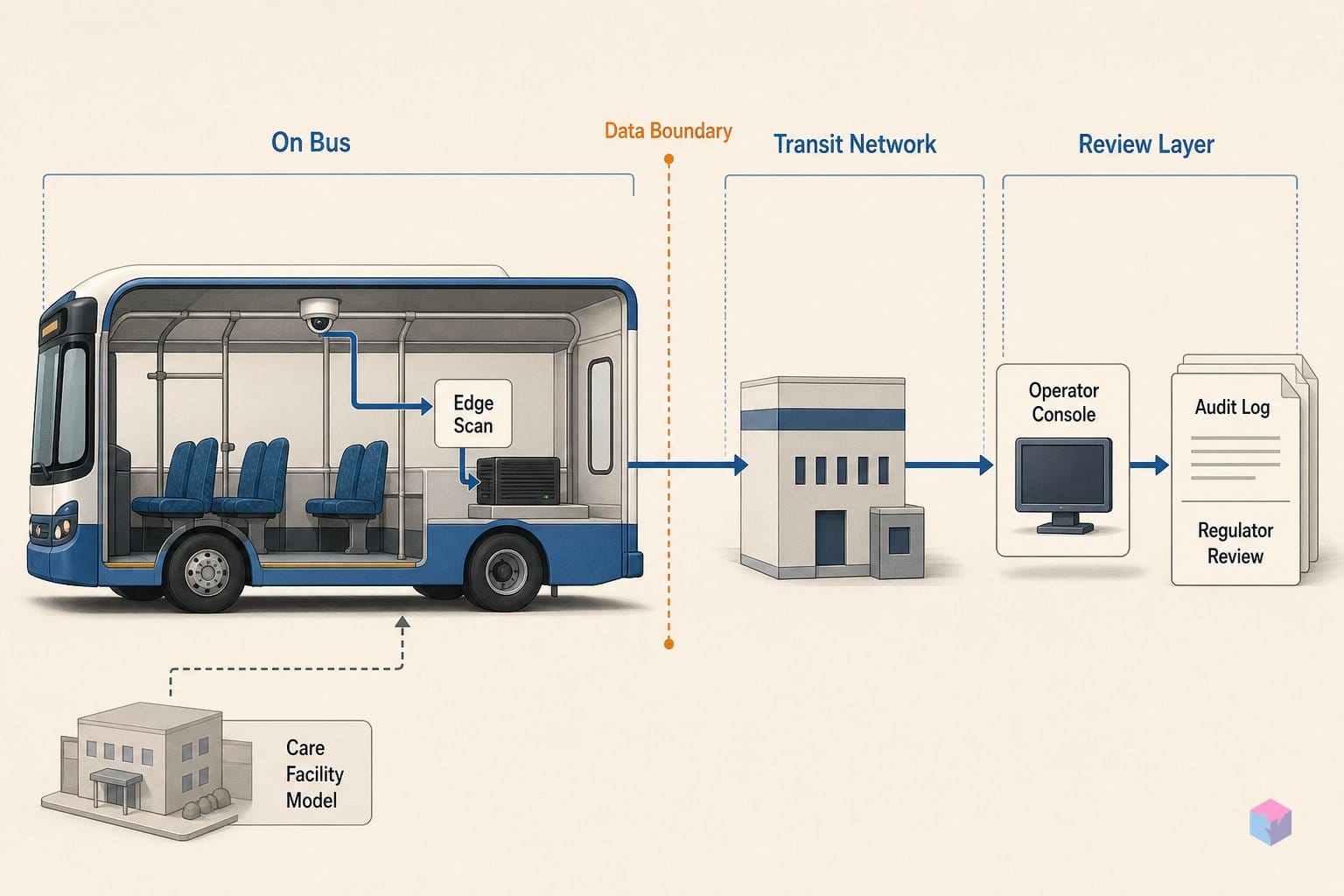
When the system scans a face and finds no match, SafeSpace says the biometric template is discarded almost immediately — no persistent face database accumulates for ordinary RideKC riders. CEO Scott Boruff told the Associated Press that face data is dropped quickly absent a match or safety event . The catch: that promise covers only the live matching layer, not the video the buses already record.
Two retention regimes run in parallel here, and conflating them is where the debate gets muddy:
- Real-time biometric templates — generated per scan, compared against the watch lists, then discarded when there is no hit. No template store builds up for non-flagged passengers .
- Ordinary bus video footage — unchanged by the FR project. KCATA archives standard onboard video on local servers and retains it for up to five years after buses return to the depot .
That five-year archive is what worries critics. The "discard" guarantee applies to the ephemeral template, not to the raw video those templates were derived from. A multi-year store of pixel data is, in principle, re-processable: point a future software build at the same footage and you can run biometric matching retroactively against faces that were never flagged the first time. The deletion claim constrains the present pipeline, not what stored video can be made to yield later.
This is the mission-creep worry in concrete form. The technical capability to re-scan archived video does not depend on a new camera install — only on a software upgrade and a policy decision, neither of which is locked down. As Biometric Update noted in covering the stalled rollout, the camera count and configuration trace to reporting rather than a published contract — meaning the boundaries are described, not bound.
What is missing is the documentation that would let anyone verify any of this. As of late June 2026, no published retention schedule, no contractual limit on re-processing, and no independent audit of the discard claim has surfaced in indexed records . The strongest assurance on the table is a vendor's word relayed through an AP interview — not a privacy impact assessment, not a board-adopted data-handling policy, and not a third-party test of whether templates are in fact destroyed on a no-match. For a system that processes every rider by default, "we delete what doesn't match" is a claim that has not yet been made auditable.
Why Missouri rejected the FR funding — and what Kansas City did instead
The clearest official opposition to the project came from the State of Missouri, which declined expected pilot funding specifically over the facial-recognition component . KCATA itself cites that decision, making it the most concrete on-record pushback — not from an advocacy group, but from the level of government expected to help pay for it.
That funding gap is one of two reasons the rollout stalled. KCATA chief mobility and strategy officer Tyler Means told the Associated Press the delay was partly technical and partly financial . On the technical side, buses needed upgraded Wi-Fi routers to run the new cameras and a new fare-collection system at the same time.
The original plan had a hard deadline. KCATA aimed to install cameras in spring 2026 so the system would be operational before Kansas City hosted FIFA World Cup 2026 matches beginning in June . The biometric layer was meant to be a security upgrade timed to a global event drawing crowds onto the RideKC network.
With the cameras halted, KCATA fell back on staffing instead of software. The interim plan covered the World Cup window with people, not biometric matching:
- Personnel substitution: up to 40 additional officers patrolling stops and transit centers , filling the security gap the cameras were supposed to address.
- New funding hunt: after Missouri's refusal, the city is pursuing local and federal money to revive the deployment .
- Bigger scope: the pilot was scoped at nine buses, but Means signaled a relaunch could expand .
Means framed the pause as a setback in timing rather than direction. He told AP he still expected a 2026 launch that could be "a little bit bigger," potentially as many as 30 buses . That is more than triple the original nine-bus footprint.
The sequence matters for anyone tracking how biometric surveillance reaches transit. A state government withheld money over privacy concerns, the city responded by seeking funding elsewhere and floated a larger deployment, and the only deadline-driven discipline — the World Cup — was met with extra officers rather than abandonment. The technology was delayed by routers and dollars, not by a policy decision to stop.
What KCATA hasn't answered before buses go biometric
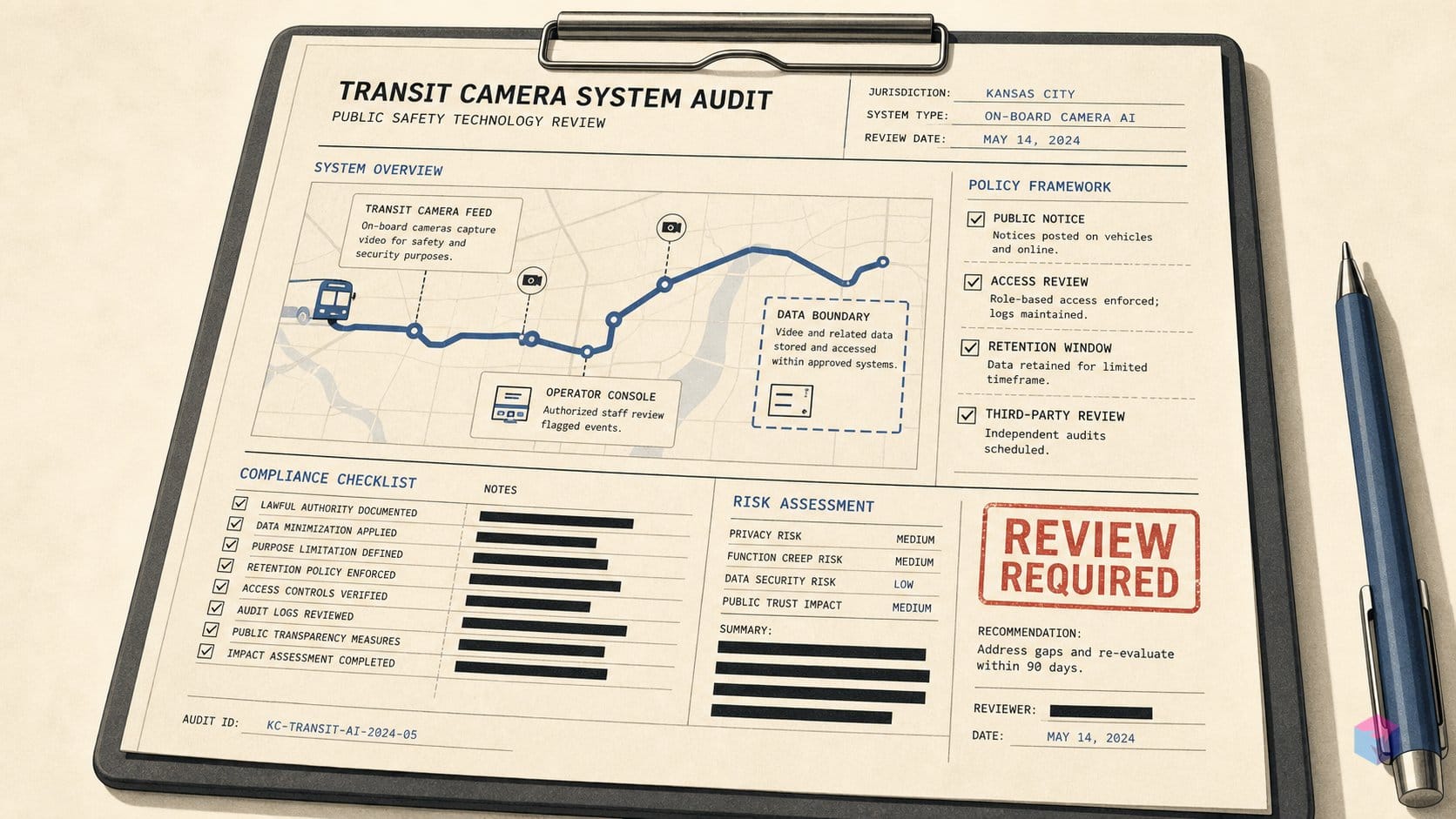
The most concrete fact about Kansas City's biometric plan is how little of it exists on paper. As of late June 2026, no official KCATA facial-recognition policy, privacy impact assessment, or published contract appears in indexed search results . Nearly every operational detail comes from Associated Press interviews with named officials, not from a governing document the public can read or challenge.
That gap matters because watch-list systems live or die on their rules. The plan checks faces against three categories of active alerts — banned riders, missing persons, and law-enforcement subjects designated by the transit authority . But the reporting does not say who holds authority to add or remove names from each list, or what match threshold triggers a real-time alert on a moving bus.
Several questions remain open before any camera goes live:
- Watch-list authority: who can add or remove a name from each of the three categories, and under what standard of evidence.
- Alert threshold: what confidence score triggers a live flag, and what human review precedes any action against a rider.
- Rider notice: whether passengers are told the buses carry live biometric cameras — no notification plan has been disclosed.
- Error remedy: how false matches get logged and corrected, a concern grounded in NIST's documented demographic error gaps.
The opt-out problem sharpens all of this. Riders on a public bus generally cannot decline to be scanned, and there is no disclosed plan to notify them that scanning is happening . Notice and consent are the usual first guardrails in biometric deployments; here, neither has surfaced.
Then there is the body that should be answering these questions. KCATA is a bi-state authority governed by a 10-member Board of Commissioners — five from Missouri and five from Kansas — that adopts significant contracts, budgets, and strategic direction in public meetings where speakers get three minutes at the chair's discretion . No board vote on a biometric-specific governance policy has been reported.
For developers and technical founders watching how AI systems acquire public authority, this is the instructive part. The model, the vendor, and the camera count have all been discussed publicly — but the access-control layer that decides whose face becomes a target is the piece still missing. A system can be technically ready and governance-blank at the same time, and right now Kansas City's is both.
From transit ban lists to drone feeds: how the Detroit contract ballooned
The clearest precedent for that worry is Detroit. Georgetown Law's 2019 America Under Watch report documented a DataWorks Plus "FACE Watch Plus" real-time video-surveillance contract worth $1,045,843.20, originally framed as a narrow tool tied to transit ban lists. The system did not stay narrow.
What makes Detroit instructive for Kansas City is the contract's own language, not its eventual headlines. The agreement carried provisions for expansion — additional feeds beyond the original cameras. Once a face-matching backend exists, adding inputs is a configuration change, not a new procurement, which is how a single ban list becomes a citywide capability.
The documented expansion path included:
- Drone feeds — aerial camera streams routed into the same recognition pipeline .
- Body-worn camera integration — mobile, officer-carried inputs feeding the same backend.
- A scope that started with one ban list and grew administratively, without a fresh public vote for each new feed.
Map that trajectory onto KCATA's proposal. One of the three published watch-list categories is "law-enforcement subjects designated by the transit authority" . For developers, that is the telling field: it is an administratively expandable bucket. Banned riders and missing persons are bounded, auditable lists. "Designated subjects" is an open key-value store with no disclosed cap, no sunset clause, and no published rule for who writes to it.
That is precisely the failure mode the ACLU flags. Jay Stanley, senior policy analyst with the ACLU's Project on Speech, Privacy and Technology, told the Associated Press that narrow watch lists "can expand over time" . Detroit shows the claim is not hypothetical — Georgetown documented the expansion provisions in a signed contract, not a slippery-slope thought experiment.
The engineering lesson transfers cleanly. When a system's data model includes a category whose membership is defined at runtime by an operator, the deployed code stops being the boundary; policy is. Kansas City has shipped the schema for an expandable watch list while leaving the access controls on that field unwritten — the same starting condition Detroit's contract began from before it grew toward drone and body-camera feeds. According to Georgetown's reporting via LJWorld, that expansion was written in from the start, which is why the unbounded "designated subjects" bucket is the part to watch here.
Riders won't be notified. The ban list isn't defined. The KCATA board hasn't voted.
Strip away the World Cup timeline and the vendor's resume, and what remains is a system whose hardest questions are still blank. As of late June 2026, the project is real and unpaused — but the parts that decide whether it is fair are the parts no one has written down .
Here is the open ledger before any bus goes biometric:
- Funding and launch. The final money mix and date are unset after Missouri declined; KCATA's Tyler Means told AP he expects a 2026 launch, possibly "a little bit bigger" — up to 30 buses versus the original nine-bus pilot .
- Watch-list control. Three categories are named — banned riders, missing persons, and law-enforcement subjects — but who adds or removes a name, and under what standard, is undefined .
- Human review. No process has been publicly described for what, if anything, a person checks before a live match triggers action on a moving bus.
- Remediation. Given NIST's documented false-positive differentials, false matches will happen — yet no protocol for logging, fixing, or notifying an affected rider has been disclosed .
Notice what each gap shares: none is a technical blocker. The delay KCATA actually cited was prosaic — financing, plus upgrading the buses' Wi-Fi routers to carry both the new cameras and a new fare system . The governance questions were never the thing being worked on.
That is the structural point. The KCATA board — ten commissioners, five from Missouri and five from Kansas — adopts significant contracts in public meetings, yet no facial-recognition policy, privacy impact assessment, or watch-list governance document has surfaced in the record . The schema shipped ahead of the rules.
So the concrete takeaway: this pause is a procurement and plumbing delay, not a deliberation. Riders are not slated for notice, the ban list has no written access controls, and the board has not voted on binding limits or independent accuracy audits. If those defaults hold, Kansas City won't decide to skip the guardrails — it will simply ship without them, and the precedent will set itself.
Last updated: 2026-06-23. Reviewed against Associated Press wire reporting and named KCATA interviews current as of June 18–23, 2026.
Frequently asked questions
What three categories does KCATA's facial recognition system check riders against?
KCATA's planned system would match live faces against three active alert lists: banned riders (transit-level bans), missing persons, and law-enforcement watch-list subjects designated by the transit authority . On top of that face-to-list matching, the project adds AI-assisted behavioral analysis. Note that no published KCATA policy defines who can add or remove names from these lists.
Why did Missouri decline to fund Kansas City's bus facial recognition pilot?
The State of Missouri declined expected funding specifically over concerns about the facial-recognition component — the most concrete official opposition on record . In response, KCATA is pursuing local and federal money instead, and chief mobility officer Tyler Means told the Associated Press he expected a 2026 launch that could be "a little bit bigger" — potentially as many as 30 buses .
Does SafeSpace's system store face data for passengers who don't match a watch list?
SafeSpace CEO Scott Boruff says biometric/face data is discarded quickly when there is no match or safety issue, so the system does not continuously store face templates absent a hit . However, ordinary bus video footage is archived by KCATA on local servers for up to five years after buses return to the depot . Critics argue future software could reprocess that archive retroactively.
What does NIST's FRVT benchmark say about facial recognition accuracy across demographics?
NIST's 2019 demographic-effects study evaluated 189 algorithms from 99 developers and found a majority exhibited demographic differentials . For one-to-one matching, false-positive rates for Asian and African American faces often ran 10 to 100 times higher than for Caucasian faces . For one-to-many matching against an FBI mugshot database, African American females showed higher false-positive rates — directly applicable to KCATA's planned watch-list use.
What is the current status of the Kansas City bus facial recognition pilot as of June 2026?
As of late June 2026 the project is stalled but not abandoned. The original nine-bus pilot, scoped for spring 2026 and ideally operating before Kansas City hosted FIFA World Cup 2026 matches, was halted just before launch . KCATA attributed the delay to Wi-Fi router upgrades and Missouri's funding refusal, and is now seeking alternative funding for a possible 30-bus rollout later in 2026 .