
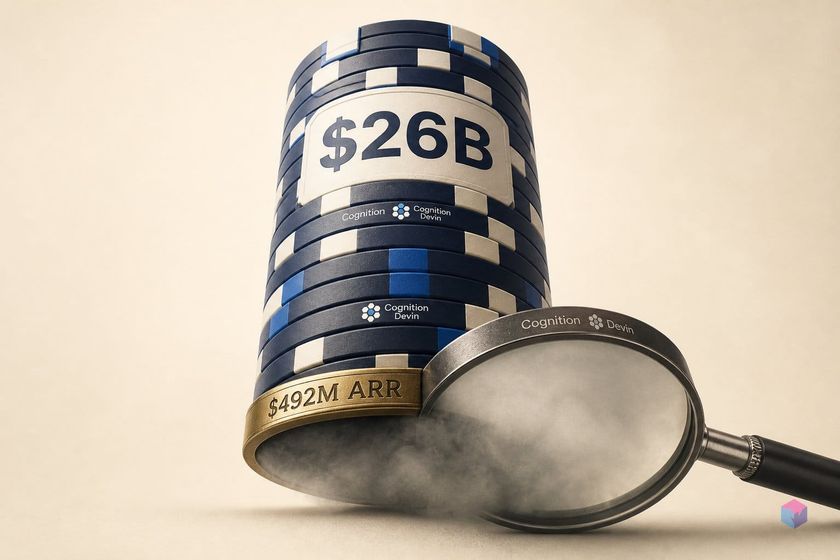
Cognition repriced itself 2.5x in roughly eight months — and the round that did it disclosed more than it explained. Here is what the Series D actually says.
The $1B Series D: Who Led It and at What Price
On May 27, 2026, Cognition — the lab behind the autonomous software engineer Devin — announced it had raised more than $1 billion in a Series D at a $25 billion pre-money valuation, or roughly $26 billion post-money . The round was led by Lux Capital, General Catalyst, and 8VC, with first-party reporting confirming the pre-money basis .
Quick Answer: Cognition raised over $1B on May 27, 2026, at a ~$26B post-money valuation, led by Lux Capital, General Catalyst, and 8VC. That is 2.5x the $10.2B post-money mark it set in September 2025 — one of the fastest repricings in the AI-coding wave.
The investor list is broad. New entrants include Ribbit Capital, Atreides, and Layer Global, while a deep bench of existing backers re-upped: Founders Fund, Elad Gil, Alpha Wave, Definition Capital, Positive Sum, Avenir, Vitruvian, Bain Capital Ventures, Conversion Capital, 137 Ventures, Soma Capital, and former NBA player Omri Casspi .
The defining feature is speed. Cognition closed more than $400 million at a $10.2 billion post-money valuation in September 2025, led by Founders Fund . The new mark arrives roughly eight to nine months later.
| Metric | Series C (Sep 2025) | Series D (May 2026) |
|---|---|---|
| Amount raised | $400M+ | $1B+ |
| Post-money valuation | $10.2B | ~$26B |
| Lead investor(s) | Founders Fund | Lux Capital, General Catalyst, 8VC |
| Change | — | ~2.5x in ~8 months |
What the announcement did not break out matters as much as the headline number — the basis for that 2.5x jump is the $492 million run-rate the next section examines.
The $492M ARR Figure: Verified vs. Unverified
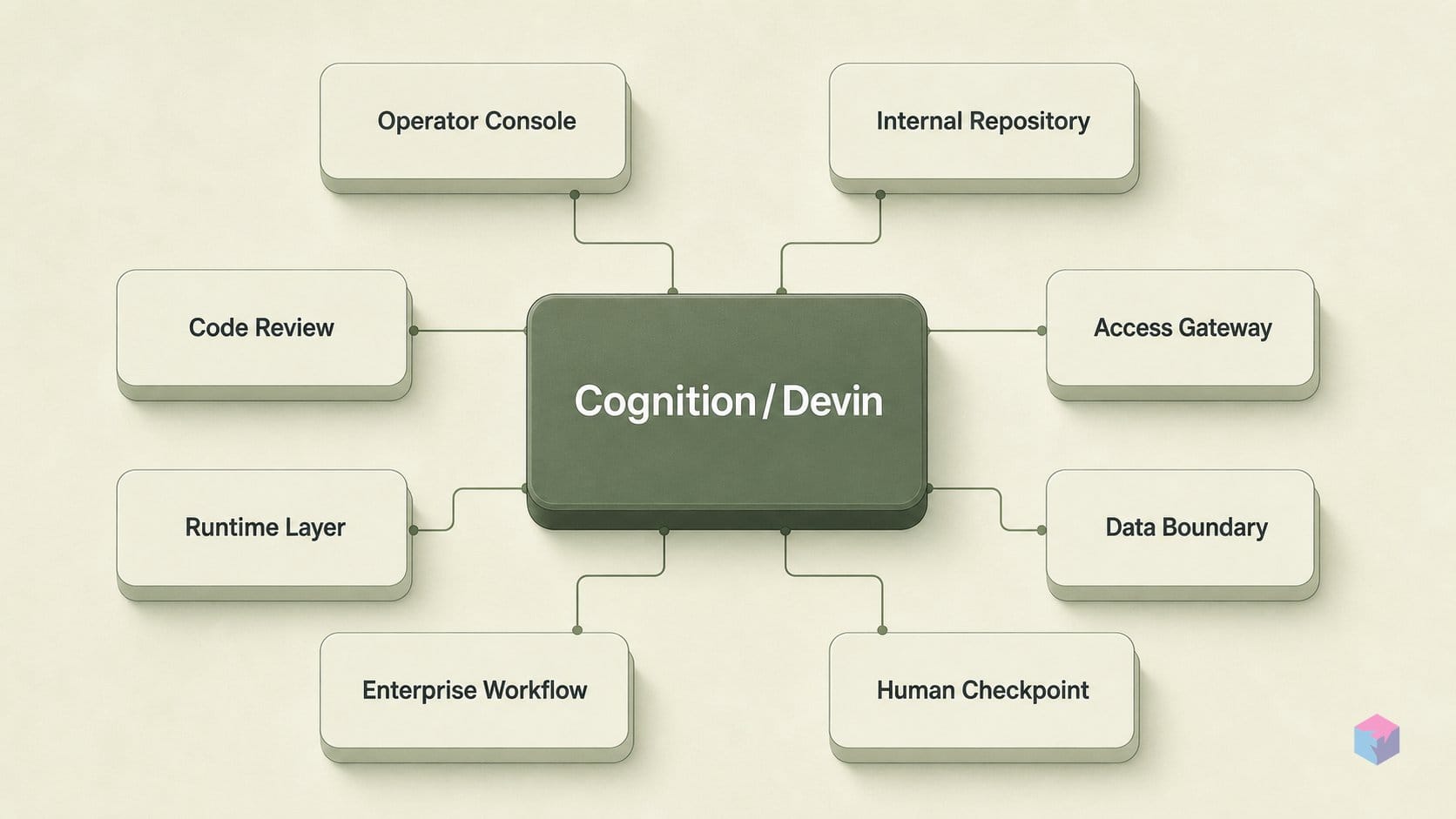
The $492 million is an annualized run-rate, not audited full-year revenue — it extrapolates a recent revenue snapshot across twelve months, so it captures Cognition's current momentum but not a closed, reported fiscal result . That distinction matters because every downstream number in the announcement, including the implied multiple, rests on a figure that no external auditor has confirmed and that can compress quickly if month-over-month growth slows.
Two structural gaps sit inside the headline. First, there is no product-line breakdown: Cognition acquired Windsurf in July 2025 with roughly $82 million of ARR attached , yet the Series D post does not separate Windsurf-originated revenue from standalone Devin sales . A reader cannot tell how much of the $492 million reflects the autonomous agent thesis the valuation is priced on versus an IDE business that predates the deal.
Second, the announcement omits the qualifiers that normally accompany a credible ARR claim: there is no stated ARR definition, no average contract length, no net revenue retention, and no disclosure of customer concentration across named accounts like Citi, Goldman Sachs, and Mercedes-Benz . Without retention, run-rate revenue could be inflated by short pilots that may not renew.
The growth claim has the same problem. Cognition states the trajectory directly:
"Enterprise usage has grown more than 10x since the start of 2026" — Cognition, Series D announcement (source: cognition.ai).
One outlet characterized that as roughly 50% month-over-month growth over the prior six months , but neither the base period nor the methodology behind that rate is disclosed. "Usage" growth is also not the same as revenue growth — a distinction left unresolved in the announcement.
53x Revenue: How the Multiple Holds Up
At a ~$26 billion valuation against $492 million in annualized run-rate revenue, Cognition is priced at roughly 53x revenue — the top of the range even for high-growth software. Comparable AI infrastructure companies at a similar stage typically clear at 20–30x ARR, so the deal asks investors to underwrite a trajectory, not a trailing multiple. The number is also built on a run-rate figure, not audited annual revenue .
One omission makes the multiple harder to read: no gross margin was disclosed. A revenue multiple without margin context is materially incomplete, because AI coding agents pass model-inference costs straight through to cost of goods sold — a structurally different position from the 70–80% gross margins of traditional SaaS. Cognition's emphasis on SWE-1.6 cost-efficiency and inference speed up to 950 tokens per second signals margin awareness, but signaling is not a disclosed number.
The bull case is straightforward compression. If anything close to the cited ~50% month-over-month pace holds, run-rate crosses $1 billion fast — and the multiple collapses against it:
| Run-rate ARR | Implied multiple at ~$26B |
|---|---|
| $492M (current) | ~53x |
| $738M | ~35x |
| $1.0B | ~26x |
| $1.5B | ~17x |
At a sustained 50% monthly rate, $492 million reaches $1 billion in roughly two months; even a far more conservative 12–15% monthly pace gets there in four to five months, pulling the multiple into the 20-25x band that peers already trade at. The bear case is that the growth rate is the fragile input. Enterprise sales cycles lengthen as deal sizes rise, seat-based pricing caps expansion inside accounts that have already adopted, and well-resourced alternatives — Anthropic's Claude Code, OpenAI's Codex, Google's Jules — can blunt momentum before the multiple earns its keep. Fifty-three times leaves no margin for a plateau.
89% AI-Written Commits: Reading the Internal Adoption Number
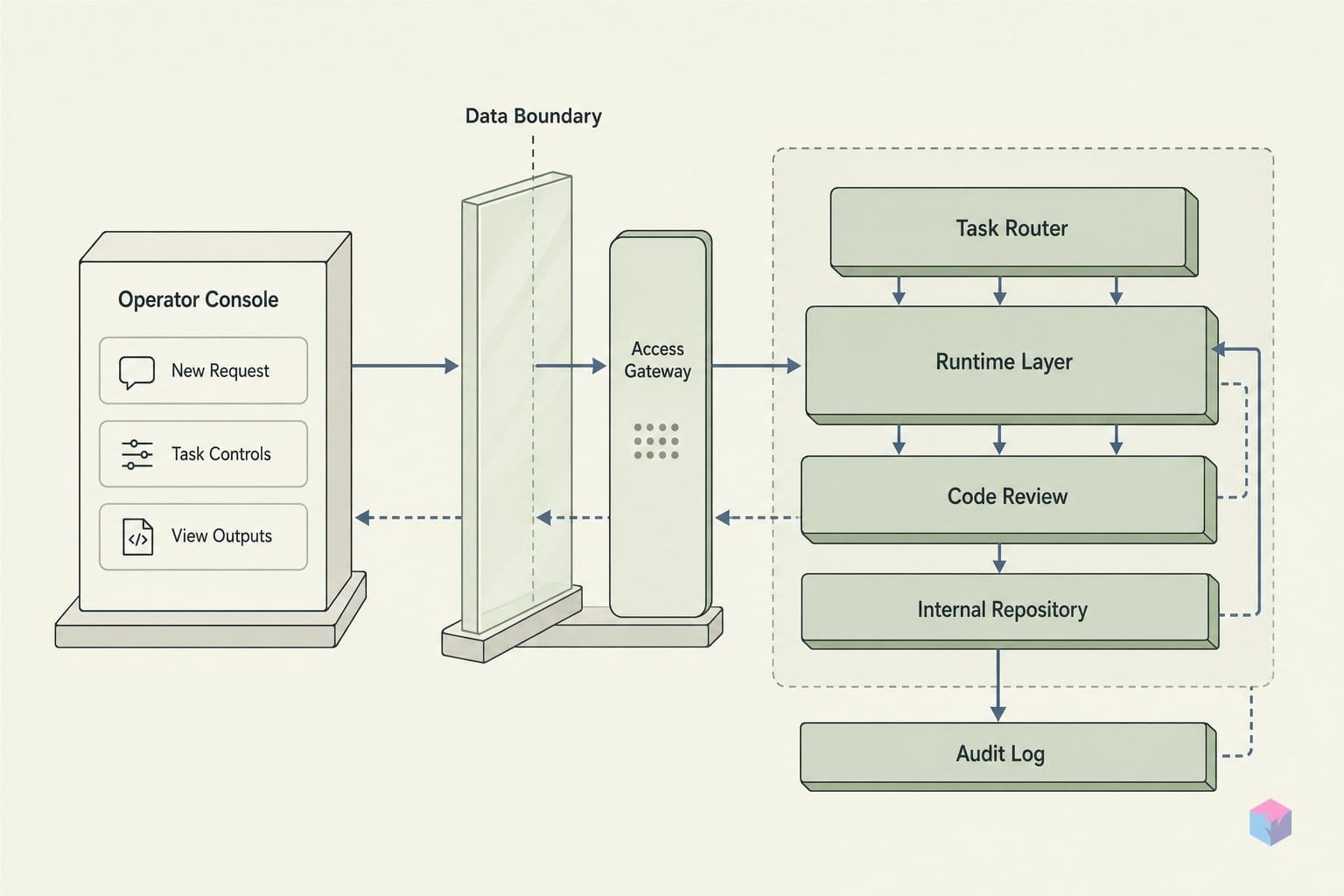
The most cited operating metric in the announcement is internal: Cognition says 89% of the code committed by its own engineering team now originates from Devin, with the remainder coming from local agents inside Windsurf . As dogfooding goes, it is the strongest possible form — the company building autonomous engineers reports that its own engineers ship almost entirely through them — and it is also the cleanest investor slide, which is exactly why it warrants scrutiny.
The problem is definitional. "Originates from Devin" is doing heavy lifting, and Cognition publishes no methodology for it. Code that is generated and accepted verbatim, generated and heavily edited by a human, or merely reviewed by Devin would all plausibly count, and each tells a different story about leverage. A commit authored by an agent and reshaped line-by-line in review is not the same productivity claim as one merged untouched. Without that breakdown, the number measures attribution, not necessarily net engineering value.
Selection bias compounds it. Cognition's codebase is unusually friendly to its own tooling: the engineers are expert users, the workflows are tuned for the product, and the model layer — including SWE-1.6, promoted internally for inference speeds up to 950 tokens per second — is co-developed with the agent. That makes 89% a ceiling on what is achievable under ideal conditions, not a baseline a typical enterprise buyer should expect.
"89% of the code committed by our engineering team now originates from Devin, with the rest coming from local agents in Windsurf," — Cognition, Series D announcement (source: cognition.ai).
Read it as a vendor-defined high-water mark, useful for sizing the opportunity and useless as an industry average.
Eight Days for 200,000 Lines of COBOL: The Case Study Math
The customer case studies are the most quotable part of Cognition's pitch, and the least independently verifiable. Mercedes-Benz reported that Devin analyzed more than 200,000 lines of COBOL and compressed an estimated eight-month modernization effort into eight days . That is a roughly 24x compression on a single legacy workload — striking, but sourced entirely to a Cognition-published account with no third-party engineering audit attached. The "eight-month estimate" is itself a counterfactual the vendor and customer agreed on, not a measured baseline.
Itaú's numbers are more granular and follow the same pattern. The bank reported 6x faster .NET-to-Java migration across 59 services, 5x faster SQL Server migration of 800 database objects, roughly 70% automatic security-vulnerability remediation, more than 300,000 repos documented, test coverage rising from about 50% to above 90%, and 75% of teams using Devin . The detail is reassuring, but every figure is vendor-reported. Treat them as directional evidence that the workflow scales inside a large regulated bank, not as benchmarked productivity multipliers you can underwrite a budget against.
The government footprint is the credibility anchor. Cognition says its platform is used across the U.S. Army, U.S. Navy, NASA-JPL, and the Treasury Department, and that Windsurf is FedRAMP High and DoD IL4/5/6 accredited while Devin runs in AWS GovCloud with a FedRAMP High version planned . Accreditation is externally verifiable in a way the case-study math is not — that matters more than any single ROI claim.
Cognition's own answer to the verification gap is the AI Productivity Guarantee, launched June 4, 2026, which pledges usage credits of up to $10 million if Devin delivers less engineering value than a customer pays for . The underlying estimator was trained on 258 sessions from 126 users and validated on 233 held-out sessions — and Cognition flags the catch itself:
"Ground truth is self-reported, volunteer samples may skew positive, and hours are not equivalent to business value," — Cognition, AI Productivity Guarantee disclosure (source: cognition.ai).
A guarantee built on a self-reported estimator is a sales instrument, not an audit. It transfers some risk to Cognition, which is genuinely useful for buyers — but it does not convert vendor case-study math into independently measured results.
What Cognition Left Out of the Announcement
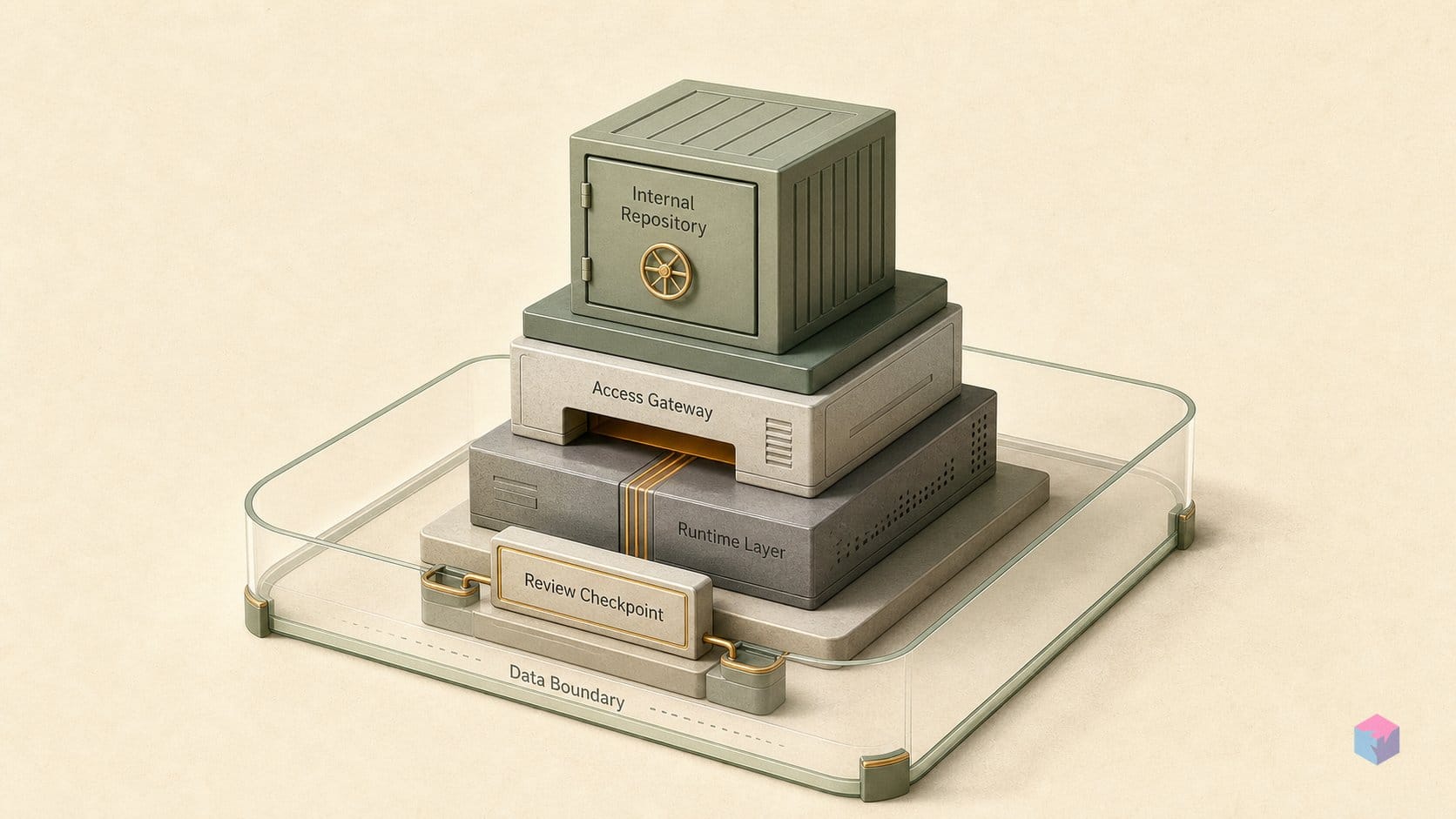
The Series D announcement is notably quiet on the financials that would let an outsider price the round independently. Cognition disclosed no use-of-proceeds statement , so how the $1 billion-plus is split across hiring, compute infrastructure, and go-to-market is unknown. There is also no primary-versus-secondary breakdown — meaning it is unclear how much is fresh capital on the balance sheet versus liquidity for founders or employees, and the exact amount raised above $1 billion was never stated .
The standard SaaS health metrics are absent too. Gross margin, churn, net revenue retention, contract length, customer concentration, the precise ARR definition, and profitability do not appear anywhere in the post . For a company priced at roughly 53x run-rate, those are the numbers that separate durable revenue from a fast-moving usage spike, and none were offered.
The one fresh piece of external-facing rigor is FrontierCode, the 150-task benchmark Cognition published on June 8, 2026, with 100 Main and 50 Diamond tasks built by 20-plus maintainers spending more than 40 hours each . The top model, Claude Opus 4.8, scored just 13.4% on Diamond, ahead of GPT-5.5 at 6.3% and Gemini 3.1 Pro at 4.7% . That is a useful signal of how hard frontier coding work remains — but the benchmark was designed and released by the vendor, so it tells you about ceiling difficulty, not about Cognition's own audited results.
The Competition Has Comparable Resources. That Changes the Math.
Cognition's hardest problem is not raising money — it is that its closest rivals have just as much. Anthropic's Claude Code, OpenAI's Codex, and Google's Jules are credible direct alternatives, and coverage of the Series D framed all three as the field Cognition is fighting in . Each is already embedded in developer workflows at scale and backed by a parent that does not lack capital. So a $26 billion mark on $492 million of run-rate revenue buys reputational momentum, but it does not buy a moat. Differentiation has to come from workflow depth and the quality of autonomous execution, not fundraising size.
The company also runs two distinct buyer motions inside one brand. Windsurf serves local, IDE-based tasks where a developer stays in the loop; Devin targets longer-horizon, more autonomous jobs that run with minimal supervision. That is a wider product surface, and arguably a real advantage — but it is also a harder sales story, because the same prospect has to be sold on two different trust thresholds at once.
For anyone evaluating the platform, the practical question cuts past the valuation entirely: what does $20 to $200 per month deliver that is not already bundled into a Claude, OpenAI, or Google subscription you may hold? If the answer is "autonomous execution that actually closes longer tasks without hand-holding," the premium is defensible. If it is "a comparable assistant with a different label," the multiple is doing the talking.
The takeaway: judge Cognition on task-completion quality in your own repos, not on its funding headline. The capital gap with its rivals is gone; the only durable edge left is whether Devin finishes work the others can't.
Frequently asked questions
What is Cognition's Series D valuation?
Cognition's Series D set a pre-money valuation of $25 billion and a post-money valuation of roughly $26 billion, announced May 27, 2026 . That is about a 2.5x step-up from the $10.2 billion post-money mark set in September 2025 — roughly eight to nine months earlier. The round, more than $1 billion in size, was led by Lux Capital, General Catalyst, and 8VC.
Is Cognition's $492M ARR a reliable figure?
Treat it as a directional snapshot, not an audited result. The $492 million is annualized run-rate revenue, not a verified annual total . Cognition disclosed no split between Windsurf's pre-existing base and Devin, no ARR definition, and no gross margin, so the number cannot be cross-checked against product-line economics. It is a Cognition-controlled metric: useful for sizing the trajectory, insufficient for underwriting the multiple. Pair it with your own usage data before drawing conclusions about durability.
Who are the lead investors in Cognition's Series D?
Lux Capital, General Catalyst, and 8VC led the round, according to Cognition's announcement . New entrants included Ribbit Capital, Atreides, and Layer Global. A broad set of existing backers re-upped, among them Founders Fund — which led the September 2025 round — plus Elad Gil, Alpha Wave, Bain Capital Ventures, and others . Cognition did not disclose the primary-versus-secondary mix or the exact amount above $1 billion.
What is Cognition's AI Productivity Guarantee?
The AI Productivity Guarantee, launched June 4, 2026, pledges enterprise customers usage credits of up to $10 million if Devin delivers less engineering value than the customer pays for . The underlying estimator predicts human-equivalent engineering hours per session; Cognition says it was validated on 233 held-out sessions and reached an r_log of 0.74 . Cognition itself flags the limits: ground truth is self-reported, volunteer samples may skew positive, and post-merge defects are not captured — a reasonable pilot signal, not a peer-reviewed metric.
How do Cognition's tools compare to Claude Code or OpenAI Codex?
Cognition targets longer autonomous tasks and deeper workflow integration through Devin, while Claude Code and OpenAI Codex sit inside the toolchains developers already use. The honest framing is that the whole category has a low ceiling on hard problems: on Cognition's own FrontierCode benchmark, the top model, Claude Opus 4.8, scored just 13.4% on the Diamond subset, with GPT-5.5 at 6.3% and Gemini 3.1 Pro at 4.7% . The practical test is task-completion quality in your own repositories, not the funding headline.