
Google didn't just trim a price — it reset the floor. On June 8–9, 2026, its entry AI subscription fell to $4.99 a month while the included storage doubled, putting fresh pressure on every $20 plan that now has to justify the gap.
What just dropped to $4.99 — and what the bundle actually includes
Google cut its entry-level Google AI Plus subscription from $7.99 to $4.99 per month — a roughly 37% reduction — on June 8–9, 2026, and doubled the bundled cloud storage from 200GB to 400GB at the same time . AI Plus first launched in January 2026 as the most affordable paid AI tier in the U.S. market, aimed at individuals and students rather than enterprises . TechCrunch framed the cut as Google "firing a warning shot" in an AI subscription price war now landing on American consumers .
For $4.99, the bundle is not a stripped-down chatbot. It packs :
- Gemini 3 Pro and Nano Banana Pro — Google's current flagship and image models
- Deep Research for multi-step report generation
- AI-powered email tools and the Daily Brief agent
- Gemini Omni for video generation
- 400GB of cloud storage, up from 200GB
The rollout is automatic on both fronts: existing subscribers receive the extra 400GB within days, and the lower $4.99 price applies on their next billing cycle .
There is one caveat worth holding onto before the comparisons start. Engadget notes that AI Plus carries more severe usage restrictions than the $19.99 AI Pro plan, and Google has not publicly disclosed how those caps compare in practice . So the headline number — a frontier-model bundle for under $5 — is real, but the throttle behind it is not yet on paper. That gap between sticker price and disclosed limits is exactly where the rest of this analysis lives.
Why Google can price this way: the storage and ecosystem leverage
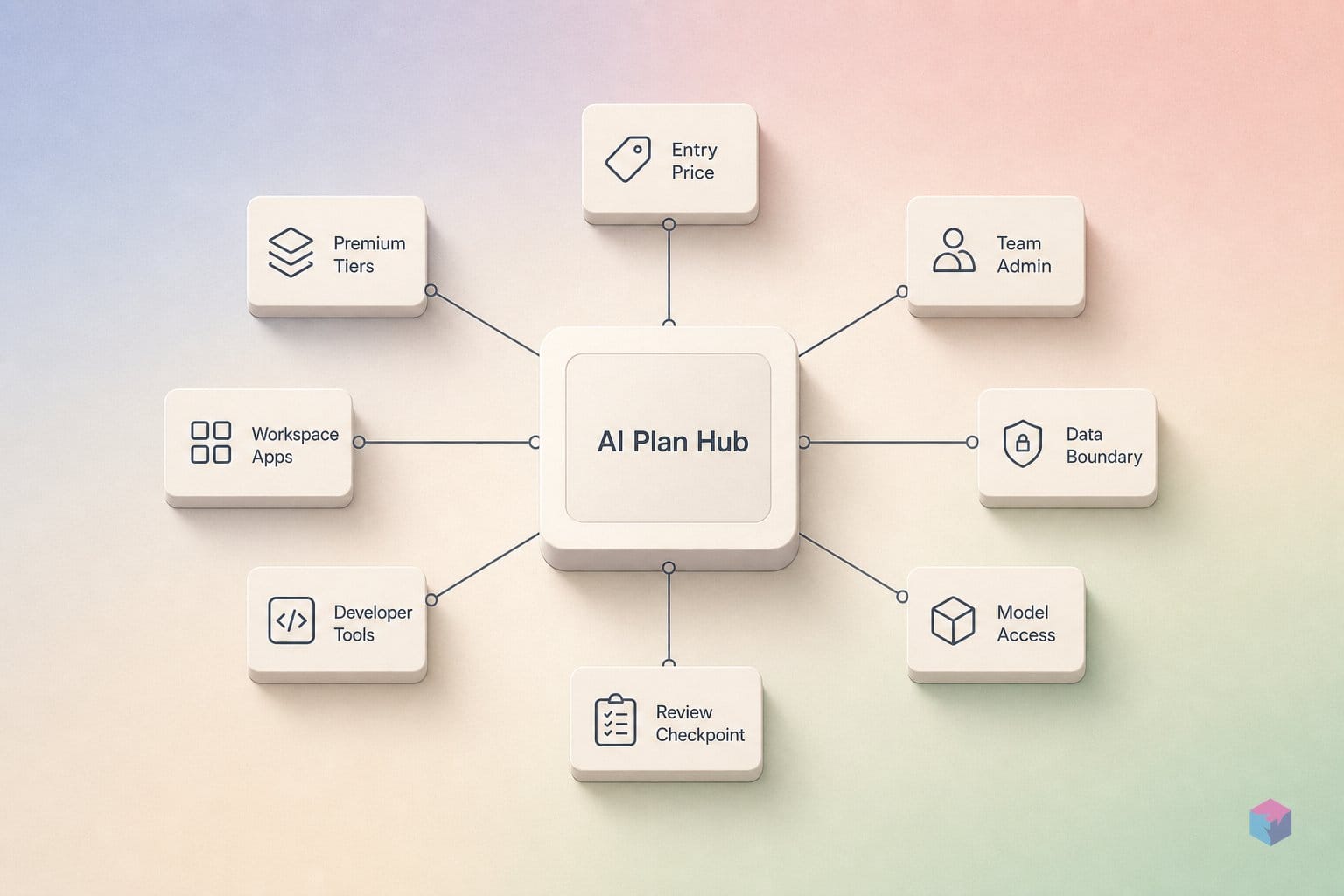
Google can sell a frontier-model bundle for under $5 because the subscription is not where it needs to make money. The $4.99 fee buys habit lock-in across YouTube, Workspace, Android, Chrome, Gmail and Search — the AI access is one input into a stack that already monetizes attention and ads. A pure-play rival selling Gemini-grade inference has to recover its compute cost from the subscription itself; Google amortizes the same infrastructure against Search and Ads, which lets it treat the AI tier as a customer-acquisition and retention lever rather than a standalone profit center.
The scale floor is the second piece. Sundar Pichai said Google processed more than 3.2 quadrillion tokens per month by I/O 2026, a roughly 7x year-over-year increase, against about 480 trillion at I/O 2025 . At that volume the marginal cost of an additional token bends sharply downward — fixed infrastructure spreads across far more usage than a smaller competitor can muster. Google also reported more than 8.5 million monthly developers and model APIs running near 19 billion tokens per minute, the kind of throughput that makes a sub-$5 consumer tier defensible .
Then there is the model-cost claim. Google says Gemini 3.5 Flash runs four times faster than other frontier models at less than half the price . That is a vendor benchmark, not an independently verified one, so treat it as a directional signal rather than a settled fact — but if it holds on neutral leaderboards, it resets what "floor economics" means for the whole sector, because the cheapest competitive offer would be defined by Google's cost curve, not the market's.
Underneath all of it sits capital. Pichai said Alphabet expected roughly $180–$190 billion in 2026 capex, about six times its 2022 level, with training distributed across more than one million TPUs on the new TPU 8t/8i generation and up to 2x better performance per watt . Custom silicon at that depth is precisely what lets Google price inference below what a rival renting GPUs can match.
Venture investor Chi-Hua Chien framed the consequence bluntly, calling the moment the "commoditization era for AI infrastructure" and arguing that infrastructure providers "get commoditized very aggressively" as customers optimize for cost (source: TechCrunch, 2026-06). For a company whose distribution is paid for elsewhere, commoditizing the layer rivals depend on is not a risk — it is the strategy.
How this playbook was tested in India first
The $4.99 cut is not an improvisation — it is the domestic release of an experiment Google and its rivals ran in emerging markets through late 2025. OpenAI launched ChatGPT Go in India at roughly $4.60/month in August 2025, the first sub-$5 AI plan in a major market . Google countered with a sub-$5 AI Plus plan in India in December 2025 . Those tiers were demand-elasticity tests: how far does usage scale, and how sticky is the habit, when the monthly price drops below the cost of a coffee?
The logic is straightforward. Low-price tiers in price-sensitive markets let a vendor measure engagement and retention before committing to a pricing change in higher-revenue Western markets, where a cut sacrifices real per-user margin. India was the controlled trial; the U.S. is the rollout.
Two forces shortened the gap between the two. First, capable open-weight Chinese models keep pulling the price floor down. TechCrunch points to pricing pressure from DeepSeek as part of the competitive backdrop — and for developers, the strategic point is sharper: when a competitive model can be self-hosted at near-zero marginal cost, a hosted subscription has to justify its price on distribution and convenience, not raw model access. Second, the transfer timeline itself signals confidence. Roughly six months separated the December 2025 India plan from the June 2026 U.S. cut , a fast move that suggests the engagement and retention data was clear enough to act on quickly.
The takeaway for anyone tracking AI pricing: watch the emerging-market tier, not the U.S. headline. The sub-$5 plan that lands in India or Southeast Asia today is the most reliable preview of what Western consumers will be offered roughly two quarters later.
How the $5, $20, and $100 plans now compare across vendors
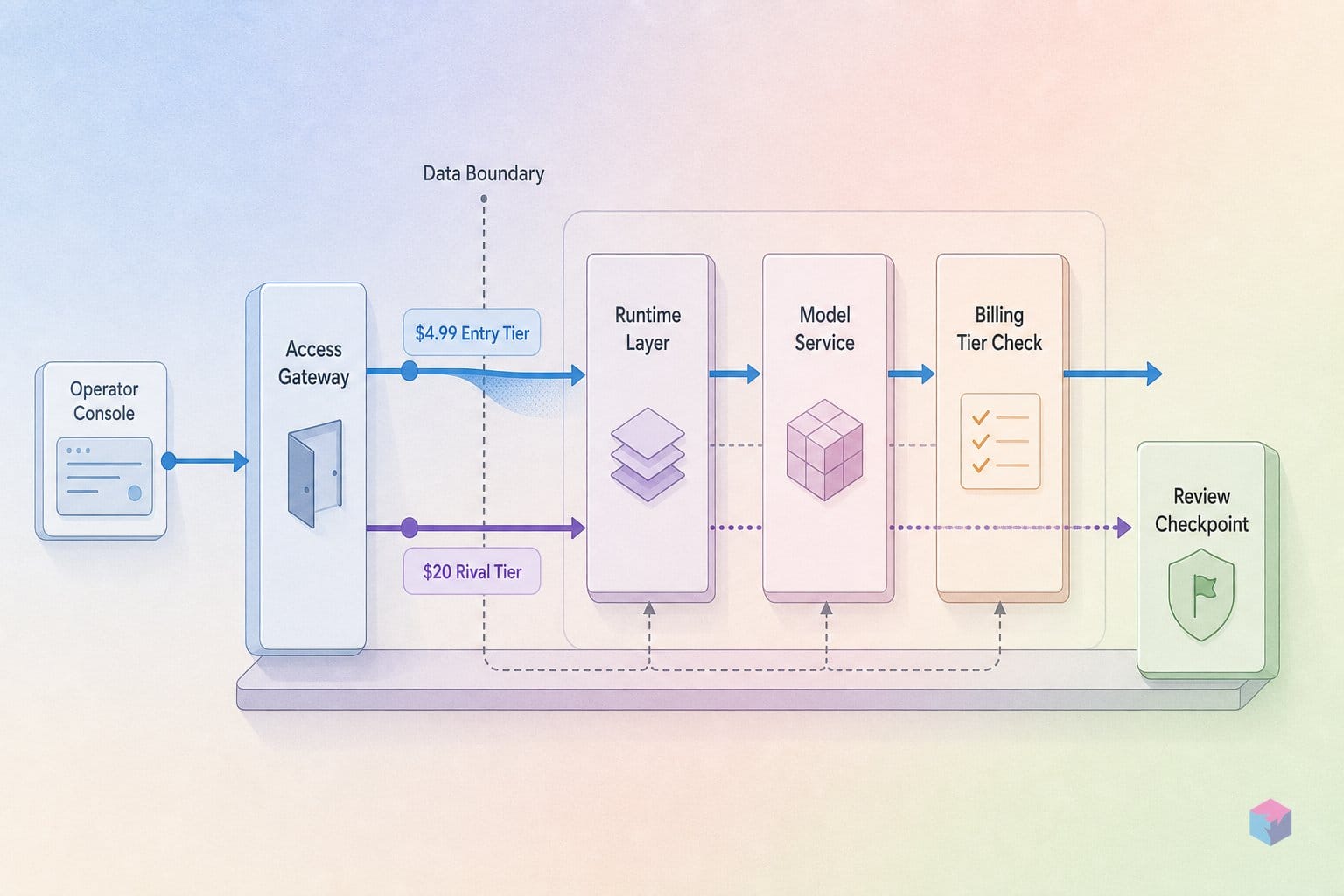
Across the three frontier vendors, the price ladder has converged on the same three rungs — roughly $5–$8 entry, $20 mid, and $100–$200 top — but the contents of each rung diverge sharply. Google now spans AI Plus at $4.99/month, AI Pro at $19.99, AI Ultra at $100, and a top Ultra at $200 . OpenAI runs Go at $8, Plus at $20, a $100 ChatGPT Pro tier, and a higher-usage $200 Pro . Anthropic keeps Claude Pro at $20 with Max at $100 and $200, and — unlike Google — has not shipped a localized budget tier .
The same dollar figures buy structurally different things. Google's upper tiers fold in YouTube Premium and up to 20TB+ of storage alongside the model access . OpenAI and Anthropic sell what is effectively pure inference: more usage headroom, more Codex or Claude credits, and priority access — no storage, no media bundle, no consumer subscription to subsidize. That is the storage and distribution arbitrage rivals cannot replicate at the same price.
| Tier | OpenAI | Anthropic | |
|---|---|---|---|
| Entry | AI Plus — $4.99/mo · Gemini 3 Pro, 400GB storage, video tools | Go — $8/mo · limited usage | — (no budget tier) |
| Mid | AI Pro — $19.99/mo | Plus — $20/mo | Claude Pro — $20/mo |
| Upper | AI Ultra — $100/mo · ~5x Pro limits, 20TB, YouTube Premium | ChatGPT Pro — $100/mo · ~5x Codex usage | Claude Max — $100/mo · 5x Pro usage |
| Top | Ultra — $200/mo · ~20x limits, Project Genie, Gemini Omni | Pro — $200/mo · higher usage | Claude Max — $200/mo · 20x Pro usage |
The reported usage multipliers line up closely — Google, OpenAI and Anthropic all describe their $100 tiers as roughly 5x the mid plan and their $200 tiers as roughly 20x . But "5x" of an undisclosed base is not a number a developer can budget against.
That points to the real gap: none of the three publishes a full numeric-limits table. Google's is the most opaque at the $4.99 entry level — Engadget notes AI Plus carries more severe caps than Pro, and Google has not said how they compare in practice . With usage drifting toward compute-based metering keyed to request complexity and chat length, the published price is increasingly the least informative line on the page . Compare the bundles and the multipliers, but treat every cap as reported rather than confirmed.
Where the $4.99 ceiling actually sits
The honest answer is that nobody outside Google knows where the $4.99 ceiling sits, because Google has not published one. Engadget reported that AI Plus carries more severe usage limits than the $19.99 Pro tier, but noted Google has not disclosed how those caps compare in practice . There is no requests-per-day number, no tokens-per-hour figure, and no rate table on the account-gated official pages — only the marketing copy for Gemini 3 Pro, Nano Banana Pro, Deep Research and Gemini Omni that ships with the plan.
What fills that vacuum is reverse-engineering. Android Central reports Google is moving paid usage toward a "compute-used" model, where the limit you hit depends on request complexity, feature type and chat length rather than a flat monthly allowance, with five-hour resets and weekly quotas layered on top . These specifics were observed by third parties, not confirmed in official documentation, so treat the five-hour windows and weekly caps as reported, not specified.
For a developer, that distinction is not a UX complaint — it is an integration risk. A few practical consequences:
- No capacity planning. If the limit is keyed to compute rather than call count, you cannot estimate how many Deep Research runs or Omni video generations a $4.99 seat actually supports before throttling.
- No SLA to recommend. Suggesting AI Plus as personal tooling, or as a budget tier for a small team, means recommending a plan whose throughput you cannot describe in writing.
- Moving target. A compute-metered ceiling can be retuned server-side without a price change, so the $4.99 figure tells you what you pay, not what you get.
The takeaway is narrow but firm: the published price is the most visible and least informative number on the page. Until Google ships an official rate table, the cheapest plan is also the hardest one to build against.
What 24/7 background AI does to the economics of cheap plans
An always-on background agent changes the unit economics of a flat-rate plan because it draws compute even when no one is typing. The clearest example is Gemini Spark — a cloud-resident personal agent running on Gemini 3.5 and the Antigravity harness, integrated with Gmail, Docs and Slides, and explicitly designed to keep working after a laptop is closed . Spark is planned as a Beta for U.S. AI Ultra subscribers after a trusted-tester phase, so it sits at the top of the stack, not the $4.99 floor — but it signals where the product is heading .
The compute profile differs by workload, and that is the part a single price tag hides. A chat turn is a bounded text completion. Spark is a long-running process that wakes itself on a schedule; Google says it will add MCP connections to Canva, OpenTable and Instacart, with more partners planned, so an agent can route work through third-party services on its own initiative . Each external hop is another inference cycle the user never explicitly requested, which makes per-user draw harder to forecast than a session-based plan.
| Workload | Example feature | Relative compute per action | Billing pressure on a flat plan |
|---|---|---|---|
| Text chat | Standard Gemini prompt | Baseline | Low, bounded per turn |
| Video inference | Gemini Omni generation | Orders of magnitude higher per request | High, unpredictable per clip |
| Always-on agent | Gemini Spark background tasks | Continuous, fires without a prompt | Highest, accrues while idle |
Video is already pulling in the same direction. Gemini Omni began rolling out in May 2026 to AI Plus, Pro and Ultra subscribers worldwide . Video inference costs far more per request than a text completion sold at the same nominal price, so a low tier that includes any video generation is absorbing a cost the $4.99 figure does not reflect — which is exactly why Engadget flagged that AI Plus carries more severe, undisclosed usage limits than Pro .
OpenAI has said the quiet part directly. Nick Turley, OpenAI's head of ChatGPT, reportedly argued that "unlimited" AI access may not make sense as models grow more compute-intensive .
"'Unlimited' AI access may not make sense as models grow more compute-intensive," — Nick Turley, head of ChatGPT at OpenAI (source: Business Insider).
If that holds, the $4.99 entry plan has a ceiling set not by what Google charges but by what it is willing to absorb. Google can offset some of the gap — it claims Gemini 3.5 Flash runs four times faster than other frontier models at less than half the price — but cheaper per-token inference does not erase the difference between a bounded chat and an agent that never logs off.
The profitability question for IPO-bound rivals
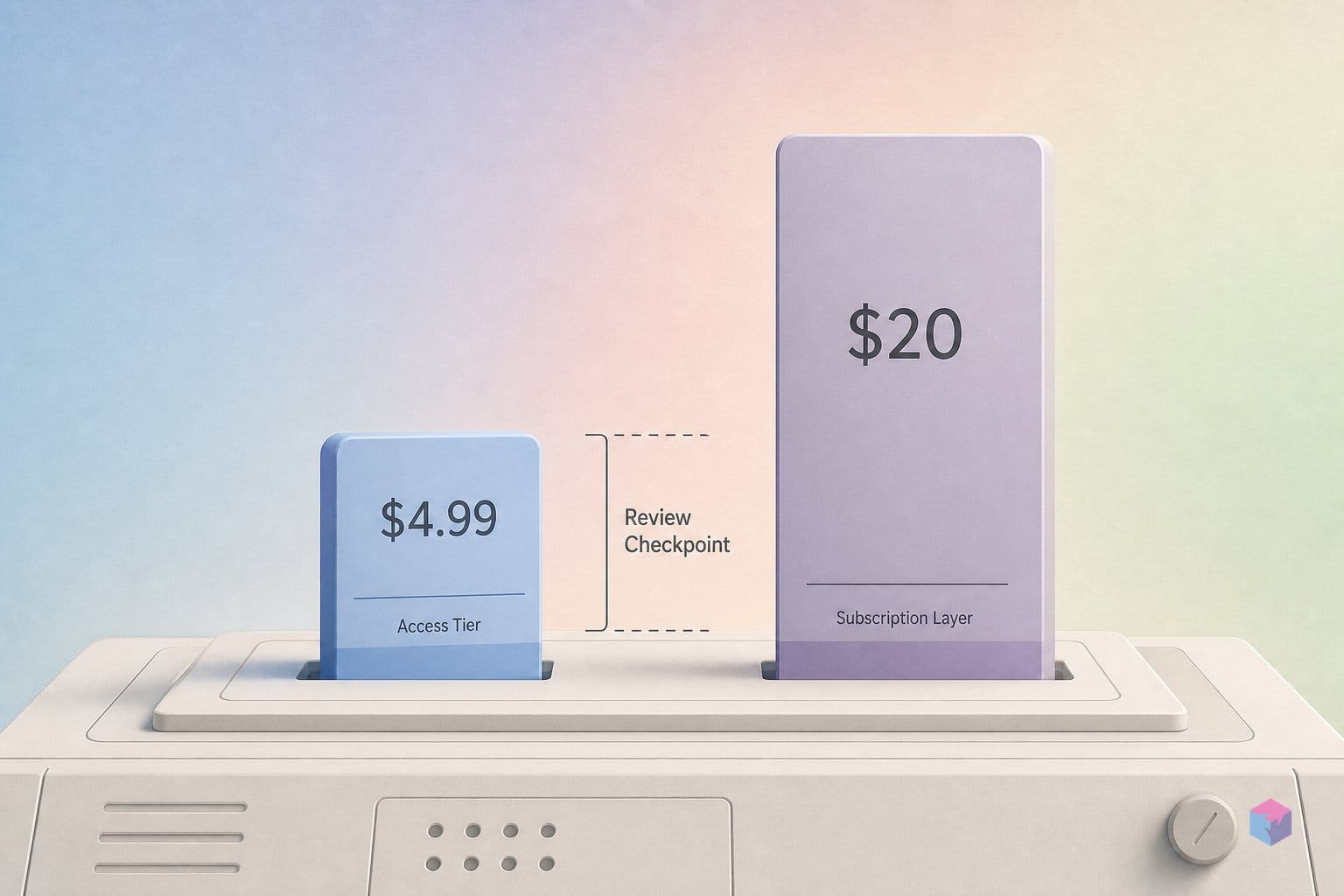
That gap is where the price war turns existential for everyone except Google. Both OpenAI and Anthropic have filed confidentially for IPOs , which means a sustained subscription price war is arriving at the worst possible moment for unit-economics scrutiny: the quarter where you most want clean margins is the one where a rival is deliberately compressing the floor. Public-market investors will price the durability of those margins, and a $4.99 entry tier from a competitor that can subsidize it indefinitely is a hard line item to explain in an S-1.
Venture investor Chi-Hua Chien framed the underlying dynamic bluntly.
"This is the commoditization era for AI infrastructure," — Chi-Hua Chien, venture investor, arguing that infrastructure providers get "commoditized very aggressively" as customers optimize for cost (source: TechCrunch, 2026-06).
The asymmetry is structural. Google's cross-subsidy moat has no equivalent among pure-play labs: there is no storage arbitrage, no Search ad revenue, and no YouTube Premium bundle to absorb below-cost AI access, all sitting behind roughly $180–$190 billion in projected 2026 Alphabet capex . Anthropic still anchors at $20/month for Claude Pro and $100–$200 for Max, with no localized budget tier ; OpenAI runs an $8 Go tier beneath its $20 Plus and $100/$200 Pro plans . None of them can route a subscription's true cost through an adjacent ad or hardware business.
The question the research leaves open is the one that matters most for those filings: can any plan priced between $4.99 and $20/month stay margin-positive once always-on background tasks, video generation, and long-running cloud automation become normal usage rather than power-user edge cases? The vendors themselves are hedging — OpenAI's Nick Turley has reportedly said "unlimited" access may stop making sense as models grow more compute-intensive .
The concrete takeaway for developers and founders: treat the current price points as a subsidy war, not a steady state. If your stack or your business model assumes a $20 ceiling will hold through 2027, build in the possibility that the labs without an ad-funded parent reprice toward compute — and that the cheapest plan in the market is the one whose owner needs it least.
Watch / Sources
Frequently asked questions
What does Google AI Plus include at $4.99/month in 2026?
As of June 2026, the $4.99/month Google AI Plus tier bundles Gemini 3 Pro, Nano Banana Pro, Deep Research, AI-powered email tools, the Daily Brief agent, and Gemini Omni for video generation, plus 400GB of cloud storage — doubled from the previous 200GB when the price dropped from $7.99 . The caveat developers should note: Engadget reports AI Plus carries more severe usage limits than the AI Pro tier, and Google has not disclosed numeric caps, so the practical ceiling on Gemini 3 Pro calls is unknown .
How does Google AI Plus compare to ChatGPT Plus and Claude Pro at $20/month?
The headline gap is price: Google AI Plus is $4.99/month versus $19.99 for AI Pro, $20 for Claude Pro, and $20 for ChatGPT Plus . But they are not the same product. Google's $4.99 plan is a bundle — storage, email tools, and ecosystem features ride alongside the model — while Claude Pro and ChatGPT Plus sell AI usage on its own . All three vendors publish vague rather than numeric rate tables, so direct comparison is imprecise. Practically, the $20 tiers offer materially more usage headroom; the $4.99 tier trades that headroom for a low entry price.
Why did Google cut AI Plus to $4.99 and not lower?
The $4.99 floor reflects bundle cross-subsidy math, not a standalone AI margin. Google can absorb the model cost because the wider stack — YouTube, storage, Gmail, Workspace, Search — carries the economics, while the AI tier drives habit lock-in. Google validated the approach abroad first: OpenAI launched ChatGPT Go at roughly $4.60/month in India in August 2025, and Google followed with a sub-$5 AI Plus plan there in December 2025 before bringing the cut to the U.S. . Competitive pressure from China's open-weight DeepSeek helped set the price-war floor that makes sub-$5 a defensible band rather than a giveaway .
What are the actual usage limits on Google AI Plus?
Google has not published numeric usage caps for AI Plus, so the precise limits are unknown. Third-party coverage describes Google moving paid usage toward a compute-based model keyed to request complexity, feature type and chat length, with five-hour resets and weekly quotas — but these specifics were reported by outlets such as Android Central rather than confirmed on Google's account-gated official pages, and should be treated as reported, not verified . What is confirmed: Engadget reports AI Plus restrictions are more severe than the AI Pro tier .
What is Gemini Spark and is it available on the $4.99 plan?
Gemini Spark is a 24/7 personal agent that runs on Gemini 3.5 and the Antigravity harness, integrates with Gmail, Docs and Slides, and is designed to keep working in the cloud after a laptop is closed; Google says it will add MCP connections to Canva, OpenTable and Instacart . It is not part of the $4.99 AI Plus plan. Spark is planned as a Beta for U.S. AI Ultra subscribers — the $100/month tier — after a trusted-tester phase, so always-on background agents sit at the top of the lineup, not the entry price .