
Interactive Brokers has wired another large language model into its trading stack — and this time it's xAI's Grok. The pitch is account-aware AI that reads your portfolio and drafts orders; the detail worth reading carefully is what "live" actually means.
What IBKR's Grok Addition Covers
IBKR has expanded its agentic trading program to include xAI's Grok, joining Anthropic's Claude — the first integration to go live — and OpenAI's ChatGPT, with Google's Gemini listed as "coming soon" . This moves IBKR past generic chat help: clients can now point ChatGPT, Claude, or Grok at their actual IBKR account to analyze portfolios, research investments, monitor risk, and draft trade instructions .
Quick Answer: IBKR added xAI's Grok to its agentic trading suite alongside Claude (first live) and ChatGPT, with Gemini coming soon. Grok connects through your existing IBKR login — no separate account, API keys, or passwords shared with xAI — and can analyze and draft orders, but cannot execute trades on its own .
The connection matters for how it authenticates. Linking uses your existing IBKR login and IBKR's own authentication — no separate AI broker account, no technical configuration, and no passwords or API keys handed to the model vendor . Credentials stay inside the brokerage's security perimeter, and access can be revoked via "Manage Third-Party Consents."
IBKR CEO Milan Galik framed the program as letting clients "securely connect AI tools to Interactive Brokers for research, analysis and execution" . The "execution" word deserves scrutiny — as later sections detail, a human still pulls the trigger.
For scale context, this is not a fringe pilot. IBKR affiliates run automated execution and custody across more than 170 markets in 29 currencies, serving 5.006 million client accounts with $789.4 billion of client equity as of Q1 2026 .
What Grok Can See in Your IBKR Brokerage
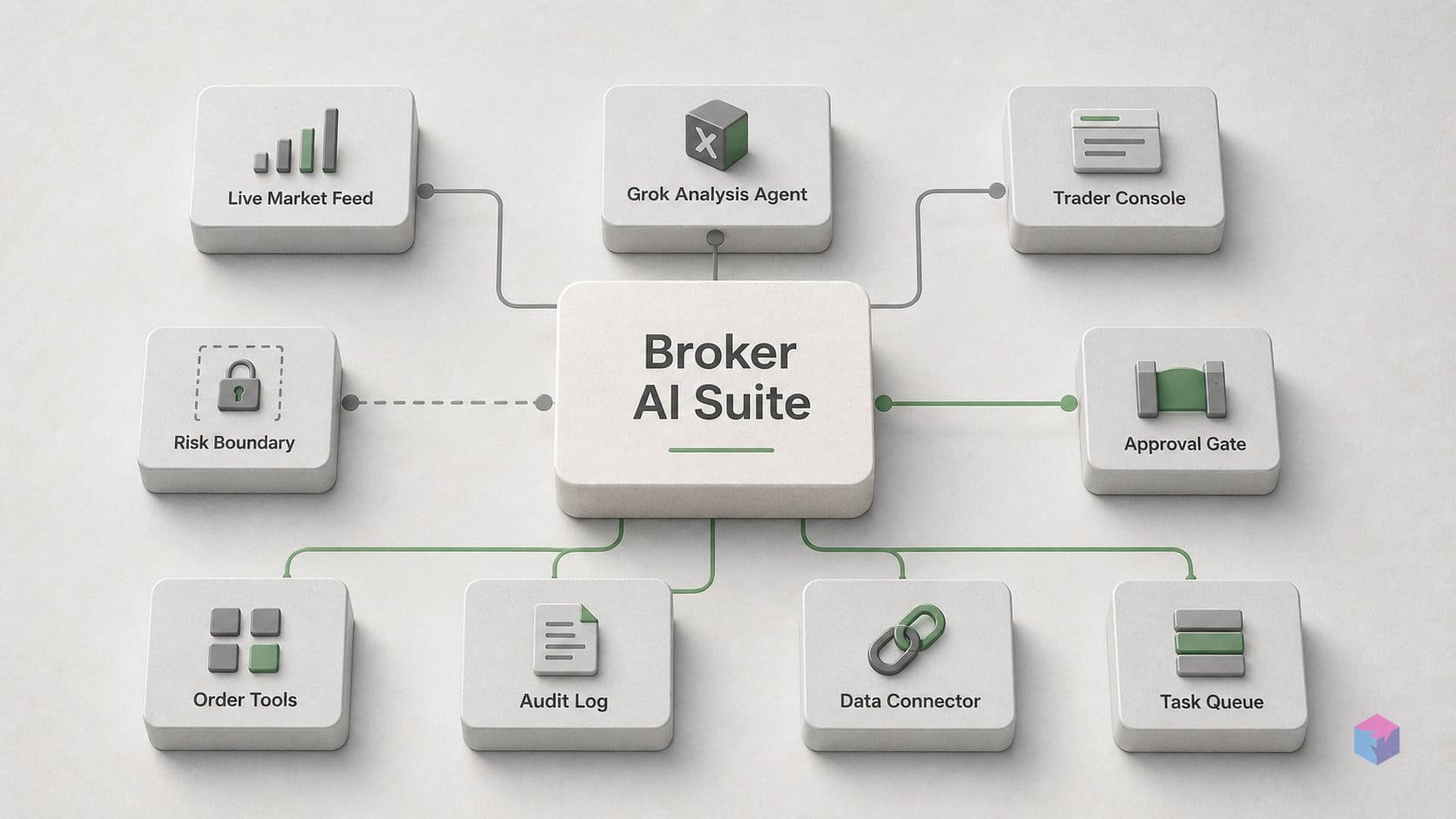
Grok sees a near-complete picture of your account once you authorize the connector. IBKR exposes positions and cash balances, margin availability, and both realized and unrealized P&L to the supported AI assistants, alongside historical transactions . That is read access to the same numbers you watch on your own dashboard — the model is querying live account context, not a summary.
The exposed surface goes deeper than balances. The same data classes include option chains, risk exposures, multi-currency balances, linked accounts, and full portfolio structures . For a developer evaluating this, that breadth is the point: it is enough context for the model to reason about concentration and factor risk, not just recite a single position size.
| Data class | What Grok can read |
|---|---|
| Holdings | Positions, cash balances, multi-currency balances |
| Risk & margin | Margin availability, risk exposures, option chains |
| Performance | Realized and unrealized P&L, historical transactions |
| Account graph | Linked accounts, portfolio structures |
What IBKR advertises on top of that read access maps directly to those classes. Listed use cases include concentration, currency, and factor-risk analysis across portfolios and asset classes, allocation comparison before you make a change, buying-power and net-liquidation-value checks, and natural-language research of global opportunities . Trade press also cited identifying overbought positions and comparing performance against benchmarks .
Practical examples to keep in mind:
- Exposure analysis — ask Grok where a portfolio is over-concentrated by currency, sector, or factor.
- Pre-trade comparison — model how an allocation shifts before committing capital.
- Buying-power checks — confirm net liquidation value and margin headroom against a proposed structure.
- Global research — query opportunities across asset classes in plain language.
None of this is gated to one interface. IBKR says the integration works across its full surface — IBKR Mobile, Web, and Desktop, specifically Client Portal, IBKR Desktop, IBKR GlobalTrader, IBKR Mobile, and Trader Workstation . So whatever Grok can read, it reads consistently whether you are on a phone or in TWS, which matters for anyone scripting workflows around a single account view.
The Mandatory Confirmation: How Order Submission Flows
Here is the part that separates this from an autonomous trading bot: Grok cannot place a trade on its own. Anything it produces is a non-binding draft. AI-generated instructions never become live orders automatically — they route to a dedicated "AI Instructions" tab, where you either click "Review & Submit" to convert a draft into a working order, or "Reject" to discard it entirely .
The framing in the coverage is blunt: the agent drafts the order and the client pulls the trigger . You control three things explicitly — what the AI can access, which drafted instructions become orders, and when those orders are submitted . There is no standing authority and no silent execution path. For developers scripting around this, the design point is clear: the model emits intent, and a human approval gate sits between intent and the order router.
A concrete example IBKR cites: ask Grok to draft a limit order to buy 50 AAPL shares at 2% below the current price, and it produces the ticket — but you submit it . The same flow covers more exotic instructions, such as trading front-month oil futures, again as a draft awaiting your click .
What is worth flagging is how much the drafting scope expanded. The original program was equity-only; the current order-instruction scope now spans:
- Equities
- ETFs
- Options
- Futures
- Futures options
That broadening matters because each new instrument class is something Grok can now structure into a draft ticket — including margin-impact comparisons across option structures and options-based hedging strategies . The wider the drafting surface, the more the human-in-the-loop tab earns its place: a hallucinated futures-options ticket is a worse failure mode than a mistaken equity order, and the "Review & Submit" step is the explicit checkpoint that catches it.
The "Live" Claim: Whether Grok Sees Fresh Quotes in IBKR
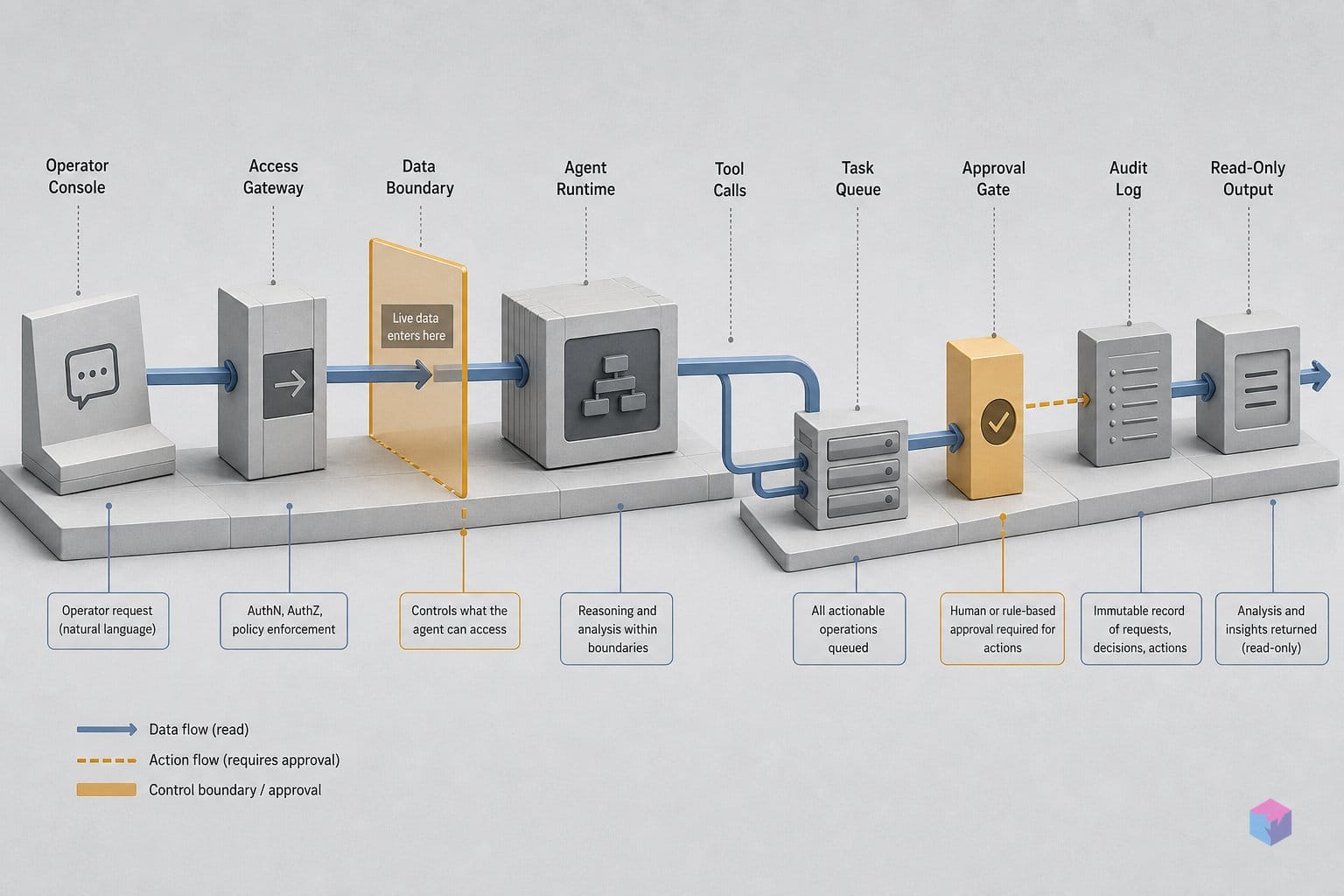
"Live market analysis" is a marketing phrase, not a confirmed data entitlement. By xAI's own documentation, Grok "has no knowledge of real-time events unless server-side search tools are enabled" . In other words, freshness is opt-in at the tool layer — a base model call answers from its training cutoff, not from the tape.
xAI exposes three relevant capabilities, and each must be deliberately activated rather than assumed on:
- Web Search — lets Grok search the web in real time and browse pages .
- X Search — keyword, semantic, user and thread search on X, with filters for up to 20 allowed or excluded handles and ISO8601 date ranges .
- Remote MCP Tools — connect Grok to external MCP servers over Streaming HTTP and SSE .
This matters because IBKR's certified connector is itself an MCP server. So Grok can read your account state through that channel — positions, balances, P&L — but "account context over MCP" is a different thing from "a real-time quote feed." One tells Grok what you hold; the other tells Grok what the market is doing right now. The phrase "live analysis" can be technically true while only the former is wired up.
The gap is that IBKR's public disclosure does not specify which xAI tools are enabled inside its consumer connector, what market-data entitlements apply, or whether continuous background monitoring is supported . xAI's developer docs are generic and describe the tools in the abstract, not the IBKR deployment's configuration .
For a developer evaluating this, three things are not confirmed by the primary sources and should not be assumed:
- Tick-level pricing — nothing states Grok receives streaming, exchange-grade quotes versus delayed or snapshot data.
- Continuous monitoring — there is no documented background process polling your portfolio; the interaction looks request-driven, not a standing watcher.
- Data-entitlement scope — your own IBKR market-data subscriptions, not the model, likely bound what fresh prices are even available to surface.
The practical read: treat Grok's market commentary as reasoning over account context plus whatever search tools happen to be on, not as a guaranteed real-time price oracle. Until IBKR or xAI publishes the connector's tool manifest and data-feed terms, "live" describes the product's ambition more precisely than its verified plumbing.
How IBKR's Broker Structure Turned Grok Into a Drop-in Addition
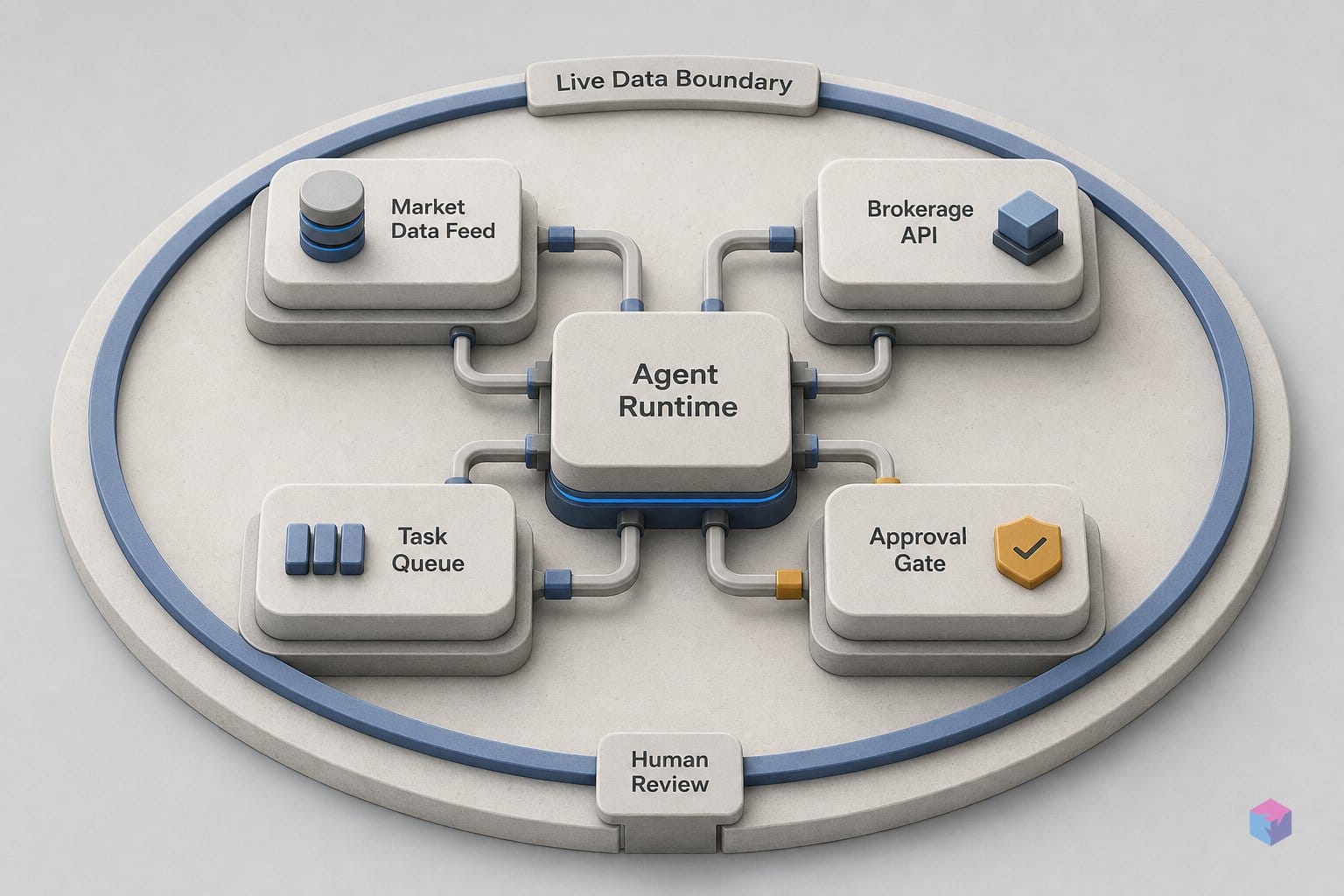
The reason Grok slotted in so quickly is architectural: IBKR built the connection on the Model Context Protocol (MCP), an open standard where a single certified broker-side connector exposes account context and trading capabilities to any compatible AI client. According to xAI's announcement and the IBKR release, the same MCP server backs Claude, ChatGPT, and Grok — IBKR wrote the integration once, not per vendor.
The practical consequence for developers watching this space is that the model layer is interchangeable. IBKR does not negotiate and engineer a bespoke pipeline for each assistant; it certifies a connector against a protocol, and any MCP-speaking client can authenticate against it. That is why Gemini is listed as "coming soon" without IBKR signaling a re-architecture — it is a new client against existing plumbing, not a new platform.
Authentication is the part worth examining closely. Linking uses the client's existing IBKR login and IBKR's own auth flow. No separate AI broker account is created, and no passwords or API keys are handed to xAI or other model vendors (source: xAI, IBKR). Credentials stay inside the brokerage's security perimeter; the model receives scoped context through the connector, not the keys to the account.
Control is also reversible. Clients decide what the assistant can read and can withdraw access through Manage Third-Party Consents in the IBKR interface, per Basenor's walkthrough. Revocation does not require deleting the AI client or rotating credentials — it is a consent toggle on the broker side.
A few takeaways from the structure itself:
- One connector, many clients — MCP makes each new assistant an integration of days, not quarters.
- Credentials never leave IBKR — the vendor sees context, not logins.
- Consent is the kill switch — access is granted and revoked entirely within the broker, independent of the model provider.
For a builder, this is the more durable story than "Grok can trade." The standardized, model-agnostic connector is the pattern other brokers and platforms are likely to copy, because it decouples capability from any single vendor's roadmap.
Where Grok Can Fail: Hallucinations, Geographic Gaps, and xAI Fee Ambiguity
The decoupling that makes Grok easy to add does nothing to fix the model itself. Large language models remain prone to hallucinations, flawed reasoning, and confidently wrong output, and IBKR does not promise consistently superior decisions . The mandatory "Review & Submit" gate is the stated mitigation — but it only catches errors the person actually notices before clicking.
That distinction matters for builders. A human-in-the-loop control is not error correction; it is error deferral to whoever approves the ticket. A plausible-looking limit order on the wrong symbol, or a hedge built on a misread option chain, passes the gate the moment a tired user trusts it. The architecture stops autonomous execution; it does not stop bad analysis from reaching a live order.
Two hard constraints and one open question shape the rollout:
- Geographic gaps: IBKR's own disclosure states AI Integration is not available in India or Japan .
- Fee ambiguity: the broker side is offered at no additional cost, but whether a paid xAI plan is required for the connector was not confirmed in primary sources .
- Tool opacity: public xAI docs do not specify which Grok tools (Web Search, X Search, Remote MCP) are enabled inside IBKR's certified connector, or what market-data entitlements apply .
| xAI cost dimension | Figure |
|---|---|
| API input tokens | $1.25 / 1M |
| API output tokens | $2.50 / 1M |
| Consumer Grok plan | ~$30 / month, top reasoning tier gated higher |
The concrete takeaway: treat Grok in IBKR as a drafting assistant with a manual safety, not a verified analyst. Before relying on it, watch for IBKR to disclose which xAI tools are active in the certified connector and whether any market-data entitlement is bundled at no extra cost . Until then, the approval click — not the model — is your last line of defense.
Frequently asked questions
Can Grok execute trades automatically through IBKR?
No. Grok cannot autonomously execute trades. Every AI-generated order instruction is non-binding and never becomes a live order on its own. Drafts land in a dedicated "AI Instructions" tab, where you must click "Review & Submit" to convert one into an order, or "Reject" to discard it . The agent drafts; the person fires.
Does linking Grok to IBKR share my login credentials with xAI?
No. The connection uses your existing IBKR login and IBKR's own authentication — no separate AI broker account, passwords or API keys are shared with the model vendor, and login details stay inside IBKR's security perimeter . You can revoke access anytime via "Manage Third-Party Consents" .
Is Grok's market analysis in IBKR actually real-time?
Uncertain. xAI documents that Grok has no knowledge of real-time events unless server-side search tools — Web Search, X Search, or Remote MCP Tools — are enabled . IBKR has not publicly disclosed which xAI tools are active in its certified connector, so the freshness of the market data Grok can reach is not confirmed.
Do I need a paid xAI subscription to use Grok inside IBKR?
On the broker side, the integration carries no additional cost and requires no new account . Whether a paid xAI consumer plan (roughly $30/month) or separate API access is required to use the connector was not confirmed in primary sources as of the announcement .
Which countries are excluded from IBKR's AI integration?
IBKR's disclosure explicitly states the AI Integration is not available in India or Japan . Elsewhere it is offered across IBKR's footprint, which spans more than 200 countries and territories and over 170 markets .